China took center stage in U.S. President Donald Trump’s newly released national security strategy, which outlines his security priorities for the coming years.
Newsweek has contacted the Chinese Embassy in the U.S. for comment by email.
Why It Matters
Typically issued once per presidential term, the national security strategy shapes policy and resource allocation across the federal government.
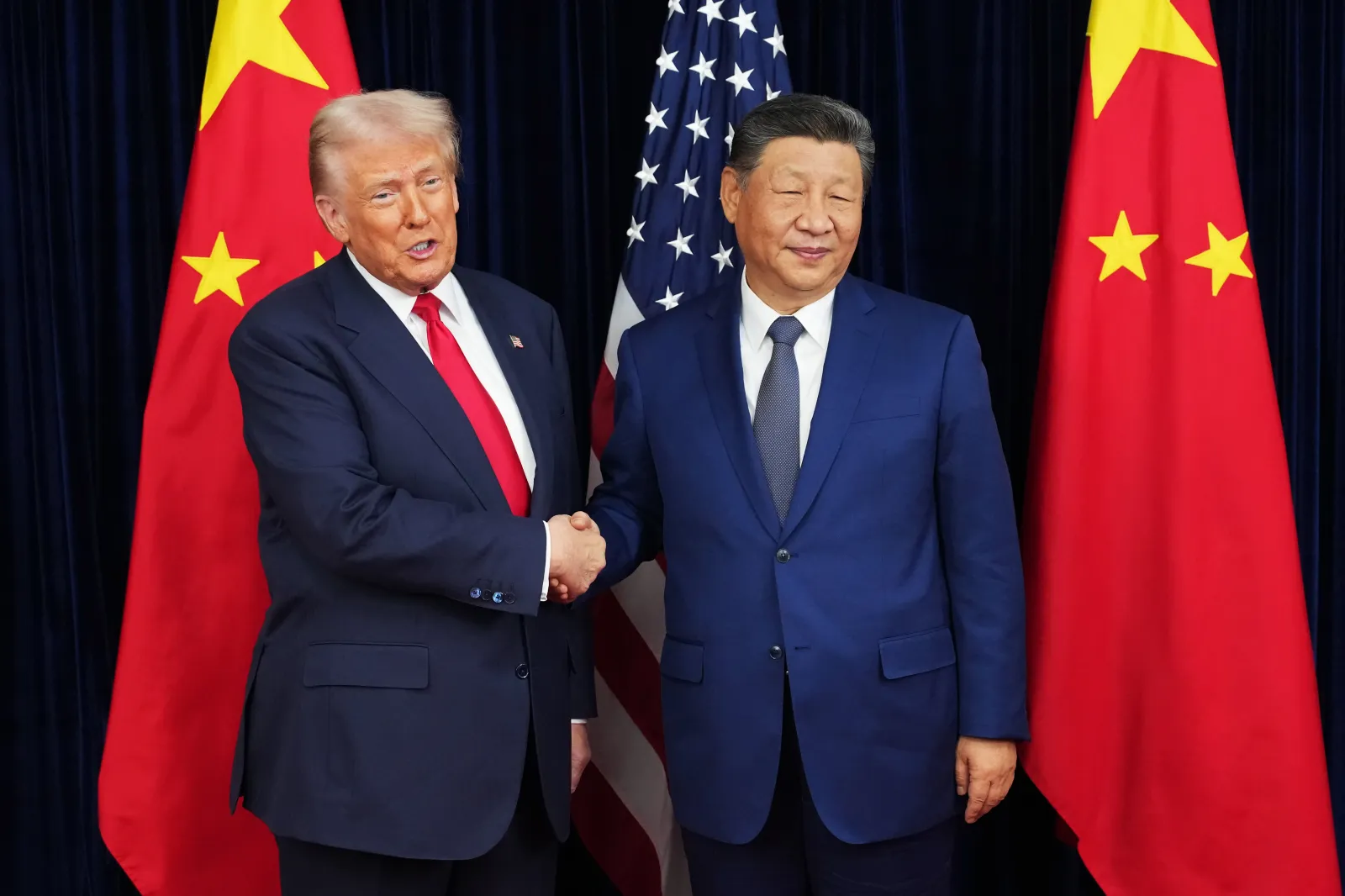
This latest strategy arrives at a time of heightened U.S.-China tensions—with disputes over Taiwan and the South China Sea and the global race for artificial intelligence dominance. Its release also comes as Trump seeks to build on his high-profile October 30 meeting with Chinese President Xi Jinping, where he touted progress toward a deal to end the ongoing trade war.
Trade
While the document largely focused on operations in the Western Hemisphere, China was by far the single most referenced country.
The document reiterated a long-standing grievance of Trump’s: the trade deficit with China and that China had adapted to tariffs placed during his first term by strengthening its grip on global supply chains and doubling exports to low-income countries to enable lower exports to the U.S.
“If America remains on a growth path—and can sustain that while maintaining a genuinely mutually advantageous economic relationship with Beijing—we should be headed from our present $30 trillion economy in 2025 to $40 trillion in the 2030s, putting our country in an enviable position to maintain our status as the world’s leading economy,” the document said.
The strategy also appeared to call for Washington to muster its partners to provide an answer to Chinese loans in the developing world, much of which has been distributed under the aegis of the trillion-dollar Belt and Road Initiative.
China has recycled perhaps $1.3 trillion of its trade surpluses into loans to its trading partners. The U.S. and its allies “have not yet formulated, much less executed, a joint plan for the so-called ‘Global South,’ but together possess tremendous resources,” the document said.
Pacific Power
On the security front, the strategy used strong language, without naming China, of stressing the need to maintain U.S. military dominance in the so-called first island chain—a string of islands spanning Japan to Indonesia that the Pentagon considers critical to containing Chinese forces in the event of a conflict.
The document stressed a need to expand the U.S. military’s access to partnered countries as well as spur them to boost their own defenses to better deter aggression.
“This will interlink maritime security issues along the first island chain while reinforcing U.S. and allies’ capacity to deny any attempt to seize Taiwan or achieve a balance of forces so unfavorable to us as to make defending that island impossible,” it continued.
Taiwan
Taiwan remains perhaps the most concerning potential flash point. China claims the major U.S. trade partner and tech hub as its territory and has vowed to unify with it, through force if necessary.
Again without naming Beijing outright, the document also raised concerns over the country’s expansive moves into the South China Sea, the trade-heavy waterway where it has territorial disputes with its neighbors, such as U.S defense treaty ally the Philippines.
The document called for stronger investment in military, particularly naval, capabilities and cooperation with governments in the region “to keep those lanes open, free of ‘tolls,’ and not subject to arbitrary closure by one country.”
What People Are Saying
Derek Grossman, an adjunct senior fellow with the Indo-Pacific Security Program at the Center for a New American Security think tank, wrote on X: “Basically zero discussion in Trump’s new NSS on Southeast Asia, AUKUS, North Korea, South Asia, or the Pacific Islands. And yet, the Quad—which appears to be dying or dead—gets a shoutout. Huh?”
Zack Cooper, a senior fellow at the American Enterprise Institute, wrote on X: “Trump team clearly seeing all of Asia through the lens of China. Southeast Asia? Almost completely absent. U.S. treaty ally Philippines isn’t even mentioned! Pacific Islands also nowhere to be seen.”
What Happens Next
It remains to be seen how closely Trump will adhere to the newly released strategy, especially given his reputation for shifting course in response to global events. Still, the document signals a clear intent: Confronting China’s rise—economically, diplomatically and militarily—remains at the top of the U.S. agenda for the foreseeable future.