A Newsweek map shows Russia and China deployed air and naval units—including bombers and an aircraft carrier—for a joint patrol and training near Japan on Tuesday.
The Russian Defense Ministry said the joint air patrol was not directed against third countries, while the Chinese military said the aerial maneuver demonstrated their ability to address security challenges and maintain peace and stability in the region.
Japan’s Defense Ministry said it scrambled fighter jets to intercept the Russia-China air formation and dispatched a warship to continue monitoring and gathering intelligence on the Chinese aircraft carrier CNS Liaoning, following a “radar lock-on” incident last week.
Why It Matters
Russia and China have closely cooperated on military matters as part of their so-called partnership “without limitations,” under which they regularly conduct joint patrols and bilateral drills to bolster their readiness to challenge the United States and its security alliances in Europe—NATO—and in Asia—Japan, South Korea and the Philippines.
The Russian and Chinese military maneuvers near Japan came amid tensions between the Moscow-Beijing quasi-alliance and Tokyo. China has strongly opposed Japan’s remarks about possible military intervention in the event of a Chinese blockade of self-ruled Taiwan, while Russia has objected to Japan hosting U.S. midrange missiles.
What To Know
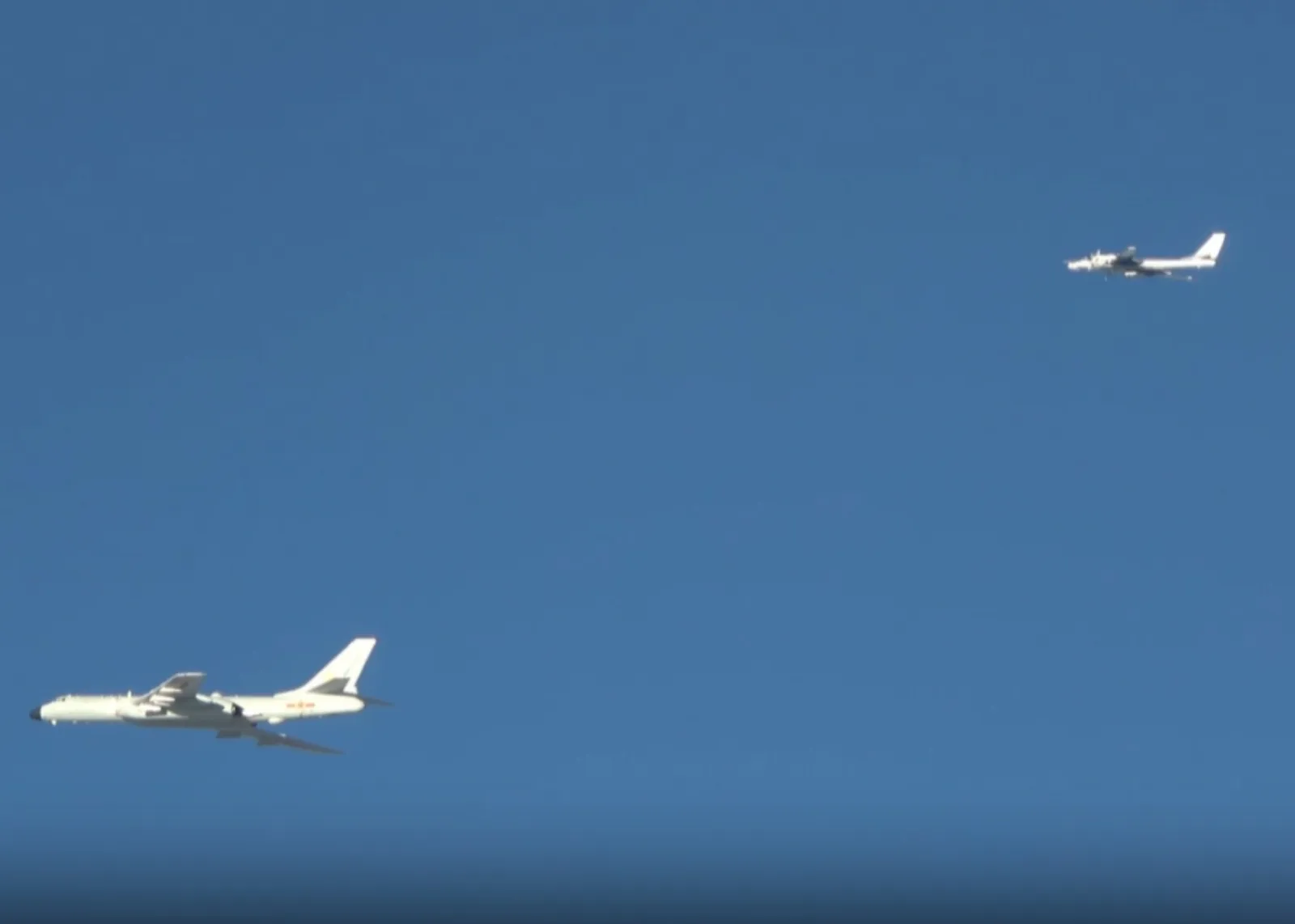
The Russian Defense Ministry said the joint air patrol, which lasted about eight hours, involved Russian Tu-95MS and Chinese H-6K bombers, which flew over the Sea of Japan—also known as the East Sea—the East China Sea and the western Pacific.
“The Chinese and Russian militaries conducted their 10th joint strategic air patrol in the relevant airspace over the East China Sea and the western part of the Pacific Ocean on Tuesday,” the Chinese Defense Ministry said in a statement, adding that it was carried out as part of what it called an “annual cooperation plan” of the two militaries.
Footage released by the Chinese military provided details about the Russia-China air formation, which also included J-11BS, Su-30MK2 and J-16 fighter jets, as well as KJ-500A early warning aircraft from the Chinese side, according to a military analyst.
The Joint Staff Office of Japan’s Defense Ministry said at least five Russian and 10 Chinese military aircraft were tracked flying over waters near three of Japan’s four main islands—Honshu, Kyushu and Shikoku—outside Japan’s territorial airspace.
Russian and Chinese aircraft patrolled within Japan’s air defense identification zone (ADIZ), which is established outside its territorial airspace—extending up to 13.8 miles from the coast—to provide identification and early warning, a Newsweek map shows.
The Russia-China patrol also flew over two key waterways near Japan—the Tsushima Strait and the Miyako Strait. The former lies between the Korean Peninsula and the Japanese archipelago, and the latter links the East China Sea with the Philippine Sea.
Meanwhile, the Liaoning—one of China’s three aircraft carriers—continued operating in the Philippine Sea east of Japan’s southwestern outlying islands and south of Kyushu.
Japan’s Joint Staff Office reported that the Liaoning and three other naval vessels were tracked sailing southwest in waters east of Kitadaitojima on Tuesday. The small island is approximately 223 miles east of Okinawa, a key island north of the Miyako Strait.
The latest reported position put the Liaoning-led task group in a maritime zone beyond waters under Japan’s jurisdiction, including its 13.8-mile-wide territorial sea and its exclusive economic zone (EEZ), which extends up to 230 miles from the coastline.
The Chinese aircraft carrier was first tracked by Japan on Friday in the East China Sea, outside Japan’s EEZ. It transited the Miyako Strait the following day and entered the Philippine Sea, where it set a northeast course, reaching waters north of Kitadaitojima.
This marked the Liaoning‘s second deployment in waters between the First and Second Island Chains since June. The island chains, located on the western and eastern edges of the Philippine Sea, respectively, link Japan with Taiwan, the Philippines and Guam.
During its previous deployment, the Liaoning operated east of the Second Island Chain. As of Tuesday, it remained in waters between the two island chains, which are part of a U.S. maritime strategy to contain Chinese military activity should there be a conflict.
What People Are Saying
The Russian Defense Ministry said: “The Russian Aerospace Forces and the Air Force of the People’s Liberation Army of China (PLA) conducted another joint air patrol in the Asia-Pacific region…The event was carried out as part of implementing the military cooperation plan for 2025 and is not directed against third countries.”
Senior Colonel Jiang Bin, spokesperson for the Chinese Defense Ministry, said: “The Chinese naval task group’s far-sea training complies with international law and practice, and does not target any specific country or entity.”
The Joint Staff Office of the Japanese Defense Ministry said: “Yesterday, due to the possibility of airspace violations in the Sea of Japan, the East China Sea, and the Pacific Ocean, fighter aircraft from the Air Self-Defense Force’s Central Air Defense Force and other units were scrambled on an emergency basis and took action. The Ministry of Defense and the Self-Defense Forces will continue to ensure complete preparedness 24 hours a day, 365 days a year, to protect our country’s territory and the peaceful lives of our citizens.”
What Happens Next
Russia and China are expected to continue their bilateral military activity in the western Pacific as part of efforts to counter the U.S.-Japan alliance. It remains to be seen whether Moscow and Beijing will conduct another joint patrol by the end of the year.