The White House recently launched a new webpage on its official government website titled “Media Offenders.” Hosted on a federal domain, it categorizes reporting as “bias,” “lies,” or “lunacy,” and invites the public to submit tips flagging journalists and news outlets as offenders.
This is not routine media criticism. It is government intimidation without oversight, and it should set off alarms in every newsroom in the country.
Already the government has labeled more than 50 journalists as “offenders,” investigative reporting is no longer simply contested; it is being publicly marked as suspect by the state. Being publicly labeled an “offender” by the government will undoubtedly diminish credibility and chill reporting.
Imagine if such a list had existed when Bob Woodward and Carl Bernstein were reporting for The Washington Post, exposing Watergate? Or when photojournalist David Jackson published the image of Emmett Till that forced America to confront the brutality of racial terror? Under the current White House’s framework, that work would likely earn them an official government designation as offenders, alongside Ida B. Wells and countless other truth tellers whom history now celebrates.
Journalism is on notice. This is a code red moment. The warning signs have been building for years.
This fall, White House reporters collectively walked out the Pentagon after refusing to comply with new, restrictive media rules imposed by Defense Secretary Pete Hegseth. The protest signaled a breaking point between access journalism and press independence, a divide that has only widened since.
Over the summer, public outrage erupted after late-night host Jimmy Kimmel was abruptly pulled off the air following political pressure tied to his criticism of the Trump administration. His eventual reinstatement appeared to pacify much of the public, but the threat to press freedom did not disappear. It evolved, becoming quieter and more strategic.
Banning one voice does not reshape an entire sector. But forcing reporters to weigh whether their names will be cataloged on an official government website for publishing facts that contradict an administration’s narrative does. In that environment, the calculus changes. Editors hesitate. Newsrooms weigh exposure over public interest. Independent journalists without legal teams, corporate shields, or institutional protection face the sharpest edge of the risk. Truth is suppressed. This is not hypothetical—it is already happening.
The most alarming question raised by this list is not simply who appears on it, but how those named may be targeted going forward. Will individuals who have been held legally accountable for spreading demonstrably false information be included, such as Alex Jones? Or will this tool be used primarily to spotlight journalists who document constitutional, civil and human rights violations carried out by the federal government itself?
If the latter, then this is not about accuracy. It is about discouraging scrutiny.
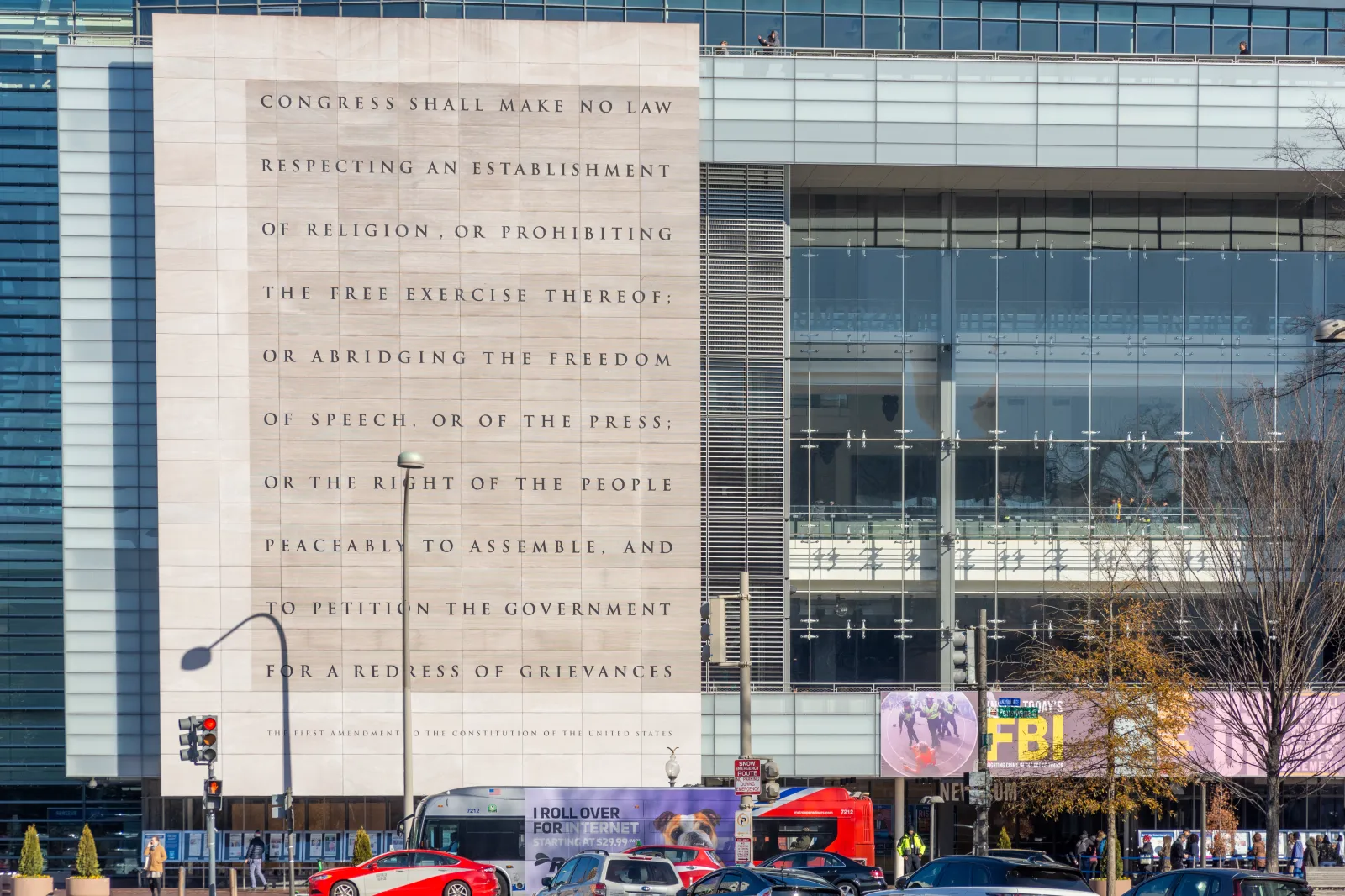
Americans often assume government-controlled media systems exist elsewhere, under authoritarian regimes far removed from our own. But democratic erosion rarely announces itself clearly. It advances through normalization. Through mechanisms that reframe dissent as misconduct and accountability as threat.
A government-maintained list of “media offenders” does exactly that.
As an independent journalist who has spent years doing enterprise reporting outside of corporate newsrooms, I recognize a code red moment when I see one. I have reported while being shot with rubber bullets and tear gassed. I have been threatened, harassed and received death threats for covering state violence and marginalized communities. I have watched journalists assaulted, detained and silenced for doing constitutionally protected work.
Publicly flagging journalists as “offenders” creates a pipeline for harassment and targeting. It signals to political supporters who should be discredited, who should be watched and who should be distrusted. In an era where threats against journalists are rising and political violence is no longer abstract, that signaling is dangerous, especially for someone like me headquartered in Minnesota, where our Democratic–Farmer–Labor Party (DFL) Speaker Melissa Hortman was assassinated this summer.
This is why the concept of neutrality in journalism must be re-examined.
You cannot be neutral about the dismantling of democracy and still expect to be protected by it. You cannot be neutral while your audiences’ rights are violated and still expect their trust. And you cannot be neutral while the government strips away your press freedoms. Those freedoms must be defended.
What did journalism school teach us about covering an authoritarian regime? For most of us, the answer is nothing. We were taught to be objective and neutral no matter what. That our ethics would protect us. That neutrality would keep us safe.
But those values only function under a just democratic government, not an unlawful authoritarian one.
This is a code red moment.
To newsroom leaders, editors, publishers and media executives: This is not about politics. It is about precedent. A government that labels journalists as “offenders” is criminalizing investigative reporting in practice and discouraging the very scrutiny democracy depends on.
The press must respond collectively. Refuse participation in state-sponsored blacklists. Challenge them legally. Name them publicly for what they are.
Ignoring this will not make it go away. Minimizing it will not protect your reporters. And waiting for it to escalate further may come at a cost we cannot afford.
The alarm is sounding. What the press does next will determine our freedom.
Georgia Fort is a three-time Midwest Emmy Award-winning journalist and one of only two reporters present in the courtroom for the sentencing of Derek Chauvin. She is the founder of BLCK Press, a media company reconnecting news to Black culture. She is also the president of The Center for Broadcast Journalism, which trains the next generation of storytellers to advance representation in media. Known for her integrity and fearless storytelling, Fort is redefining what it means to anchor news with purpose as one of the country’s leading voices in equitable journalism.
The views expressed in this article are the writer’s own.