A Newsweek map shows where China has constructed three silo fields, each capable of housing about 100 missiles, as part of its counterstrike strategy in the event of a nuclear war.
In its annual report on Chinese military power released on Tuesday, the Pentagon said that throughout the rest of the decade, China will continue to refine its ability to launch a nuclear counterstrike after receiving early warning of an enemy attack.
China’s Foreign Ministry said the East Asian power maintains its nuclear weapons for self-defense and keeps them at the minimum level required for national security, while the military said its modernization aims to safeguard sovereignty, security and interests.
Why It Matters
As part of President Xi Jinping’s goal to build a “world-class” military to challenge the United States, China is undergoing a rapid nuclear modernization that has given it the world’s third-largest arsenal, behind Russia and the U.S., with more than 600 warheads ready for use—a figure the Pentagon expects will rise above 1,000 by 2030.
Over the past year, the Chinese military has made significant progress in building what it calls a “lean and effective” nuclear force, including the introduction of a long-range missile capable of reaching anywhere in the world and penetrating defenses. It also trained with its Russian counterpart to bolster its ability to counter missile threats.
What To Know
The Pentagon report assessed that China “probably made progress on its attempts to achieve an early warning counterstrike (EWCS) capability” in 2024 and has likely loaded over 100 DF-31 intercontinental ballistic missiles at the Hami, Yulin and Yumen silo fields in northern and northwestern regions to support this position.
Yumen is the largest and has the most missile silos of the three sites, with 120 spread across 424 square miles, while Hami, measuring 396 square miles, and Yulin, covering 321 square miles, have 110 and 90 silos, respectively, according to the Pentagon and the Federation of American Scientists’ Nuclear Information Project.
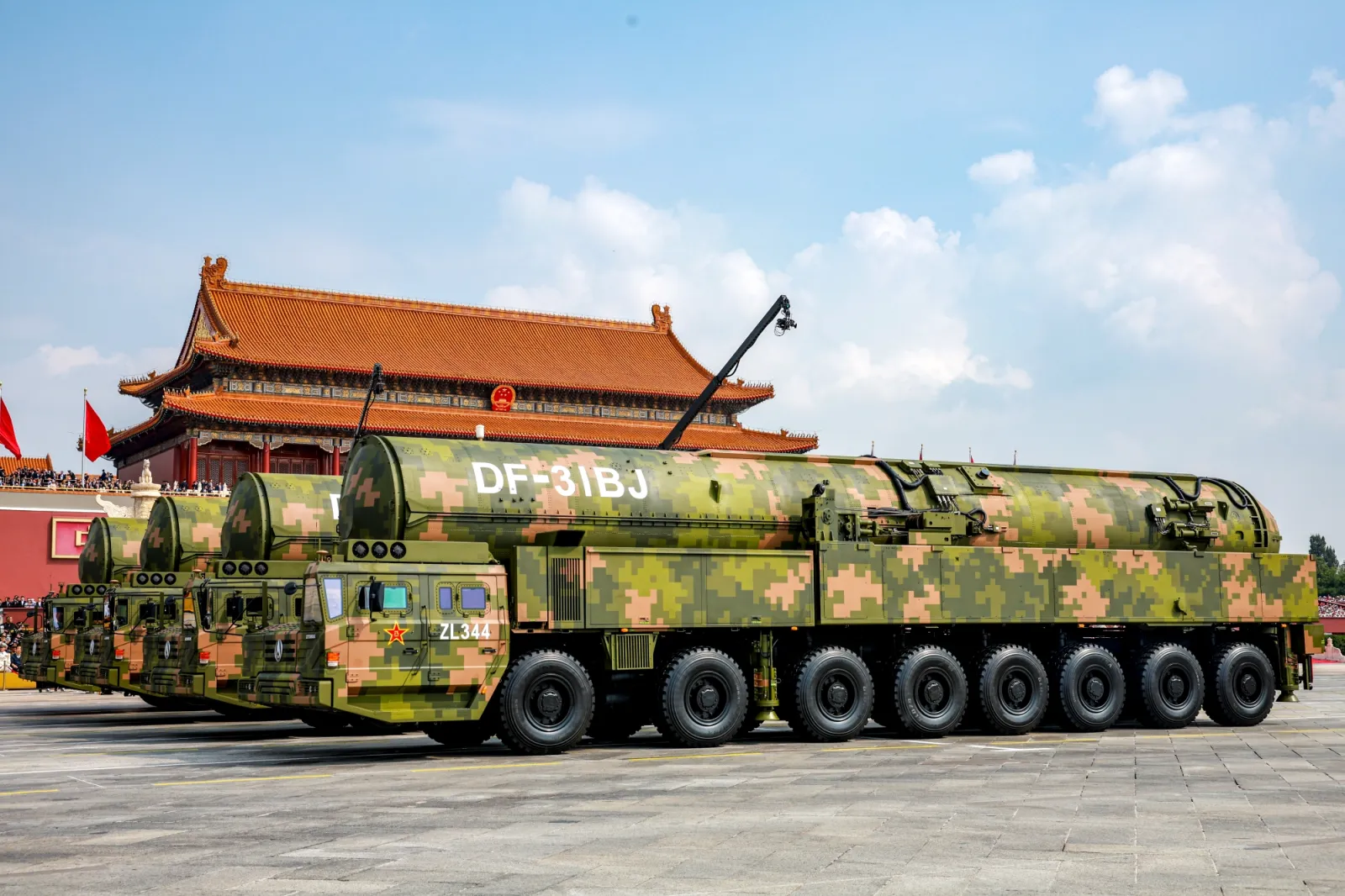
During a September military parade, China unveiled the DF-31BJ intercontinental ballistic missile, which the Federation of American Scientists assessed could be the designation for the missile assigned to the three previously mentioned large silo fields.
In last year’s report, the Pentagon said China had placed “at least some” intercontinental ballistic missiles at Hami, Yulin and Yumen following the completion of construction in 2022, while it is building at least 30 new silos in the central region for DF-5 intercontinental ballistic missiles, increasing the total from 18 to 48.
By comparison, the U.S. currently operates 450 intercontinental ballistic missile silos across five states—Colorado, Montana, Nebraska, North Dakota and Wyoming—of which 400 are loaded with Minuteman III nuclear missiles and the remainder are ready to be loaded if necessary, the Nuclear Information Project said in a January report.
In addition to supplying missile silos, the Chinese military fired several intercontinental ballistic missiles in quick succession from a training center into the country’s western region in December 2024, demonstrating its ability to rapidly launch multiple silo-based weapons as required for the EWCS, according to the Pentagon’s latest assessment.
China also “probably expanded” its space-based early warning system by launching two satellites capable of detecting an incoming intercontinental ballistic missile within 90 seconds of launch, with an alert sent within minutes. The satellites are supported by several ground-based radars that can spot missiles “thousands of kilometers away.”
What People Are Saying
The Pentagon’s Chinese military power report read: “China’s historic military buildup has made the U.S. homeland increasingly vulnerable. China maintains a large and growing arsenal of nuclear, maritime, conventional long-range strike, cyber, and space capabilities able to directly threaten Americans’ security.”
The Chinese Defense Ministry said: “The entire [Pentagon] report is filled with erroneous perceptions of China and geopolitical biases, and it hypes up the so-called ‘Chinese military threat’ to mislead the international community. We express our strong dissatisfaction and firm opposition to this.”
The Chinese Foreign Ministry said: “The U.S., as a nuclear superpower sitting on the world’s biggest nuclear arsenal, must fulfill its special and primary responsibility for nuclear disarmament, further make drastic and substantive cut to its nuclear arsenal, and create conditions for other nuclear-weapon states to join the nuclear disarmament process.”
What Happens Next
It remains unclear whether China, which says it will always maintain a no-first-use policy for nuclear weapons, will load the remaining silos with intercontinental ballistic missiles at the three remote sites to further enhance its counterstrike capability.