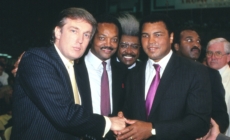
Jesse Jackson and Donald Trump’s Unique Relationship
4 hours ago
4,992
Jesse Jackson and Donald Trump have shared one of the more unexpected relationships in modern American politics—one that shifted dramatically over time.
In 1999, when Trump briefly explored a presidential bid on the Reform Party ticket, Jackson offered positive remarks about him, praising his business record and willingness to engage with minority communities. Those comments later resurfaced as Trump sought to highlight past praise from prominent Black leaders and counter racism accusations.
But the tone changed sharply in the years that followed. As Trump entered politics as a Republican and later won the presidency in 2016, Jackson became a vocal critic. He condemned Trump’s positions on immigration, voting rights and race, arguing that the administration’s policies harmed the very communities Jackson had spent decades advocating for.
The contrast reflects how different their political worlds have always been. In the 1980s and 1990s, Jackson was one of the nation’s most prominent civil rights leaders, twice running for the Democratic presidential nomination and building a multiracial coalition through the Rainbow PUSH Coalition. Trump, meanwhile, was a high-profile New York real estate developer immersed in business, celebrity culture and tabloid media. Their occasional overlap in New York’s political and social circles once suggested cordiality. Over time, however, that early goodwill gave way to sharp political opposition.
Early New York bonds
In the 1980s, Jackson and Trump moved in overlapping but largely separate spheres shaped by New York’s business and media culture. Jackson was a nationally prominent civil rights leader, heading Operation PUSH and later the Rainbow PUSH Coalition, which pressured corporations to expand minority hiring and investment in deprived communities. Trump, meanwhile, was a high-profile Manhattan real estate developer who had expanded into Atlantic City with casino properties bearing his name.
Jackson said Trump had taken his bids for the presidency seriously in both 1984 and 1988. “When many others thought it was either laughable or something to avoid, he came to our business meeting here in New York because he has this sense of the curious and the will to risk to make things better,” Jackson said.
Both men attended major boxing matches hosted at Trump Plaza in Atlantic City in 1988, 1989 and again in 1991—glitzy, televised events that drew politicians, celebrities and business leaders.
Jackson praises Trump
In early 1999, Jackson publicly praised Trump at the Rainbow PUSH Coalition’s Wall Street Project conference, which aimed to expand minority access to corporate America and financial markets. At the January 14, 1999 event in New York, Jackson introduced Trump warmly and thanked him for supporting the initiative, including providing free office space at 40 Wall Street.
Speaking to the Wall Street Project conference, he emphasized his record as a builder and employer, pointing to his construction projects as creating jobs for large numbers of minority workers. He argued that his companies had long worked with minority contractors and employees and said expanding access to capital and opportunity in urban communities was both good business and good policy. Trump framed himself as a dealmaker who could help open doors in finance, real estate and investment for underrepresented groups.
He said of Jackson: “He’s a terrific guy. We love him and I’m here for him.”
The appearance came as Trump was beginning to explore a national political run. Later that year, he formed an exploratory committee to consider seeking the presidency as a Reform Party candidate.
Jackson becomes vocal Trump critic
However, the friendly rapport between the two men swiftly broke down when Trump entered partisan politics and launched his first full bid for the White House as the Republican candidate in 2016.
In the days after Trump’s victory over Hillary Clinton, Jackson openly condemned the tone and substance of his rhetoric and policies.
“The idea of making America great again reopens the wounds in America’s immoral foundation, born in sin, and shaped in inequity,” he said.
“We need not for a moment underestimate the damage done to our country…in the last few days,” he said. “What are we confronted with? There is a tug of war for the soul of America.”
Jackson also criticized Trump personally: “Trump says you must be able to speak the language of English, [be] qualified, and have a job skill.
“Jesus would not qualify to come in Trump’s country—he would not qualify to get into Jesus’ kingdom.”
Jackson consistently highlighted Trump’s leadership as dangerous and divisive, expressing concern about the impact on lawmakers of color and on inner-city communities. He described Trump’s attacks on minority representatives as “dangerous, divisive and diversionary” and warned that such rhetoric fueled broader social tensions.
Trump uses Jackson to counter racism accusations
For his part, Trump has always rejected accusations of racism and has pointed to past relationships with Black leaders as part of his defense.
When pressed by reporters in January 2018 following controversy over remarks attributed to him about Haiti and African nations, Trump responded: “No, no. I’m not a racist. I am the least racist person you have ever interviewed.” He also denied using the specific language reported, arguing that his record did not support claims of racial bias.
Trump’s supporters have frequently circulated archival video, notably during his most recent presidential campaign, from the Rainbow PUSH Wall Street Project conference in 1999, where Jackson praised Trump’s engagement with minority business initiatives.
Relationship arc mirrors new political landscape
Jackson and Trump’s relationship mirrors the shifting sands in American politics over the past 40 years. What started as polite interactions in New York in the 1980s—and even public praise in 1999—later turned into strong political opposition after Trump became the Republican president. Trump supporters pointed to Jackson’s past comments to push back against accusations of racism. Jackson, meanwhile, has argued that Trump’s presidency went against the civil rights progress he fought for.
As Trump’s presidency deepened national divisions, any shared ground they once had became a small footnote from a time when politics was less divided and personal ties sometimes crossed party lines.
Um die besten Erfahrungen zu bieten, verwenden wir Technologien wie Cookies, um Geräteinformationen zu speichern und/oder darauf zuzugreifen. Wenn Sie diesen Technologien zustimmen, können wir Daten wie das Surfverhalten oder eindeutige IDs auf dieser Website verarbeiten. Die Nichteinwilligung oder der Widerruf der Einwilligung kann bestimmte Merkmale und Funktionen beeinträchtigen.
Functional
Always active
The technical storage or access is strictly necessary for the legitimate purpose of enabling the use of a specific service explicitly requested by the subscriber or user, or for the sole purpose of carrying out the transmission of a communication over an electronic communications network.
Preferences
The technical storage or access is necessary for the legitimate purpose of storing preferences that are not requested by the subscriber or user.
Statistics
The technical storage or access that is used exclusively for statistical purposes.The technical storage or access that is used exclusively for anonymous statistical purposes. Without a subpoena, voluntary compliance on the part of your Internet Service Provider, or additional records from a third party, information stored or retrieved for this purpose alone cannot usually be used to identify you.
Marketing
The technical storage or access is required to create user profiles to send advertising, or to track the user on a website or across several websites for similar marketing purposes.