Vladimir Putin’s full-scale invasion of Ukraine turned Russia into a pariah state in the West overnight.
The Russian president had assumed he could topple the Ukrainian government within days. But as his 40-mile armored column stalled on the road to Kyiv, Moscow found itself in a protracted conflict, with an unexpectedly resilient opponent backed to the hilt by Washington and Brussels.
Its economy was hit by a withering package of U.S.-led sanctions, severance from the SWIFT international payment system and an exodus of international firms.
The early years of the war marked unprecedented isolation for Moscow. It’s regained some legitimacy with Trump’s return to the White House. But from 2022-2024, China stepped into the void of being Russia’s most crucial ally.
NATO called Beijing the “decisive enabler” of Russia’s ability to keep the war going for four years. It’s a strategy that’s directly supported Moscow but also allowed Beijing to draw its diminished but still powerful neighbor into its geopolitical center.
Diplomatic Cover
When it comes to China’s official line on Russia’s invasion, Beijing says its position has been consistent.
“We neither fuel the flames, nor seek profit from the crisis, and will never accept blame-shifting,” Liu Pengyu, spokesperson for the Chinese Embassy in Washington, D.C., told Newsweek.
“China will continue to play a constructive role in its own way to ease the humanitarian situation in Ukraine.”
But Beijing has played a key role in amplifying the Kremlin’s narratives, particularly in the developing world, says Volodymyr Dubovyk, senior fellow with the Center for European Policy Analysis’s Democratic Resilience Program.
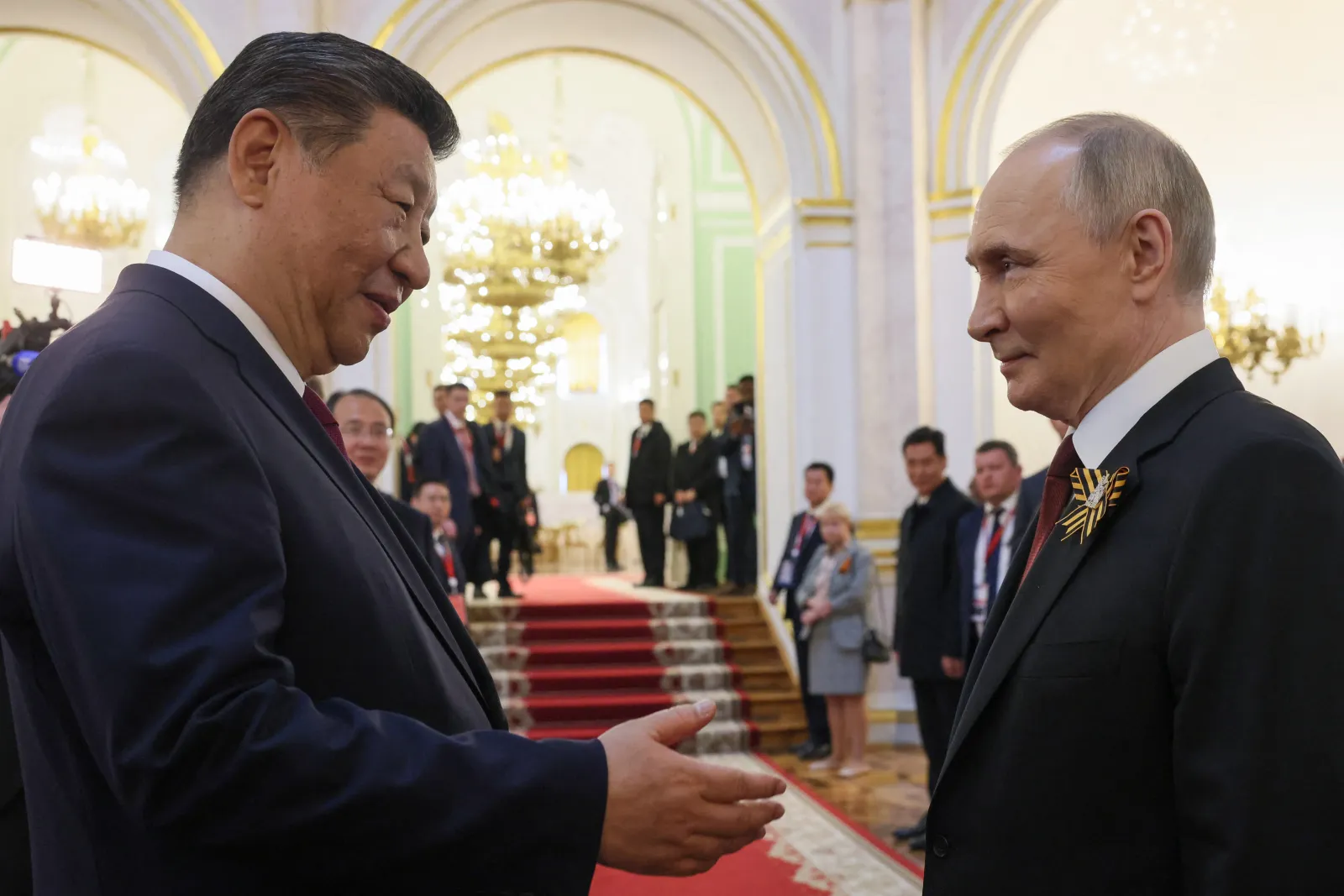
Part of that has been diplomatic optics. Putin has been given a prominent role in China’s major global events, such as the Shanghai Cooperation Organization leaders’ summit last year. In visiting Beijing in September, he was bestowed the seat of honor at the “Victory Day” military parade next to Chinese president Xi Jinping.
Having Putin side-by-side with Xi signals China’s strength to audiences across the Global South, analysts say. “It signals Beijing’s emergence as a pole of stability against Western pressure,” said Alessandro Arduino, associate fellow at the Royal United Services Institute.
Economic Backstop
China has also been crucial in keeping Russia’s heavily sanctioned wartime economy afloat. The two states have achieved record levels of trade, with flows of discounted Russian gas and oil, and Chinese exports of civilian components and technologies that can be put to military use.
“China has emerged as Russia’s indispensable economic backstop: absorbing energy exports, supplying dual-use goods and providing diplomatic cover, all while calibrating its support to avoid triggering secondary sanctions or crossing the red line of direct military assistance,” said Arduino.
And unlike Russia’s ally Iran and co-belligerent North Korea, China has refrained from supplying direct military assistance to its northern neighbor, allowing it to preserve “strategic ambiguity” and avoid the brunt of U.S. secondary sanctions, he added.
While China is not believed to be supplying Russia with ready-made weaponry at scale, it supplies up to 80 percent of the critical components used by Russia’s Defense Ministry, the European Union believes.
China is the source of increasingly sophisticated dual-use systems such as engines for drones used to destroy Ukrainian critical infrastructure. It may also be taking part in the kill chain, disclosing satellite information for Russian missiles targeting Ukraine’s energy facilities, per Ukrainian intelligence.
“Our impression is that China has effectively opened up ‘lend-lease’ for Russian drone manufacturers, for example for fiber-optic drones, which are invulnerable to Ukrainian electronic warfare systems,” Yurii Poita, a Ukrainian China expert, affiliated with Kyiv-based Center for Army, Conversion and Disarmament Studies, told Newsweek.
The resurgent Russian military’s offensive capabilities benefit China by holding NATO forces at threat and creating more favorable conditions should Beijing make a move against Taiwan, Poita added.
China now the ‘Big Brother’
Such assistance has made China the “decisive enabler” of the Kremlin’s war machine, NATO members—including the U.S.—stated at the alliance’s 2024 summit.
But it has come at the cost of increasing dependency on the world’s second-largest economy.
“For the first time in the modern era, Beijing is unmistakably ‘the big brother’ marking a historic inversion in the relationship with Moscow,” Arduino said.
He says that Chinese state media increasingly frames Russia’s trajectory within a world shaped by Xi’s leadership.
Yet even the influence of a “no-limits partner” may have its limits.
“I am pretty sure that Xi did not expect such a war, scale and duration,” Dubovyk told Newsweek. “But Beijing never wavered in its support and stuck with Moscow nevertheless. It saw the stakes as high enough and clearly did not want its ally to lose and for the West to persevere and win.”
And while Xi was caught off guard by Russia’s blitz on February 24, 2022, Dubovyk doubts the Chinese leader would—or could—have prevented it.
“He probably saw that Putin is going to do this anyway and that this is a priority for him, so did not try to stop. And perhaps would not be able to do so.”
He says Xi most likely has that view towards efforts to stop the war, especially now given it appears that “Russia has adapted and recaptured initiative in the war.”
The tight bond has continued throughout the war. The two had a video call in February where Xi said the pair had “steered China-Russia relations into a new stage of development”. He called for ties to be further strengthened.
Putin echoed this sentiment. Moscow’s relations with Beijing, he said, were an “important stabilizing factor amidst growing turbulence in the world”.