The U.S. provided “intelligence support” to Mexican authorities in an operation that killed one of the world’s most wanted drug lords, the White House has said.
Mexican security forces killed Nemesio Oseguera Cervantes, known as El Mencho, in the Mexican town of Talpalpa in an operation designed to capture the drug baron, Mexican authorities said on Sunday.
Cervantes headed up the notorious and powerful Jalisco New Generation Cartel (JNGC) in the central-western Jalisco state. Another three members of the JNGC were killed at the scene, and three others died while being transported to Mexico City for emergency medical care, officials said. Two further alleged cartel members were arrested and three army personnel were injured.
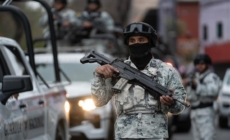
The cartel boss’ death ignited violence in multiple Mexican states, with cars set ablaze and armed supporters of Cervantes taking to the streets. Footage widely shared online showed plumes of smoke rising above the Jalisco coastal city of Puerto Vallarta, while Mexico’s security cabinet said around 20 banks had been damaged in clashes and roadblocks were still being cleared.
The U.S. Embassy in Mexico warned U.S. citizens to “shelter in place” amid widespread violence and many flights from cities in Jalisco were canceled on Sunday.
Mexico’s president, Claudia Sheinbaum, called for calm and said daily life was continuing as normal in many areas of the country.
Why Was the U.S. Involved, and What Do We Know?
Cervantes has long been in the U.S.’ sights. The Drug Enforcement Agency (DEA) had offered a reward of up to $15 million for information leading to his arrest.
White House press secretary Karoline Leavitt called Cervantes a “top target” for both the Mexican and U.S. governments on Sunday, and said he was responsible for trafficking fentanyl into the U.S.
President Donald Trump and his administration have vowed to crack down on drug flows into the U.S., killing at least 148 people in strikes on alleged narco smuggling boats in the Pacific Ocean and Caribbean waters since September. The campaign, which the administration says is legal, was quickly criticized as failing to target key fentanyl routes into the U.S.
Fentanyl mostly makes its way into the U.S. from China and India via the Mexican border, rather than from South America. The White House designated the JNGC a foreign terrorist organization last year, giving the U.S. more options for how it could target the cartel.
Trump: Cartels ‘running Mexico’
Shortly after U.S. forces captured former Venezuelan leader Nicolás Maduro and brought him to New York to face narco-terrorism charges in January, Trump had said cartels were “running Mexico” and suggested the U.S. would “start now hitting land with regard to the cartels.”
After the U.S. operation in Venezuela, Sheinbaum played down the possibility of U.S. military action in Mexico without the Mexican government’s say so and reiterated the importance of the country’s sovereignty, despite pressure from Washington to act against cartels. “There is coordination, there is collaboration with the United States government,” she said last month.
Leavitt said the U.S. supported the Mexican operation with intelligence, but did not elaborate further. Mexico’s Defense Ministry said it had received information from American authorities under bilateral agreements between the two nations.
A joint U.S.-Mexico task force that frequently collaborates with the Mexican military was involved in the operation on Sunday, U.S. media reported, citing anonymous U.S. defense officials.
The Trump administration established the Joint Interagency Task Force-Counter Cartel last month, working under the U.S. Northern Command, which covers American operations in areas beyond the U.S., like Mexico, Canada and Greenland.
The task force focuses on intelligence sharing to battle cartels working across the U.S.-Mexico border, the U.S. government said.
The U.S. has a long history of exchanging intelligence with countries in Latin America that are battling drug rings, including Mexico. Cooperation between the U.S. and Mexico for sharing information has existed for decades, and experts say the two countries have a range of agreements between their institutions, a set of standard procedures and personal relationships between high-up officials across the border.
Omar García Harfuch, Mexico’s public security minister, has overseen more intelligence sharing with the U.S., observers say.
In a polarized era, the center is dismissed as bland. At Newsweek, ours is different: The Courageous Center—it’s not “both sides,” it’s sharp, challenging and alive with ideas. We follow facts, not factions. If that sounds like the kind of journalism you want to see thrive, we need you.
When you become a Newsweek Member, you support a mission to keep the center strong and vibrant. Members enjoy: Ad-free browsing, exclusive content and editor conversations. Help keep the center courageous. Join today.