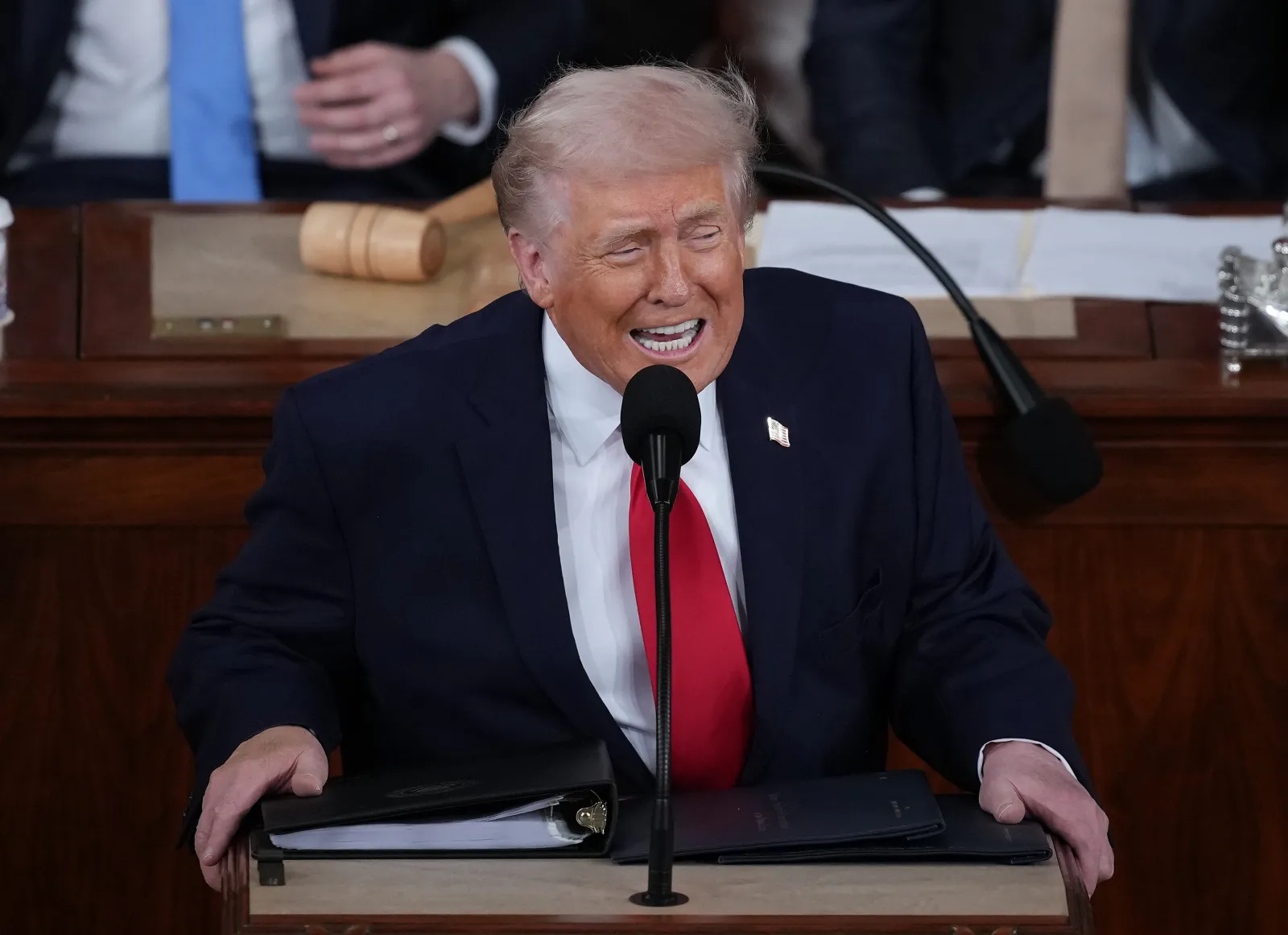
President Donald Trump took the opportunity during his State of the Union address to deliver a new high-profile warning to Iran as nuclear negotiations persist under the threat of U.S. military action against the Islamic Republic.
“We are in negotiations with [Iran]. They want to make a deal, but we haven’t heard those secret words: ‘We will never have a nuclear weapon,'” Trump said during his speech.
“My preference is to solve this problem through diplomacy, but one thing is certain, I will never allow the world’s number one sponsor of terror, which they are by far, to have a nuclear weapon,” he added. “And no one should ever doubt America’s resolve. We have the most powerful military on Earth.”
Newsweek has reached out to the Iranian Mission to the United Nations for comment.
What Trump Said About Iran
Trump’s warning came as he criticized the Islamic Republic for a history of violence, including aiding allied militias in Iraq that targeted U.S. troops in the wake of the 2003 U.S.-led invasion, killing more than 600 soldiers, according to the Pentagon. Trump also lauded his own role in ordering the strike that killed Islamic Revolutionary Guard Corps (IRGC) Quds Force chief Major General Qassem Soleimani in January 2020.
“Many decades since they seized control of that proud nation, 47 years ago, the regime and its murderous proxies have spread nothing but terrorism and death and hate,” Trump said. “They’ve killed thousands of American service members and hundreds of thousands, and even millions of people, through roadside bombs. They were the kings of roadside bombs.”
“And we took out Soleimani, I did that during my first term,” the president continued. “It had a huge impact. He was the father of the roadside bomb.”
Trump then went on to accuse the Iranian government of killing up to 32,000 protesters amid the nationwide demonstrations and unrest that erupted across Iran last month and took credit for preventing the execution of a number of those arrested “with the threat of serious violence.”
The U.S. leader also warned of the dangers posed by Iran’s missile program and boasted about the unprecedented strikes he ordered against three Iranian nuclear facilities during the 12-Day War between Iran and Israel last June. He warned of an Iranian attempt to reconstitute its nuclear program despite Tehran’s official consistent denials of any effort to produce weapons of mass destruction.
“They’ve already developed missiles that can threaten Europe and our bases overseas, and they’re working to build missiles that will soon reach the United States of America,” Trump said. “After Midnight Hammer, they were warned to make no future attempts to rebuild their weapons program, in particular, nuclear weapons. Yet they continue starting it all over.”
“We wiped it all out and they want to start all over again,” Trump added, “and are at this moment again pursuing their sinister ambitions.”
Trump’s Strike Options
While the vast majority of Trump’s nearly two-hour address focused on domestic affairs, including a number of rhetorical attacks on Democrats, his comment on Iran come at a potentially decisive moment for the two longtime foes.
The remarks come roughly five days after Trump announced a 10–15-day deadline for Tehran to come up with a new proposal for the ongoing nuclear negotiations, the second round of which was held in Geneva last Tuesday. Both sides have signaled some degree of progress in the talks, but as an anticipated third round nears this upcoming Thursday, distance between the two positions looms large.
Underlying Trump’s warnings of a new operation that would go beyond the June 2024 bombings of three Iranian nuclear facilities in the midst of a previous attempt at nuclear diplomacy and the 12-Day War launched by Israel against Iran, is a massive U.S. military build-up in the region, the likes of which have not been since the 2003 U.S.-led invasion of Iraq.
And while the “armada” assembled on Trump’s orders appears ill-suited for a full-scale land war, the sheer number of vessels and aircraft, both at sea and positioned in the broader region, offer ample capabilities to wage a devastating campaign on Iran’s remaining nuclear sites and vast military infrastructure, including heavily fortified missile production and launch facilities.
Analysts and former officials have told Newsweek that U.S. strikes on Iran’s military infrastructure are perhaps the likeliest option for a president known to prefer precise and limited action bearing immediate results. At the same time, further-reaching operations, including the targeting of senior leaders, even Supreme Leader Ayatollah Ali Khamenei himself, or a prolonged conflict for the purpose of forcing a deal or regime change, have not been ruled out.
In the U.S. Delta Force that seized Venezuelan President Nicolás Maduro and his wife from their home in Caracas last month, Trump managed to both score a quick victory and abduct the nation’s head of state without entering into a shooting war. During the State of the Union, Trump even referred to Venezuela—now led by Maduro’s former deputy, Acting President Delcy Rodríguez—as Washington’s “new friend and partner” in light of new energy cooperation forged in the wake of the operation.
Iran may prove more complicated, however, given its heavily entrenched security apparatus, the ideological roots of Khamenei’s Velayat-e Faqih system and a history of attritional warfare.
“They claim to be invincible, but this is a false and futile claim,” Iranian Army commander-in-chief Major General Amir Hatami said Monday, according to the semi-official Tasnim News Agency. “This enemy is the same one who fought for 20 years in Vietnam and Afghanistan and finally left in humiliation, the same thing happened to them in Iraq and other countries.”
“They enter with pretense and intimidation, but they always leave with humiliation,” Hatami said. “So, the defeat of the enemy is inevitable, but its realization requires a clear understanding of the current state of the world and the steadfastness and resistance of the Iranian nation.
The following day, hours before Trump delivered his State of the Union address, the Islamic Revolutionary Guard Corps (IRGC) held a combined military exercise in southern Iran and islands of the Persian Gulf, with a distinct focus on the Strait of Hormuz.
The IRGC has been directly involved in the regional conflict that erupted following the war in Gaza that began in October 2023 with a Hamas-led attack against Israel. After two rounds of strikes exchanged between Iran and Israel, the two sides fought an intensive 12-Day War last June, during which scores of senior IRGC commanders were killed.
The role of the IRGC and its Basij paramilitary unit in the deadly suppression of nationwide protests and unrest last month could make personnel and headquarters a target as well for Trump, who warned at the time that “killers and abusers” involved in the crackdown “will pay a big price” as he first ordered the massive U.S. military build-up in the region.
Risk Factors
While both the U.S. and Israel have demonstrated conventional superiority of Iran’s defensive capabilities, the Islamic Republic has a number of options at its disposal to attempt to raise the costs of an attack.
From the longstanding threat of closing the Strait of Hormuz to activating the full weight of allied Axis of Resistance militias, including the Lebanese Hezbollah, the Islamic Resistance in Iraq and Yemen’s Ansar Allah, also known as the Houthi movement, Tehran may seek to risk escalation if deemed capable of frustrating White House hopes for another decisive win.
“We were not the ones who started any war, and our approach in the past was to prevent the expansion of the scope of the war and reduce casualties, but America’s actions caused us to change our approach,” Iranian Armed Forces Chief of Staff General Abdolrahim Mousavi said during a meeting earlier Tuesday with his Armenian counterpart, according to an IRGC readout.
“And this time, if it makes a mistake, we will inflict heavy casualties on the enemy,” he said, “and our nation and armed forces are determined to stand against the system of domination until the end.”
The risks associated with such a conflict have also weighed heavily on the minds of close U.S. partners in the Middle East, including Arab states lying across the Persian Gulf and NATO ally Turkey. A number of nations, including Jordan, Saudi Arabia and the United Arab Emirates, have expressed that they would not allow the U.S. to launch attacks against Iran from bases located on their respective territories, and have called for a diplomatic resolution.
Among the many interests for which the administration counts on good ties with these regional countries is Trump’s Board of Peace initiative, announced in September and launched last month in a bid to enforce the White House’s 20-point peace plan to end the war in Gaza. There is also the potential backlash that Middle East instability could wreak on the cost of oil, with Trump having touted the reduction of gas prices as one of his milestones during his address Tuesday.
As the White House deliberates on its next steps, Trump has sought to downplay reports of concern mounting within the Pentagon over the consequences of a conflict with Iran. In a Truth Social post Monday, the president rejected “Numerous stories from the Fake News Media” alleging that Air Force General Daniel Caine, who serves as the Chair of the Joint Chiefs of Staff was among those raising such concerns.
“Everything that has been written about a potential War with Iran has been written incorrectly, and purposefully so,” Trump wrote at the time. “I am the one that makes the decision, I would rather have a Deal than not but, if we don’t make a Deal, it will be a very bad day for that Country and, very sadly, its people, because they are great and wonderful, and something like this should never have happened to them.”