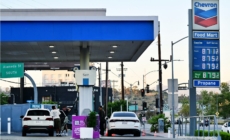
Gas prices have climbed across the United States—and the world—since the start of the Iran war, accelerating with each week as the conflict spirals out across the Middle East and destroys or endangers critical oil infrastructure.
As of Thursday, the average price of gas across the U.S. was $3.884, according to data from AAA—a sharp increase from an average of $2.929 just three weeks earlier.
Patrick De Haan, head of petroleum analysis at GasBuddy and among the most respected authorities on the topic of gas prices, wrote on X Wednesday that considering “where things stand now,” the U.S. has “a 90 percent chance” of hitting an average of $4 per gallon of regular gas “perhaps by the end of the month.”
Why It Matters
President Donald Trump returned to the White House with the promise of lowering the cost of living—including gas prices—for all Americans, bashing his predecessor Joe Biden for higher inflation during his pledges. Only four days before the U.S. and Israel launched their joint strikes against Iran on February 28, the White House touted recent declines in gas prices, attributing them to “American energy dominance.”
But being the world’s leading oil producer did not shield the U.S. from the global rise in prices that has followed the onset of the war in the Middle East and restriction on travel through the Strait of Hormuz, where one fifth of the world’s oil usually transits.
While gas prices remain below the pandemic peak of over $5 reached in June 2022 under Biden, Trump and the Republican Party risk facing a backlash from disgruntled voters during this year’s midterms because of higher prices at the pump.
Gas prices keep climbing across the U.S.
With Brent crude prices briefly soaring to almost $120 per barrel on Monday—up from about $73 before the U.S.-Israeli strikes on February 28—experts and industry players are warning that $5 gas is now within sight.
As of AAA’s most recent state‑by‑state averages, the following are reporting regular gasoline prices above $4 per gallon:
- California—$5.61
- Washington—$5.14
- Hawaii—$5.07
- Oregon—$4.70
- Nevada—$4.66
- Arizona—$4.43
- Alaska—$4.42
- Illinois—4.04
AAA data shows that the highest prices remain concentrated in Western states, with California once again standing out as the most expensive market in the nation, well above the national average.
Why is gas so expensive right now?
Experts point to the escalating conflict with Iran as the main driver behind the latest spike. The war has severely disrupted oil flows through the Strait of Hormuz, a critical shipping route.
And as global crude prices surge, those costs are quickly passed on to consumers at the pump. Experts believe there is further room to grow, as Brent crude—the international benchmark—continues to climb past $100 a barrel.
Mark Zandi, chief economist at Moody’s Analytics, wrote on Sunday that Americans would “soon be paying $4 a gallon for regular unleaded,” and an increasing number of Polymarket users are wagering that by the end of March, prices could reach $5 for the first time since 2022—the odds of which stood at 43 percent as of Monday morning.
How to find the cheapest gas near you
Finding cheap gas is no easy task, but several tools exist that can help drivers find the most affordable nearby option: Chief among them is GasBuddy, a community-driven app that can show gas price maps and locate the stations with the lowest prices.
AAA also offers a trip cost calculator, in which drivers can put their start and end points and figure out how much gas they’ll need and what it will cost.
Short of those options, Google Maps and Waze also indicate the prices at gas stations, or using the Upside app to earn cash back on gas purchases, which can be recycled into paying for gas.
The real trick will come down to some legwork as a consumer—which means being brand-agnostic to find the stations with the lowest price and lean into loyalty programs, like Shell’s Fuel Rewards or BP Rewards, which offer price reductions with repeated use.
And last—but not least—shopping at warehouse clubs like Costco or Sam’s Club can help find cut-rate gas.
When will the Iran war end?
Trump said Thursday that he will not deploy U.S. ground forces to Iran, as the war’s economic fallout intensified and oil prices surged. The White House spent the day scrambling to calm markets and reassure allies as the conflict’s third week brought new questions surrounding strategy, transparency and the widening global energy crisis.
The Trump administration previously defined the objectives of Operation Epic Fury as aiming to destroy Iran’s ballistic missile capacity, annihilate its navy, ensure its terrorist proxies cannot destabilize the region and guarantee that Iran can never possess a nuclear weapon, according to a White House official.
In the weeks following the initial joint U.S.-Israeli strike on Iran, which killed Ayatollah Ali Khamenei and dozens of other high-ranking officials in the regime, the U.S. has conducted thousands of strikes and destroyed or damaged numerous Iranian vessels.
The timeline for the conflict continues to evolve, as Trump and Defense Secretary Pete Hegseth issue differing opinions on how long the conflict may last—although Hegseth stresses that ultimately the president has the final say on when to determine that the mission has achieved victory.
“We’ll end this conflict on our timeline,” Hegseth has said, at other times saying Trump “gets to control the throttle” of the conflict and operation.