As Easter approaches, schools are once again asking children to decorate eggs, bonnets or themed crafts to mark the holiday. For many families, these projects are meant to be completed independently—or at least mostly by the child—but one Easter creation shared on social media has sparked a heated debate about parental involvement.
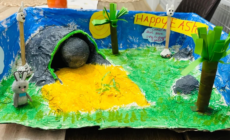
User huamanticacacaca posted a photo on Reddit of their daughter’s Easter school project, which shows a shoebox transformed into a detailed scene from the Christian Bible. The display features blue skies, green grass, a cave with a large rock acting as a door, and a figurine of Jesus pushing the rock aside.
The Easter scene depicts a central moment in Christianity, illustrating the belief that Jesus rose from the dead after being buried in a tomb following his crucifixion.
The post, titled “If my daughter doesn’t win the prize for best Easter craft project, I’m [going to] kick off,” quickly gained traction, earning over 6,600 upvotes.
Underneath the image, text reads, “Surely this is [going to] be the best,” in second grade, and then “Me and my dad,” which is crossed out, before ending with “She spent ages on this.”
When Help Becomes Too Much
While some viewers admired the creativity, others questioned whether the project crossed the line between helping and doing the work for a child.
Previous studies indicate that, when parents closely monitor or assist with schoolwork without being asked, it can negatively affect a child’s motivation and academic performance. A 2023 study found that this type of “hovering” support may make children feel less capable—especially if they believe intelligence is fixed rather than something that can grow with effort.
To explore this further, researchers followed 563 first- and second‑grade children for one school year and 1,613 middle- and high-school students over two years.
In both age groups, children with a fixed mindset experienced greater drops in academic achievement when parents frequently stepped in to help with homework without being invited.
The findings suggest that unasked‑for help can be especially damaging for children who don’t believe they can improve through practice and learning.
The comments section reflected that same concern.
One user wrote: “Parents should start taking pictures of the kid at various stages of the project. At least it might give teachers a better idea about the kids involvement. It’s not fool proof but it couldn’t hurt and might help.”
Another commenter was more critical, saying: “If she didn’t actually make it, she definitely shouldn’t win. She didn’t get to learn how to paper mache, or get to practice those new skills while trying to understand scale and dimensions from practical experience in the way you cannot get from just theory. It’s also a big blow to the self-confidence of every kid in her class that did actually make their own models.
“Now they are comparing themselves to the work of an adult, thinking another kid the same age did that, and they probably feel pretty terrible in comparison. Teaching your kid to lie about who did the work because winning is more important is not a great life lesson.”
A third added: “I love when a kids project just becomes the homework for the adults.”
Newsweek reached out to @huamanticacacaca for comment. We could not verify the details of the case.
Reference
Park, Daeun, et al. “Parental Intrusive Homework Support and Math Achievement: Does the Child’s Mindset Matter?” Developmental Psychology, vol. 59, no. 7, July 2023, pp. 1249—67. PubMed Central, https://doi.org/10.1037/dev0001522.