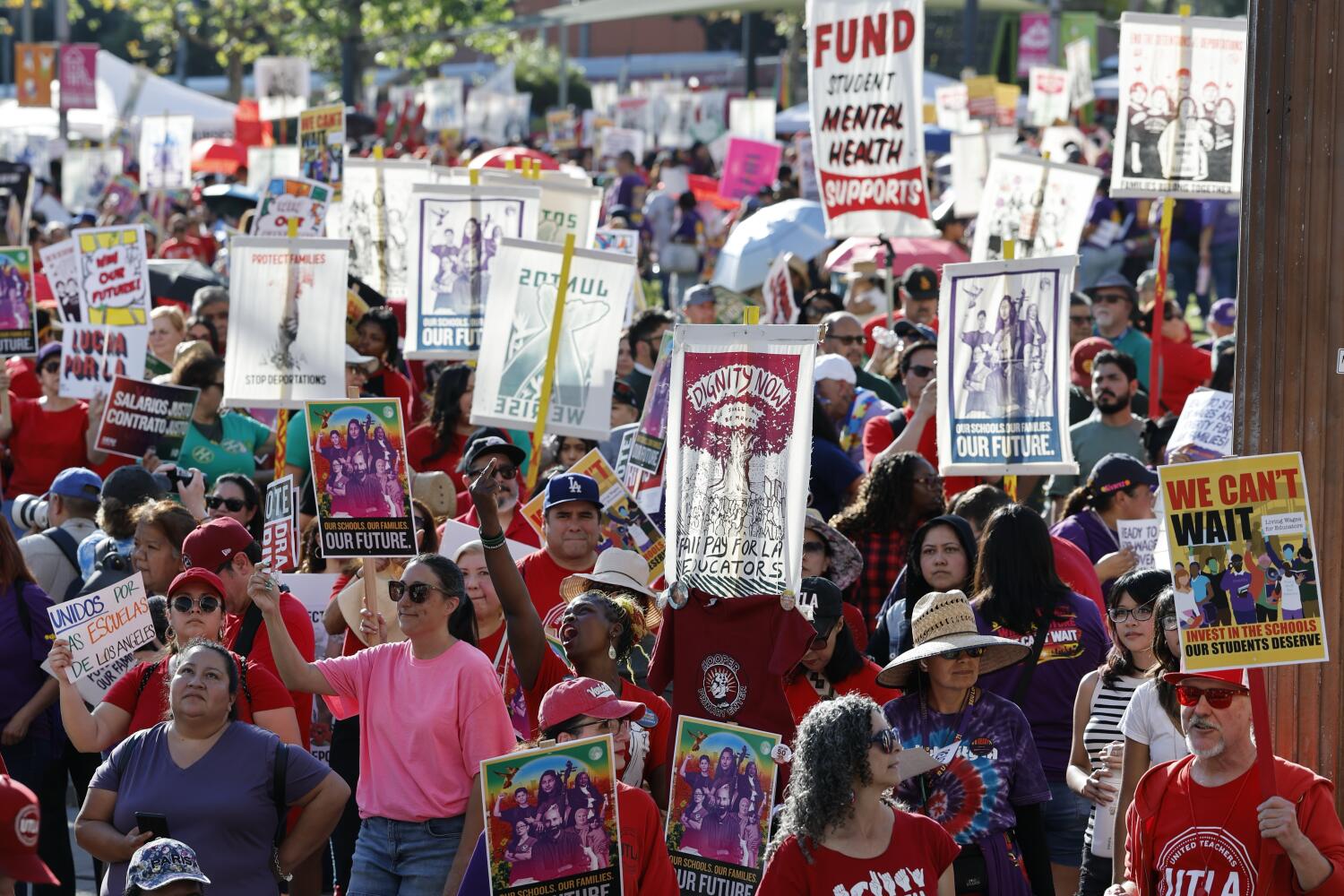
Los Angeles schools are one week away from a historic employee walkout — which for the first time would involve three major unions representing teachers, most non-teaching staff and school administrators, including principals and assistant principals.
If a strike unfolds on April 14 with the three unions — or even two of the three — it would be impossible to keep all campuses open, the district confirmed Monday, upending the education of some 390,000 students and their families’ workday routines.
Parents would scramble for child-care options and an alternative for weekday breakfasts and lunches. Depending on how long a potential strike lasted, important state testing could be disrupted, as could student plans to take college-admissions assessments, such as the SAT and Advanced Placement exams.
The Los Angeles Unified School District wants families to plan ahead.
“Families should prepare now by ensuring their child can access learning through Schoology” — which is the district’s online learning system, according to a statement provided in response to questions from The Times. Parents also should make sure their child “has a working device and internet connection.”
Parents, too, should identify “local food distribution sites and childcare options. They should also make sure their contact information is up to date to receive District updates through Blackboard Connect.” This system communicates with parents via phone, text and email.
A scramble for options
L.A. Unified is exploring an idea to create regional hubs at which parents could drop off students — as a fallback for families with no other child-care options, according to sources with knowledge of the planning. For example, one elementary school might serve as a hub to accept students from five to 10 elementary schools in that area.
But working out details, including staffing, even for this minimalist remedy, is tricky.
District-employed bus drivers would be on strike, limiting transportation. Some school bus drivers are not district employees but they are still unionized and might not cross picket lines.
Food-service workers also would be on strike.
The school system has not yet disclosed a hub plan publicly but has committed to making food and academic resources available. The district also intends to partner with the city and community groups to provide supervision and possibly meals.
“At the end of the day, there is no other infrastructure other than LAUSD that can get to the scale of serving all the kids in Los Angeles,” said Ana Teresa Dahan, executive director of Thrive L.A. a new civic-advocacy group. “So when you close LAUSD schools down, there is no alternative entity.”
Status of talks with teachers
UTLA represents about 37,000 teachers, counselors, nurses, and middle and high school librarians.
Last week, the district offered a one-time bonus of 3% for the current school year, then a permanent hike of 4% on July 1, 4% more on Jan. 1, 2027 and 2% more on Jan. 1, 2028. Any delay in the raises saves money for L.A. Unified.
The union has pushed for a different approach. It wants steep increases to the automatic raises teachers already receive based on years of experience and additional education credits. The union also wants to push the annual salary of a starting teacher from $68,695 to $77,670, a 13% jump.
UTLA describes its proposal as offering an average 17% increase for union members. The money is needed to offset the impact of inflation in an already high-cost region, the union has said.
District officials said that they are fine with the automatic raise approach but that the district also must be able to afford the increases.
“Our proposals to UTLA alone have an ongoing cost of $480M” per year “and reflect significant increases over prior proposals,” district officials said in a statement, “demonstrating the District’s good faith efforts toward reaching agreements.”
UTLA and the district are scheduled to resume negotiations on Wednesday.
Fact-finding falls flat
In California, a step in the process that leads to a legal strike is “fact-finding.” This process involves a three-person panel, consisting of a neutral party, called the “chair,” who is accepted by both sides. A second person is chosen by the union and a third person by the district.
If both sides can develop a common understanding of district finances, reaching a deal may be more likely.
For example, on one side, all three unions point to a $5-billion reserve as of July 1, 2025, healthy state tax revenue and almost certain increased state education funding over time. On the other side, the district points to ongoing deficit spending that officials predict is likely to wipe out entirely the reserves in three to four years.
UTLA and the district finished their fact-finding process last week and UTLA can thus proceed to an open-ended strike.
The neutral fact-finder, Donald S. Rascka, who was approved by both UTLA and the district— did not determine how much more, if any, the district could afford to pay. Instead, he trusted the district’s explanation.
“On one hand, the Chair acknowledges the District’s confidence in its proposal, believing that they would not have made an offer they cannot afford.” Rascka wrote. “On the other hand, the Chair remains less certain of the Union’s claims regarding the affordability of its own proposal.”
“Given the size and complexity of LAUSD’s budget, verifying the accuracy of these claims would require considerable time and effort, well beyond the scope of the Chair’s expertise in forensic accounting,” Rascka wrote. “The Chair simply cannot answer that question.”
The two other fact-finders are typically also from outside their own organization — intended to bring a fresh perspective. In this instance, however, each side chose its own lead negotiator for the panel.
Predictably, the district appointee liked the fact-finder’s report. The union appointee did not.
“What was needed of the Fact Finder was a dive into the financial analysis of both parties to determine what portion of the budget could be allocated to these needs,” wrote the union’s Brian McNamara.
The district asserted that it would, separately, “participate in an independent financial review by a jointly selected fiscal expert … UTLA has declined this offer.”
Local 99 on hold for even longer
Local 99 members have been working under terms of an expired contract since June 30, 2024. The union represents more than 30,000 district employees, including teacher aides, bus drivers, cafeteria workers, computer techs, custodians and gardeners. Their members include some of the district’s lowest-paid workers.
The district describes its offer as 13% over three years. The union wants more, with the terms varying depending on the job.
Local 99 is also seeking stable work schedules because many of its members have had their hours reduced due to budget cuts. In some cases, these workers fell below the threshold of hours needed to qualify for health benefits. The union says the average salary for its members is $35,000 per year.
The next scheduled negotiating session is Thursday. The union said this session will address how to minimize the impact of recently announced layoffs on affected union members. The Board of Education recently approved about 700 layoffs, which are expected to fall heavily on Local 99 members. One Local 99 demand is to rescind the cuts.
Principals angry too
AALA/Teamsters 2010 represents administrators with teaching credentials, such as principals, and also a group of central managers, such as a database administrator and a construction manager. For the principals, the most recent union proposal is 7% for the current school year; 6% for next year. The district is offering 4% and 4% as of a union update that was online Monday.
The district and AALA had a bargaining session on Monday.