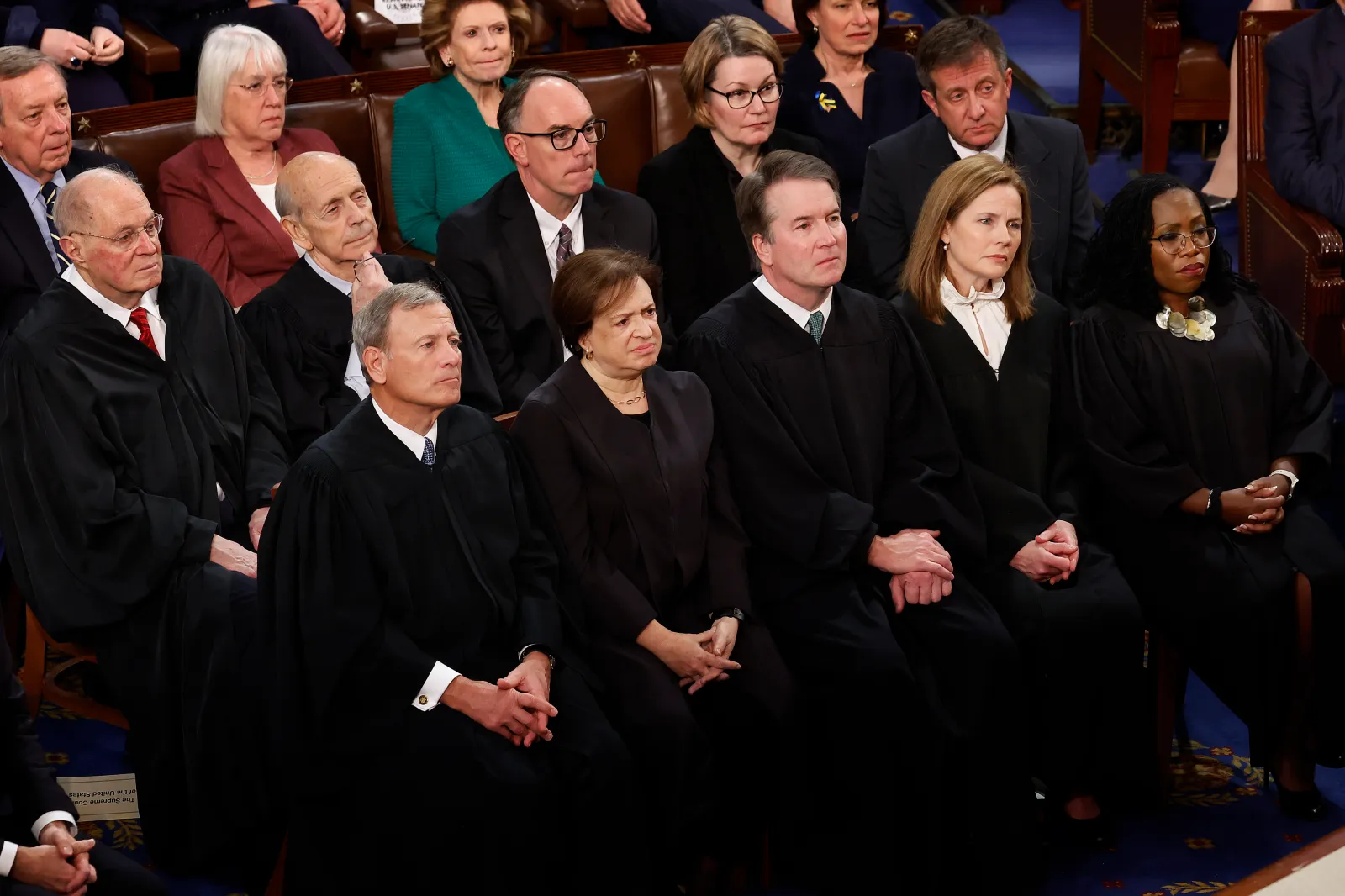
Supreme Court Justice Amy Coney Barrett compared her relationship to other justices on the bench to an “arranged marriage” during a fireside chat at her alma mater, Notre Dame Law School, saying justices don’t choose their colleagues but work together for years, sometimes for life.
Why It Matters
The Supreme Court has nine justices, and currently a 6-3 conservative majority. Justices are nominated by the president and confirmed by the Senate. They serve for life unless they retire, resign or in extremely rare instances, are removed through impeachment.
Since 1993, the average justice serves about 28 years, according to the Brennan Center for Justice. While an October Gallup poll found that over 40 percent of Americans, an all-time high, say the Court is “too conservative,” the justices ruled unanimously in 42 percent of cases decided last term. In 2023, they ruled unanimously in 44 percent of cases, and in 2022, the rate was 50 percent, according to SCOTUSblog.
What To Know
During a fireside chat last month, Barrett reflected on her time as a Notre Dame law student and faculty member, as well as her legal career, including her years on the nation’s highest court. She also offered students personal and professional advice.
Barrett emphasized the importance of relationships and rapport in the judiciary, saying that despite political and doctrinal differences, the justices maintain a sense of collegiality.
“We are nine people who are in an arranged marriage. We don’t pick our colleagues, but we’re going to be colleagues for a very, very long time,” she said, according to the university.
She went on telling students how best to navigate disagreements in their personal and professional lives, saying, “You need to always assume the best about those with whom you disagree. If you are looking for bad faith, you’ll find it. Assume the best, until proven otherwise.”
Several justices have echoed the idea that they remain collegial outside of their judicial differences, notably the late Ruth Bader Ginsburg and Antonin Scalia. Earlier this year, Justice Sonia Sotomayor said that although she often disagrees with Justice Clarence Thomas’ opinions on the bench, “I know that he is voting in good faith for what he believes.” She described the court as “a family” and emphasized that she looks “first at the good in people.”
Several proposals to impose Supreme Court term limits have been introduced over the years, but none have been enacted. Many legal scholars say term limits would likely require a constitutional amendment because the Constitution states that federal judges hold office during “good Behaviour.”
What People Are Saying
Justice Sonia Sotomayor said about Justice Clarence Thomas in September: “Thomas knows the name of practically every employee in the building. And not infrequently, we’re walking out of a conference or the dining room and he’ll say, ‘Did you know somebody in the building has lost a parent, a sick son?’ Something about them personally. He cares deeply about people.”
Justice Amy Coney Barrett, at the Ronald Reagan Presidential Library in September: “A democracy requires compromise. We can’t govern ourselves if we’re not willing to compromise and meet in the middle. Moreover, you know, we’re all in this together, and if we have a winner takes all approach, where you just want to crush the enemy, if you regard people who disagree with you as the enemy, we can’t constructively move forward as a society.”
What Happens Next
The court will hear oral arguments next on January 12.