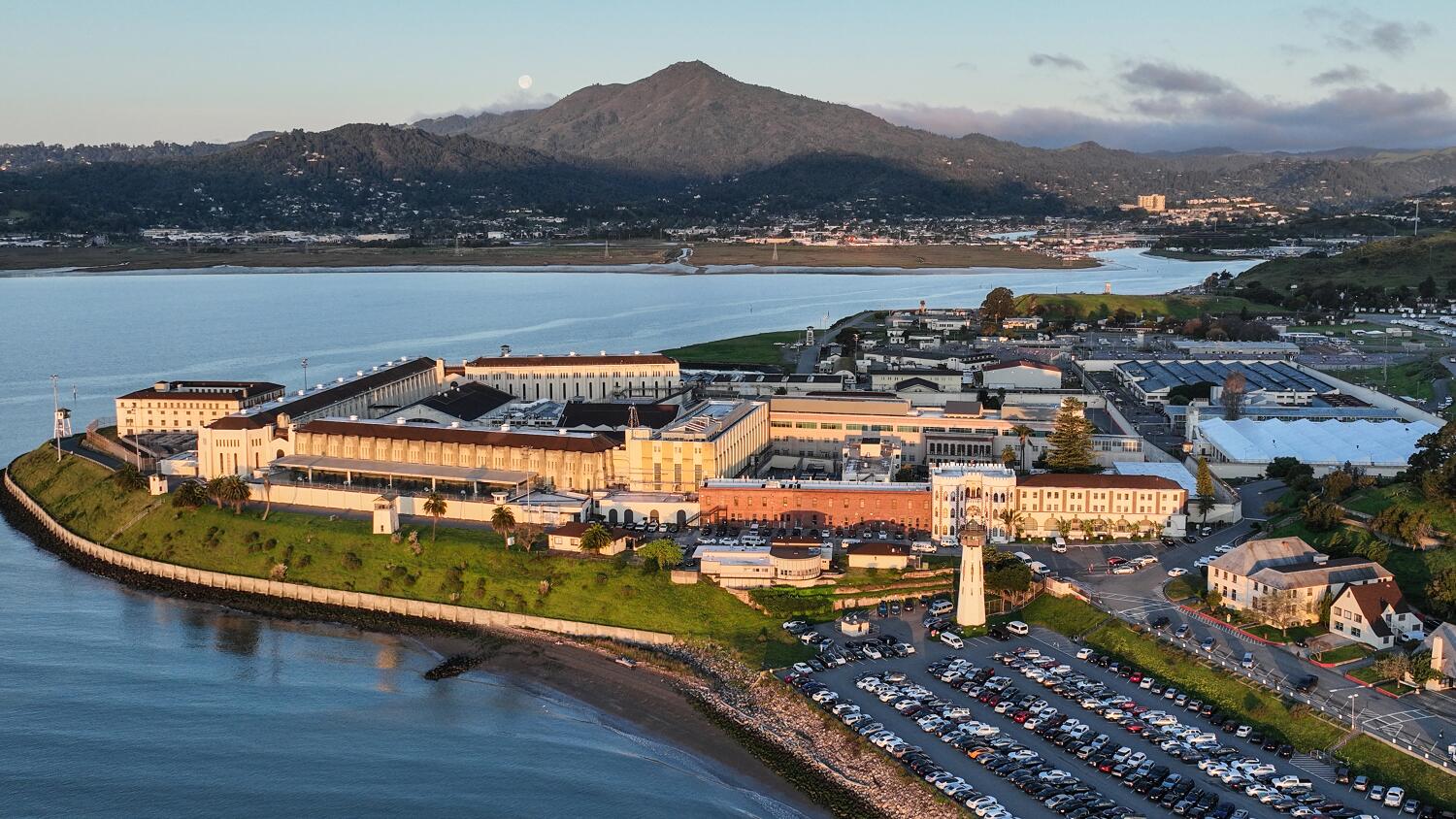
A strange quirk at San Quentin state prison is that most of those incarcerated behind its towering walls are unable to see the San Francisco Bay that literally laps at the shore a few yards away.
That changed recently with the completion of new buildings — holding among other accouterments a self-serve kitchen, a library, a cafe and a film studio — and third-floor classrooms that look out over that beautiful blue expanse, long a symbol of freedom and possibility.
In the new San Quentin Rehabilitation Center, along with learning job skills and earning degrees, incarcerated men can do their own laundry, make their own meals, and interact with guards as mentors and colleagues of sorts, once a taboo kind of relationship in the us-and-them world of incarceration.
“You want to clothes wash? You wash them,” said Gov. Gavin Newsom, debuting the new facilities, including laundry machines, for reporters last week. “You want to get something to eat. You can do it, whenever.”
“All of a sudden, it’s like you’re starting to make decisions for yourself,” he said. “It’s called life.”
Listen closely, and one can almost hear President Trump’s brain exploding with glee and outrage as his favorite Democratic foil seemingly coddles criminals. A cafe? C’mon. Bring on the midterms!
But what Newsom has done inside California’s most notorious prison, once home to the largest death row in the Western Hemisphere, is nothing short of a remarkable shift of thinking, culture and implementation around what it means to take away someone’s freedom — and eventually give it back. Adapted from European models, it’s a vision of incarceration that is meant to deal with the reality that 95% of people who go to prison are eventually released. That’s more than 30,000 people each year in California alone.
“What kind of neighbors do you want them to be?” Newsom asked. “Are they coming back broken? Are they coming back better? Are they coming back more enlivened, more capable? Are they coming back into prison over and over?”
When it comes to reforming criminals, “success looks like more and more people gravitating to their own journey, their own personal reform,” Newsom said, sounding more like a lifestyle influencer than a presidential contender. “It’s not forced on you, because then it’s fake, man. If it’s coerced, I don’t buy it.”
Of course, coming back better should be the goal — because better people commit fewer crimes, and that benefits us all. But coming back over and over has become the norm.
Traditional incarceration, a lock-’em-up and watch-them-suffer approach, has dramatically failed not only our communities and public safety writ large, but also inmates and even those who guard them.
Incarcerated people come out of prison too often in California (and across the country) with addictions and emotional troubles still firmly in place, and no job or educational skills to help them muddle through a crime-free life. That means they often commit more crimes, create more victims and cycle back into this failed, expensive, tough-on-crime system.
Still, it’s a favorite trope of Trump, and the justification for both his immigration roundups and his deployment of National Guard troops in Democratic cities, that policies such as Newsom’s are weak on crime and have led to the decline of American society.
This narrative of fear and grievance goes back decades, recycled every election by the so-called law-and-order party because it’s effective — voters crave safety, especially in a chaotic world. And locking people up seems safe, at least until we let them go again.
But, as Chance Andes, the warden of San Quentin, pointed out last week, “Humanity is safety,” and treating incarcerated people like, well, people, actually makes them want to behave better.
Here’s where the tough-on-crime folks will begin composing their angry emails. Why are we paying for killers to have a view? Why should I care if a rapist has a good book to read? Our budget is bleeding red, why are tax dollars being used for prison lattes? (To be fair, I do not know whether they actually have lattes.)
But consider this: The prison guards back Newsom.
“Done right, it improves working conditions for our officers and strengthens public safety,” said Steve Adney, executive vice president of the California Correctional Peace Officers Assn., the union that represents guards, of the California model, as Newsom calls his vision.
Faced with high rates of suicide and other ills such as addiction, corrections officers have long been concerned about the stress and violence of their jobs. A few years ago, some union members traveled to Norway to see prisons there. I tagged along.
The American officers were shocked to see Norwegian prisoners access kitchen knives and power tools, but even more shocked that the guards had built relationships with these criminals that allowed them to do their jobs with far less fear.
Rather than jailers, these corrections officers were more like social workers or guides to a better way of living. Of course, the corrections officers aren’t dumb. That only works with vetted inmates, such as those at San Quentin, who have proved they want to change.
But when you have officers and incarcerated people who are able to coexist with respect and maybe a dash of kindness, you get a different outcome for both sides.
“If we are capable of building this at San Quentin, then we are capable of making the workplace safe for every officer who walks in the gates,” said CCPOA President Neil Flood, a startling statement in favor of radical reform from a law enforcement officer.
But in a moment when most Democrats with ambitions for national office (or even an eye on replacing Newsom) are backing away from criminal justice reform, it would be naive to think the California model won’t be used to bludgeon Newsom in a presidential race, and provide further fuel to the dumpster-fire narrative about the state.
Soon — before the midterms — many expect Congress to move forward on Trump’s expressed desire for a crime bill that would empower police with even greater immunity for wrongdoing, create longer sentences for crimes including those involving drugs and further erode criminal justice reform in the name of public safety.
Trump is going hard in the opposite direction, toward more punishment, always the easier and more understandable route for voters fed up with crime (even though crime rates have been declining since President Biden was in office).
The California model is “a political liability in this environment,” said Tinisch Hollins, a victims advocate who worked on the San Quentin transition and heads Californians for Safety and Justice.
But she retains faith that “the majority of people don’t believe that shoving everyone into prison is how we resolve the problem.”
Newsom deserves credit for standing by that position, when simply backing away and dropping the California model would have been the simpler and safer route — it’s complicated and messy and oh-so-easy to make it sound dumb.
I refer you back to the cafe. If construction had been cut at San Quentin, the budget cited as the reason, no one would have noticed and few would have complained.
Instead, sounding a bit like Trump, Newsom said he “threatened the hell out of them if they didn’t get it done before I was gone.”
“This is not left or right,” he said. “This is just being smart and pragmatic and you know, I just … I believe people are not the worst thing they’ve done.”
Politically at least, San Quentin is a legacy for Newsom now, the best or worst thing he’s done on crime, depending on your personal views of second chances.
But it is undeniably a vision of public safety starkly at odds with Trump, one Newsom will carry into his next political fight — where it is certain to cause him some pain.