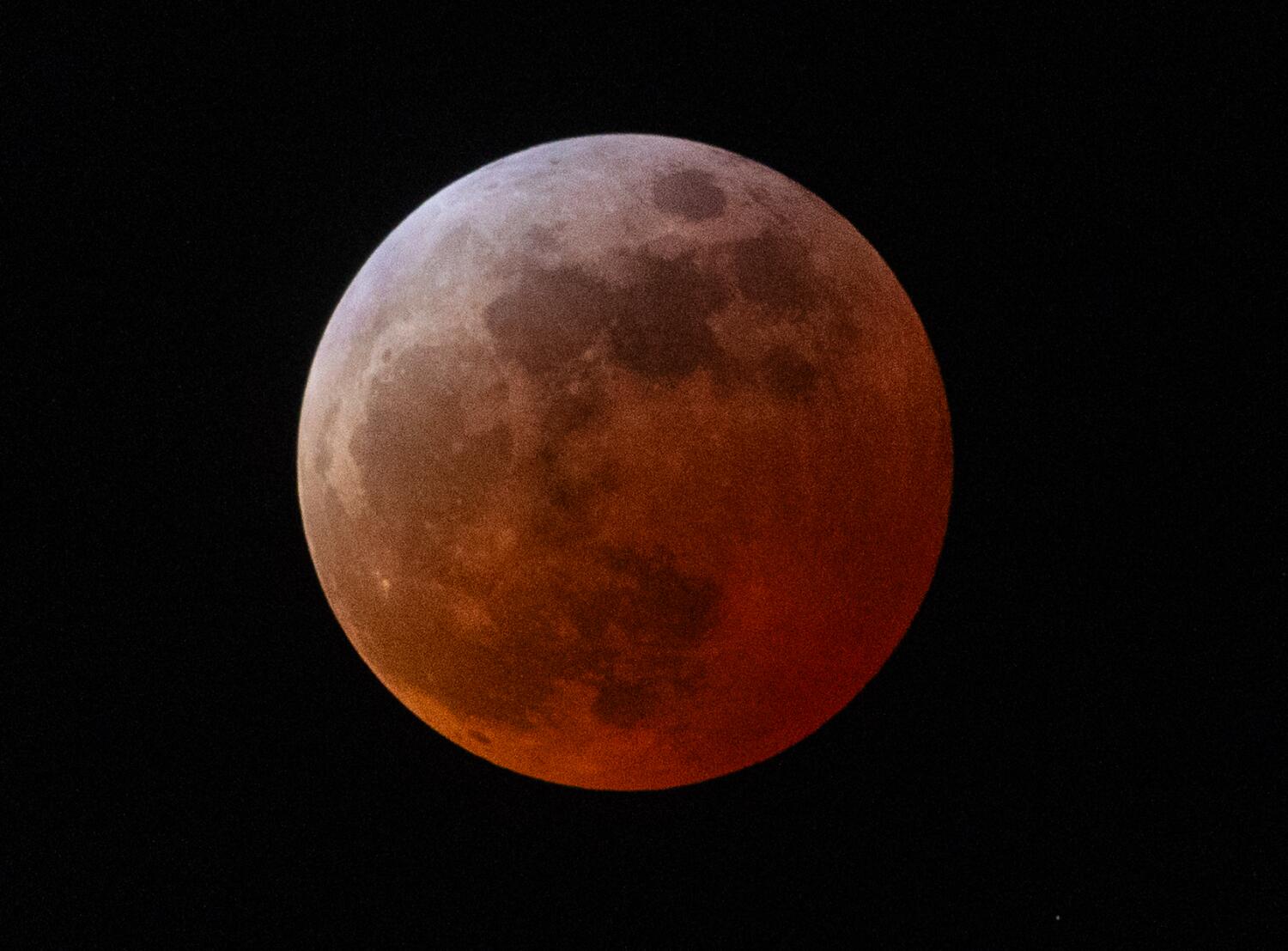
Celestial enthusiasts across Southern California will have a chance to watch the moon turn red during a total eclipse early Tuesday, but you’ll have to be up before dawn to catch it.
Between midnight and dawn on Tuesday, the Earth will pass directly between the sun and the moon.
Earth will cast an enormous shadow across the moon’s surface, turning it a deep reddish-orange, which is commonly referred to as a “blood moon,” according to NASA.
The red color occurs because, during the total eclipse, the Earth is blocking most of the sun’s light from reaching the moon, NASA said. The light that does reach the moon’s surface is filtered through a thick slice of the Earth’s atmosphere.
This alignment can only occur during a full moon phase. About four to seven times a year, the Earth, moon and sun line up to create an eclipse.
There are two types of eclipses: lunar and solar. During a lunar eclipse, Earth’s shadow obscures the moon; in a solar eclipse event, the moon blocks the sun from view.
How can you watch the total lunar eclipse?
The total eclipse will occur from 12:37 a.m. to 6:25 a.m. on Tuesday. Totality, or when the Earth completely covers the moon, is at 3:04 a.m.
No equipment is necessary to watch the color-changing display; just look up and to the southwest.
If you want to enhance your view, NASA recommends using a pair of binoculars or a telescope.
For an even more enhanced observing experience, find a dark environment away from bright lights to attend the total eclipse show.
The Griffith Observatory is hosting an online broadcast of the total lunar eclipse on Tuesday from 12:37 a.m. to 6:25 a.m.
Is the red moon all you’ll see Tuesday morning?
NASA says that, as the Earth’s shadow dims the lunar surface, constellations may be easier to spot than they usually are during a full moon.
At the time of the eclipse, the moon will be in the constellation Leo, under the lion’s hind paws.