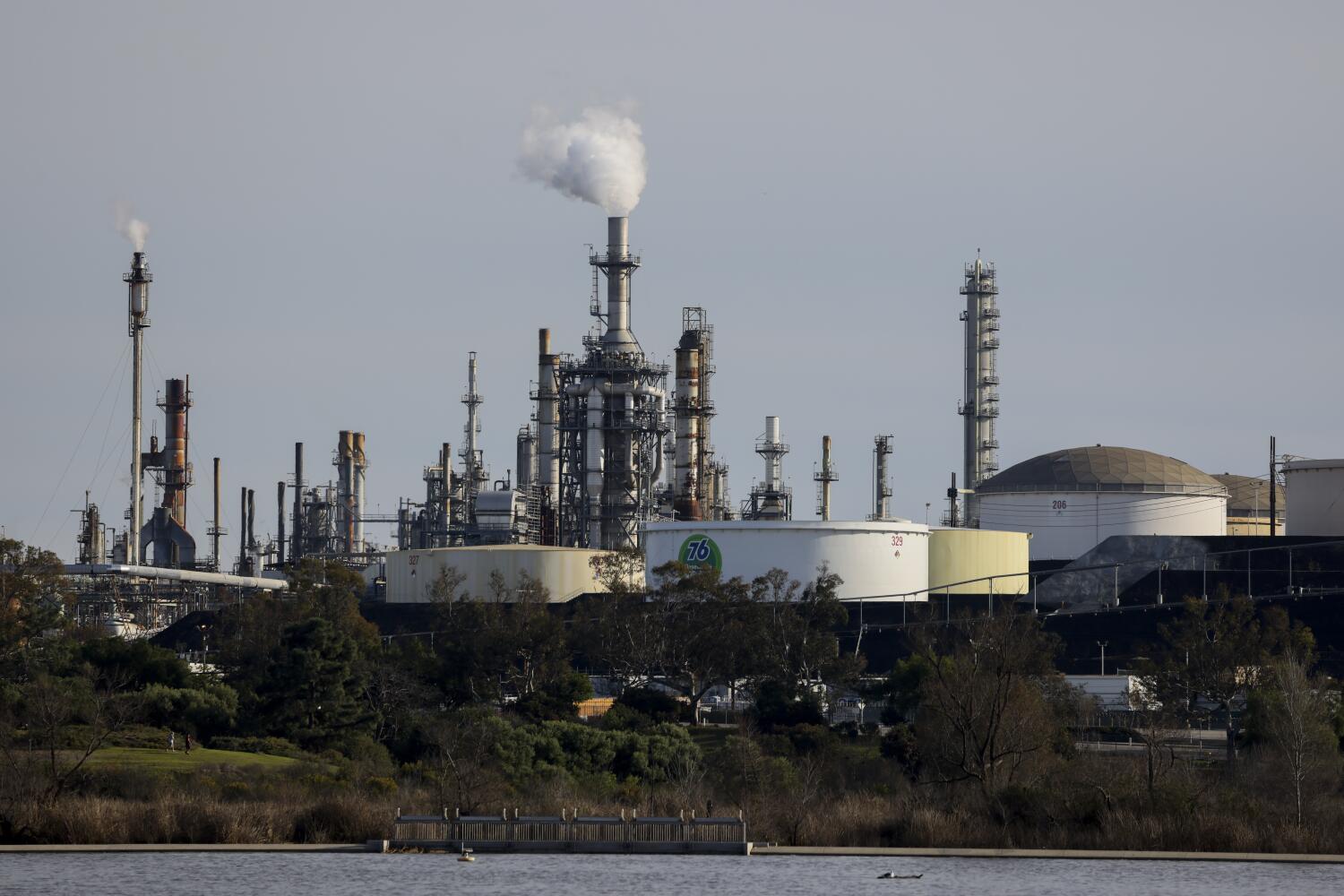
The U.S. attack on Iran is expected to have an unwelcome impact on California drivers — a jump in gas prices that could be felt at the pump in a week or two.
The outbreak of war in the Middle East, which virtually closed a key Persian Gulf shipping lane, spiked the price of a barrel of Brent crude oil by as much as $10, with prices rising as high as $82.37 on Monday before settling down.
The price of the international standard dictates what motorists pay for gas globally, including in California, with every dollar increase translating to 2.5 cents at the pump, said Severin Borenstein, faculty director of the Energy Institute at UC Berkeley’s Haas School of Business.
That would mean drivers could pay at least 20 cents more per gallon, though how much damage the conflict will do to wallets remains to be seen.
“The real issue though is the oil markets are just guessing right now at what is going to happen. It’s a time of extreme volatility,” Borenstein said. “We don’t know ether the war will widen or end quickly, and all of those things will drive the price of crude.”
President Trump has lauded the reduction of nationwide gas prices as a validation of his economic agenda despite worries about a weak job market and concerns of persistent inflation.
The upheaval in the Middle East could be more acutely felt in the state.
Californians already pay far more for gas than the rest of the country, with the average cost of a gallon of regular at $4.66, up 3 cents from a week ago and 30 cents from a month ago, according to AAA. The current nationwide average is about $3 per gallon.
The disruption in international crude markets also comes as refiners are switching to producing California’s summer-blend gas, which is less volatile during the state’s hot summers. The switch can drive up the price of a gallon of gas at least 15 cents.
The prices in California are largely driven by higher taxes and a cleaner, less polluting blend required year-round by regulators to combat pollution — and it’s long been a hot button issue.
The politics were only exacerbated by recent refinery closures, including the Phillips 66 refinery in Wilmington in October and the idling and planned closure of the Valero refinery in Benicia, Calif., which reduced refining capacity in the state by about 18%.
California also has seen a steady reduction in its crude oil production, making it more reliant on international imports of oil and gasoline.
In 2024, only 23.3% of the crude oil refined in the state was pumped in California, with 13% from Alaska and 63% from elsewhere in the world, including about 30% from the Middle East, said Jim Stanley, a spokesperson for the Western States Petroleum Assn.
“We could see a supply crunch and real price volatility” if the Middle East supply is interrupted, he said.
The Strait of Hormuz in the Persian Gulf, through which about 20% of the world’s oil passes, was virtually closed Monday, according to reports. Though it produces only about 3% of global oil, Iran has considerable sway over energy markets because it controls the strait.
Also, in response to the U.S. attack, Iran has fired a barrage of missiles to the neighboring Persian Gulf states. Saudi Arabia said it intercepted Iranian drones targeting one of its refinery complexes.
California Republicans and the California Fuels and Convenience Alliance, a trade group representing fuel marketers, gas station owners and others, have blamed Gov. Gavin Newsom’s policies for driving up the price of gas.
A landmark climate change law calls for California to become carbon neutral by 2045, and Newsom told regulators in 2021 to stop issuing fracking permits and to phase out oil extraction by 2045. He also signed a bill allowing local governments to block construction of oil and gas wells.
However, last year Newsom changed his stance and signed a bill that will allow up to 2,000 new oil wells per year through 2036 in Kern County despite legal challenges by environmental groups. The county produces about three-fourths of the state’s crude oil.
Borenstein said he didn’t expect that the new state oil production would do much to lower gas prices, because it is only marginally cheaper than gas imported by ocean tankers.
Stanley said the aim of the law was to support the Kern County oil industry, which was facing pipeline closures without additional supplies to ship to state refineries.
Statewide, the industry supports more than 535,000 jobs, $166 billion in economic activity and $48 billion in local and state taxes, according to a report last year by the Los Angeles County Economic Development Corp.