Former All-Star power forward Horace Grant enjoyed one of the most quietly remarkable NBA careers in league history.
The 6-foot-10 Clemson product may be most remembered for his seven-year stint with the Chicago Bulls, from 1987-94, but he was ultimately a starter on a whopping five NBA Finals-bound teams, for three different franchises. Grant also wrapped up his 17-year career as a reserve on a sixth Finals club, although he was hurt before the playoffs.
Grant, Scottie Pippen and Michael Jordan served as the driving two-way forces that led Chicago to three straight titles from 1991-93. While Jordan and Pippen earned understandable accolades for their dynamic playmaking and scoring, Grant did a lot of the less-glamorous dirty work as the Bulls’ primary enforcer.
The rising Bulls big man fended off a terrifying rotation of All-Star power forwards — and occasionally centers and small forwards, too — while protecting the rim, gobbling up rebounds, using his impressive bulk and wingspan to score at will within the post, and knocking down a reliable jumper at the top of the key.
More news: Bulls Legend Horace Grant Sends Clear Message on Chicago’s Recent Struggles
Before Chicago broke through to own the 1990s, the club frequently found itself hitting a hard ceiling in the Motor City during the latter half of the previous decade. The Bulls were ousted by the Isaiah Thomas/Joe Dumars-era Detroit Pistons in each of Grant and Pippen’s first two pro seasons, first in the second round during the 1988 playoffs and subsequently in the 1989 Eastern Conference Finals.
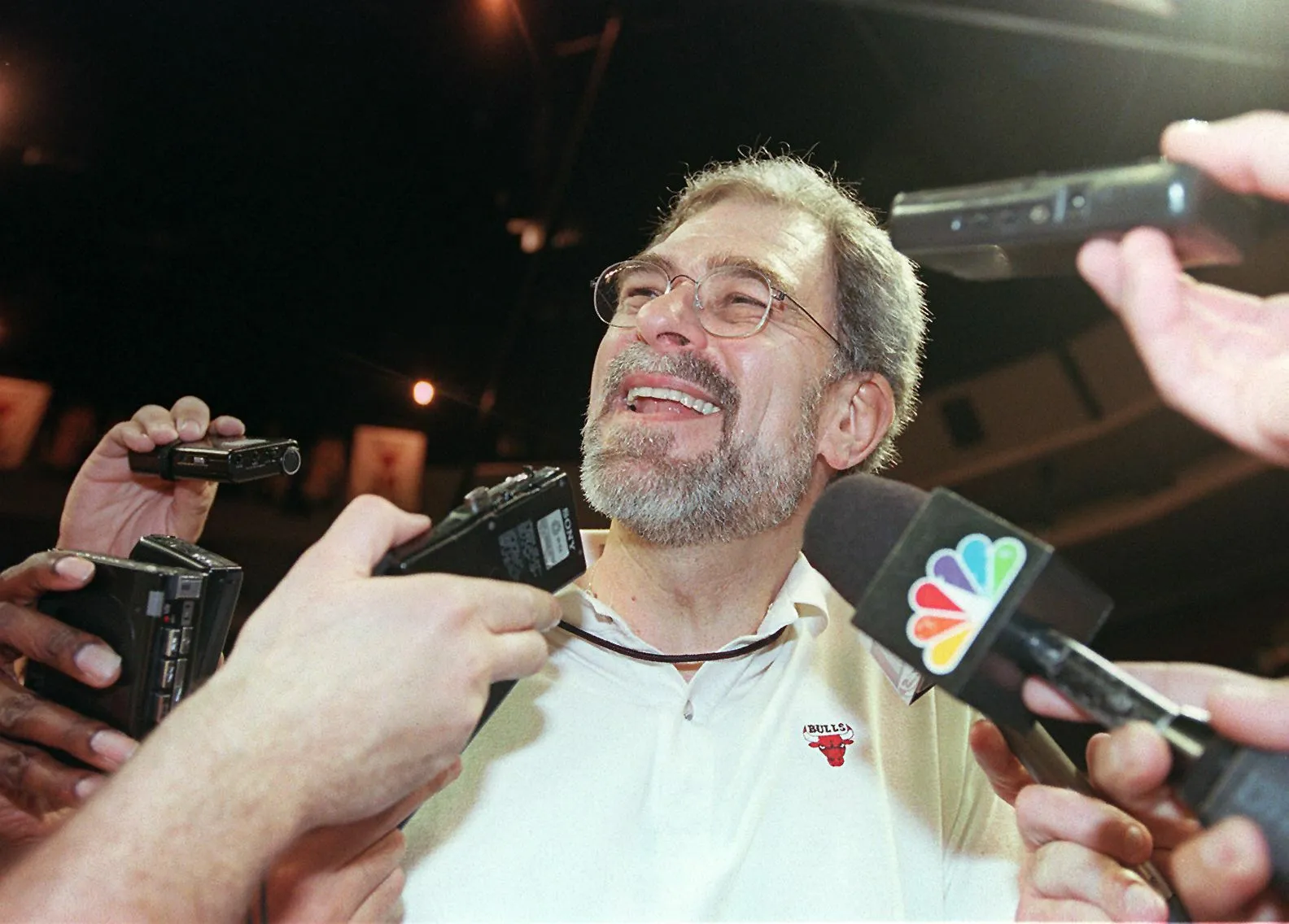
Chicago team president Jerry Krause decided to make a coaching change after that disappointing six-game East Finals defeat. He fired eventual Hall of Fame head coach Doug Collins, an emotionally charged motivator whose offenses leaned too heavily on Michael Jordan isolation scoring. Assistant coach Phil Jackson, who would become infamous for his unorthodox, “Zen” approach to leading his teams, earned his first head coaching nod ever. 11 titles ever, it’s pretty clear that was the right call in the moment. Chicago got a bit further, technically, during its first season under Jackson, pushing Detroit to seven games in the 1990 East Finals on the heels of a 55-win season.
Those loaded, hard-fouling Pistons squads advanced to the NBA Finals in each of those three Bulls clashes, winning in ’89 and ’90.
But Jackson refurbished Chicago’s offense ahead of Grant and Pippen’s fourth season, as both those hyper-athletic talents continued to grow alongside the already-established Jordan. Assistant coach Tex Winter’s triangle offense empowered Jordan’s Bulls teammates to operate with the ball in their hands more than ever, and the result was the first of three straight Chicago championships. The Bulls’ top six that season was rounded out by former All-Star center Bill Cartwright, starting point guard John Paxson, and reserve guard BJ Armstrong.
Jackson’s unique approach to navigating his treatment of his best three players wound up involving some crafty 4D psychology. He met with Grant in secret one day, and confided to the gritty pro that he intended to start hounding him throughout team practices and games — although he would be covertly projecting his frustrations around Jordan and Pippen onto his power forward.
“It’s so crazy,” Grant says. “He calls me into his office. He says, ‘Horace, I’m going to ask you to do something that’s going to be a little strange, but I need for you to do it.’
“I said, ‘PJ, whatever for the team.’
“He said, ‘I’m going to yell at you, but I’m yelling at Michael and Scottie.’ I’m like, “Make that make sense.’
“He was like, ‘I don’t want to get under their skin and they’ll lose their thought patterns.’
“I’m like, ‘Okay, I can take it.’ I didn’t know it was going to be for seven years, you know?” Grant chuckles. “I thought it was going to be [for one season], but it was for seven years! But he and I to this day have a great relationship, PJ. What a wonderful man, just a great leader — not just for basketball players, but for men. He treated us like men out there.”
More news: Bulls, Mavericks Trade Idea Sends $36 Million Star to Dallas
So how was Jordan, a five-time MVP often considered the best player in the history of the league, as a leader on those classic, hardscrabble Bulls teams?
“MJ was a leader — matter of fact, one of the greatest leaders who I ever played with. He would make sure that you deserve to be in the foxhole with him,” Grant recalls while in conversation with Newsweek Sports. “If you folded, then he’s gonna break you. But if you have that mentality that he has — you want to win — he’ll bring you along.”
Sans Jordan, Chicago won 55 games and was probably one dubious Hue Hollins call away from at least making the Eastern Conference Finals for a sixth straight season.
When Jordan announced his first retirement ahead of the 1993-94 season, Grant elevated his game as a two-way player, earning an All-Star appearance and his second of four All-Defensive Team honors. He also finished 10th in Defensive Player of the Year voting that season, a testament to his tenacity on that end of the court.
Across 70 games that season, Grant averaged 15.1 points on 52.4 percent field goal shooting and 59.6 percent free throw shooting, 11.0 rebounds, 3.4 assists, 1.2 blocks and 1.1 swipes per.
Grant, who was drafted in the 1987 lottery along with Pippen, credits his longtime friend and teammate with approaching leadership in a wholly different way from Jordan. Grant notes that Pippen’s methodology seemed to channel the collegial style generally preferred by the club’s Hall of Fame head coach, Phil Jackson.
“Pip took the philosophy of Phil Jackson — PJ — of getting his point across without yelling, telling you where to be in certain instances on the basketball court. Prime example, the year that MJ retired, Pip’s leadership took us to 55 games. Unfortunately, we didn’t win the ‘chip that year,” Grant says. “He showed his leadership that year.”
Pippen finished third in MVP voting that season, behind Houston Rockets center Hakeem Olajuwon (that season’s winner) and San Antonio Spurs center David Robinson (the next year’s winner).
Jackson’s application of the triangle offense, through 1994 All-Stars Pippen, Grant and Armstrong and the rest of the Bulls that season, helped Chicago thrive even without a certain North Carolina alum.
All told, Jackson’s system equipped his various star-laden NBA squads with a certain fluidity in their flow. After an 18-month baseball sabbatical, Jordan would go on to rejoin the Bulls in March 1995, only to be knocked out of the second round by Grant’s new Finals-bound team, the Shaquille O’Neal/Penny Hardaway-era Orlando Magic. Chicago appreciated that it needed a solution for the Magic’s jumbo-sized starting frontcourt tandem of O’Neal and Grant, and traded for an aging Dennis Rodman by sending reserve center Will Perdue to the San Antonio Spurs.
All told, Jackson would go on to lead Chicago to six NBA Finals appearances across eight seasons. He would go on to reunite with Grant in the middle of his third three-peat since the start of the 1990s, on the O’Neal/Kobe Bryant-era Los Angeles Lakers in 2000-01. Grant returned to Orlando the next season, but did circle back to the Lakers for their contentious 2003-04 season, this time as a reserve. A hip injury kept him officially inactive during LA’s run to the NBA Finals that summer.
Jackson would coach his Bulls and Lakers clubs to a combined 13 NBA Finals appearances, including 11 championships, between the 1990-91 and 2009-10 seasons. Grant played for five of those Finals-bound seasons, on both teams.
“One of the greatest things about PJ — Phil Jackson — is that he understood your personality,” Grant says. “He did not want to infringe on your personality. But your personality needed to be team-first, if that makes sense. It’s got to be a concept of a team first. He can let you be who you are.”
The Chicago Bulls’ 2025 Ring of Honor Class
On Nov. 22, during a Bulls-Washington Wizards encounter, Chicago honored Grant, Cartwright, Paxson, former All-Star ’70s guard Norm Van Lier, former dynasty-era Chicago coach Johnny Bach, and former longtime radio and TV announcer Neil Funk by naming the group to the Bulls’ 2025 Ring of Honor class — replete with a halftime celebration.
All six Bulls icons were feted with their own tributary essay. Horace Grant’s twin brother, 11-year NBA pro Harvey, wrote Horace’s piece.
“Man, it was one of the best weeks of my life — first, being honored with such a great organization. Secondly, just reminiscing with guys like Pax and Bill and Neil Funk and the late great Johnny Bach — with his family there,” Grant says. “It was so exciting, man. And plus, all the fans there.”
Legends In Session
He’s in the midst of production on the first season of a new series for Urban Grind TV, Legends In Session. Grant is filming a series of interviews in Chicago, of course, as he speaks with several hoops luminaries from his era. Verified guests include Pippen, Grant’s fellow former NBA teammates Stacey King, BJ Armstrong, Vernon Maxwell, Charles Oakley, Gary Payton, and Penny Hardaway, and Harvey Grant.
The show boasts a very active Instagram presence, where fans can — and should — keep tabs on its progress.
“I just felt that I should have my voice out there a little bit more. Everyone who knows me knows that I’m a no-nonsense type of guy, I wear my heart on my sleeve and just have a story to tell,” Grant explains. “This TV series is just going to be my journey from my adolescence and my growth [in] college, 17 years in the NBA, and my guests are going to do the same. So it’s going to be fascinating, transparent and fun. Of course we’re going to talk about ’80s and ’90s basketball compared to basketball now and things of that nature.”
Legends In Session aims to cover each player’s, well, legend with deep dives into their full biographies — going far beyond the hardwood in the process.
“I already know all these guys, but I want them to share it with the public, with the fans, about their growth from childhood, adolescence, college, what were their keys to success, and what are they doing now since us old heads have retired?”
Grant intends to explore the platform of the program to help give back a bit with a charitable element, too.
“Like I say to a lot of people, it takes a village to raise a family, and a lot of things were given to me. It’s just a part of giving back. Each guest is going to go to the Legends In Session Hall of Fame, and we’re going to sign memorabilia, and that memorabilia is going to be auctioned off to their choice of charity, so it’s just a way of giving back.”
Legends In Session is already shaping up to be a must-watch for ’90s NBA fans. Assuming the episodes are anything like Newsweek Sports’ chat with Grant, look for insightful, thorough chats that delve into moving personal stories and fascinating behind-the-scenes scoops on classic basketball moments.
Listen to this reporter’s full conversation with Horace Grant on the Bulls Bros podcast.
More news: Former Bulls Star Horace Grant Takes Firm Stance on Rooting for NBA Nephew
For all the latest NBA news and rumors, head over to Newsweek Sports.