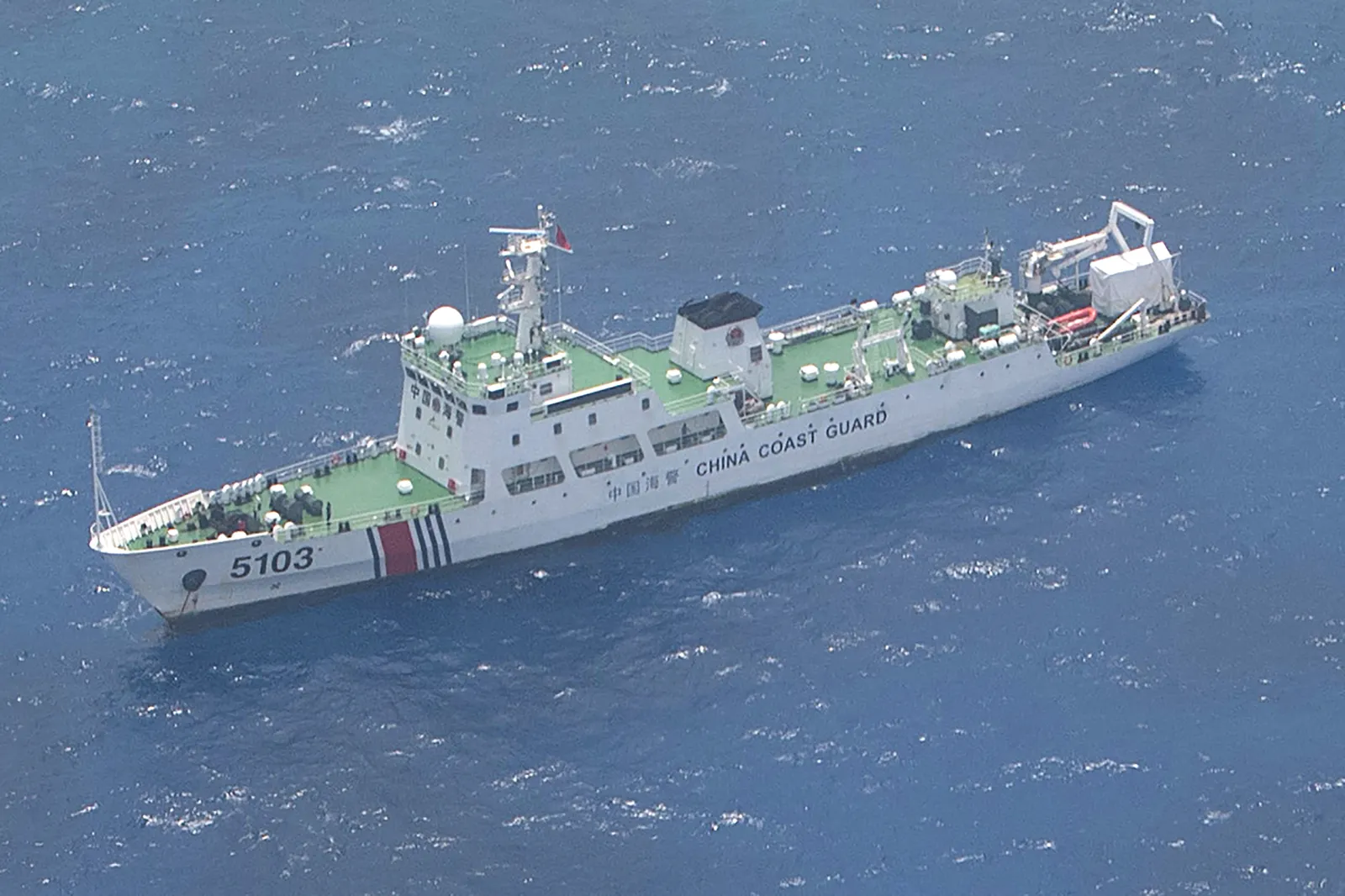
China and Japan have issued conflicting reports about a coast guard encounter early Tuesday near a disputed island chain in the East China Sea, against a backdrop of tensions between the neighbors.
Why It Matters
Known in Japan as the Senkakus and in China as the Diaoyus, the uninhabited islets are home to rich fishing grounds and are widely believed to contain significant natural gas and oil deposits. They have also been at the center of a territorial dispute since Tokyo nationalized them in 2012, with China stepping up patrols by its coast guard ships in response.
The reports come as Tokyo and Beijing continue to deteriorate over Japanese Prime Minister Sanae Takaichi’s statement last month that a military blockade of Taiwan could necessitate military intervention under Japan’s pacifist constitution. China, which claims self-ruled Taiwan is its territory, responded by warning of a “severe blow” and canceling Japan-bound flights.
Newsweek has reached out to Japan’s Foreign Ministry and China’s Defense Ministry via email with requests for comment.
What To Know
China’s coast guard issued a statement saying a Japanese fishing boat had on Tuesday “illegally entered the territorial waters” Beijing claims around the largest of the islands. The Chinese side said it issued warnings and “took necessary control measures” to expel the vessel.
According to a Japanese coast guard account of events carried by local media, two Chinese coast guard patrol ships armed with autocannons had sailed within the 12 nautical mile (13.8-mile) territorial sea around the islet at around 2:30 a.m. local time while approaching the 9.7-ton fishing vessel and its two-person crew.
A Japanese patrol vessel broadcast radio warnings ordering the Chinese ships to leave the area. Both vessels withdrew to contiguous waters, a buffer outside of territorial waters shortly after 5 a.m., per the statement. Another two heavily armed Chinese coast guard cutters were already operating in this zone, according to the Japanese statement.
While Chinese coast guard ships have in recent years patrolled near the Senkakus almost daily, they enter the so-called territorial sea far less frequently.
What People Are Saying
Chinese coast guard spokesperson Liu Dejun said, “Diaoyu Dao and its affiliated islands are China’s inherent territory.” He called on the Japanese side to” immediately cease all infringement and provocation activities in the waters.”
The Japanese coast guard (JCG) said on its website: “The JCG will continue to respond calmly and resolutely in accordance with international and domestic laws without escalating the situation.”
Group of Seven (G7) foreign ministers said in a joint statement last month: “We reiterated our strong opposition to any unilateral attempts to change the status quo in particular by force or coercion, including in the East China Sea and the South China Sea.”
What Happens Next
Chinese “escalation” in the East China Sea, including the Senkakus, was among the issues Takaichi raised with Chinese President Xi Jinping during their October 31 meeting on the sidelines of an Asia-Pacific Economic Cooperation summit in South Korea, according to a readout from Japan’s Foreign Ministry.
The international legal status of the islands remains unresolved. While the United States does not take a position on the sovereignty matter, officials have repeatedly confirmed that the Japan-U.S. Security Treaty applies to Japanese nationals in the Senkakus.