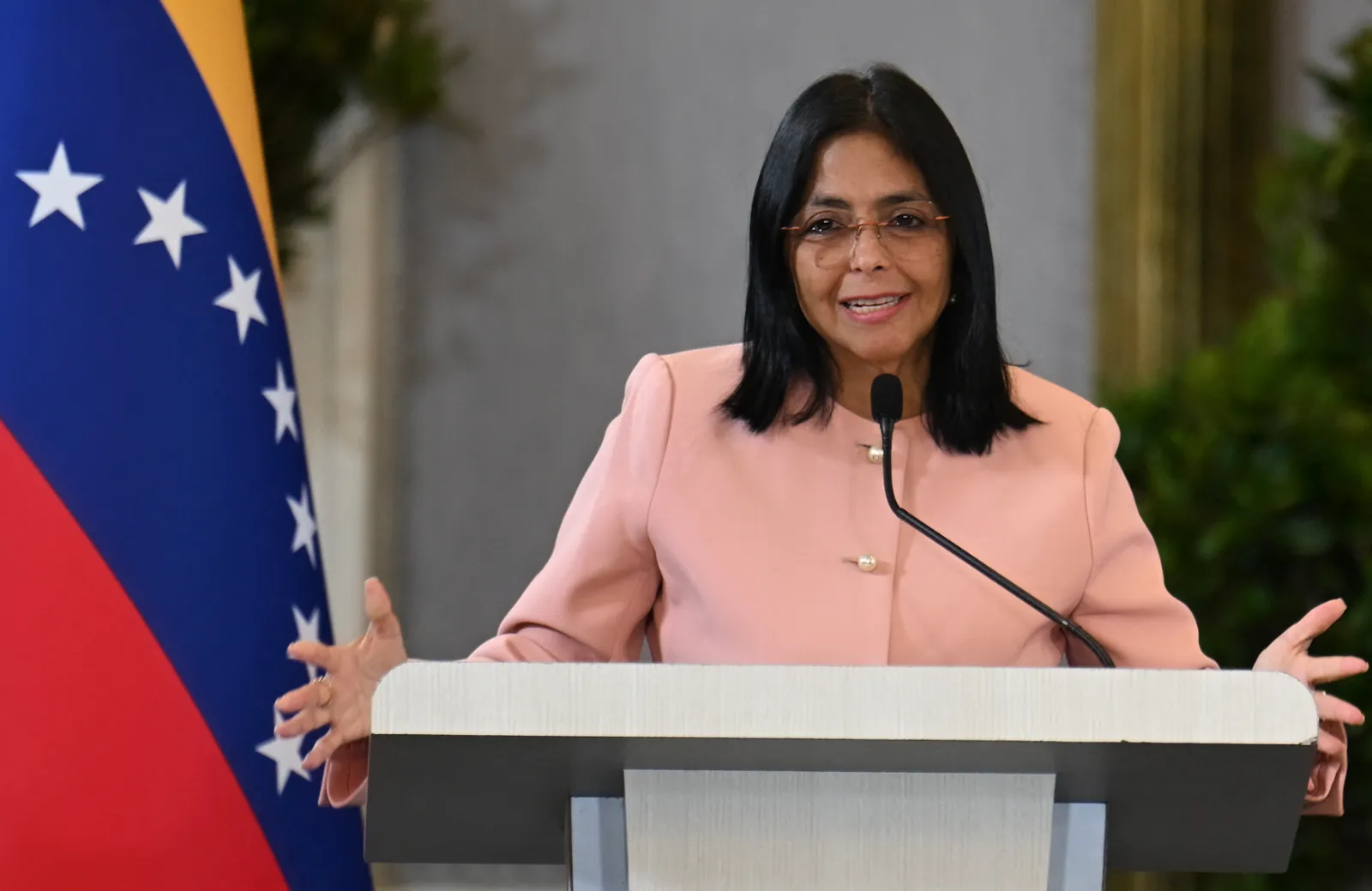
Venezuela’s Supreme Court Constitutional Chamber ordered Vice President Delcy Rodríguez to assume the role of acting president on Saturday following the detention of President Nicolás Maduro by U.S. forces.
The court ruled that Rodríguez must take on “all the attributions, duties and faculties inherent to the position of President of the Bolivarian Republic of Venezuela, in order to guarantee the administrative continuity and the integral defense of the Nation.”
Maduro was detained early Saturday morning in what Venezuelan authorities are characterizing as a “foreign military aggression” and “kidnapping” by U.S. forces.
Why It Matters
Maduro had been indicted in March 2020 on “narco-terrorism” conspiracy charges in the Southern District of New York. In August 2025, the U.S. doubled its bounty to $50 million for information leading to Maduro’s arrest. He has consistently denied these charges.
However, the U.S. captured Maduro and his wife during a “large-scale strike” against Caracas early Saturday morning. Maduro earlier declared a national emergency after multiple explosions rocked the capital city.
President Donald Trump on Saturday said that he did not see Venezuela’s opposition leader Maria Corina Machado as a potential replacement for Maduro.
What To Know
The Supreme Court’s ruling invoked Articles 234 and 239 of Venezuela’s Constitution, interpreting them to address what it termed an “exceptional, atypical situation” not explicitly covered in constitutional text.
The court described Maduro’s detention as creating a “situation of impossibility” for him to exercise presidential functions. According to the ruling, Rodríguez’s appointment is a “protective measure” meant to ensure state continuity while the court continues deliberations on “the applicable legal framework” for the situation. The decision was made ex officio—on the court’s own initiative—and characterized the circumstances as “force majeure” requiring immediate action.
The court emphasized that its action represents an “urgent and preventive precautionary” measure rather than a final determination of whether Maduro’s absence should be classified as temporary or permanent under constitutional provisions.
The ruling ordered immediate notification to the Executive Vice President, National Defense Council, Military High Command, and National Assembly.
What People Are Saying
Venezuela’s Supreme Court Constitutional Chamber: “This fact, public and notorious, which occurred on January 3, 2026, constitutes an exceptional, atypical situation and force majeure not literally provided for in the Constitution of the Bolivarian Republic of Venezuela, generating a situation that requires constitutional certainty due to the maximum gravity that threatens the stability of the State.”
The court further stated: “It is imperative, necessary and proportionate to provide for this function to be exercised immediately, in order to facilitate the preservation of the interests of the Nation in the face of foreign aggression that it currently faces.”
What Happens Next
The Supreme Court indicated it will continue deliberating to “determine the applicable legal regime to guarantee the continuity of the State, the administration of government, and the defense of sovereignty in the forced absence of the President of the Republic.”