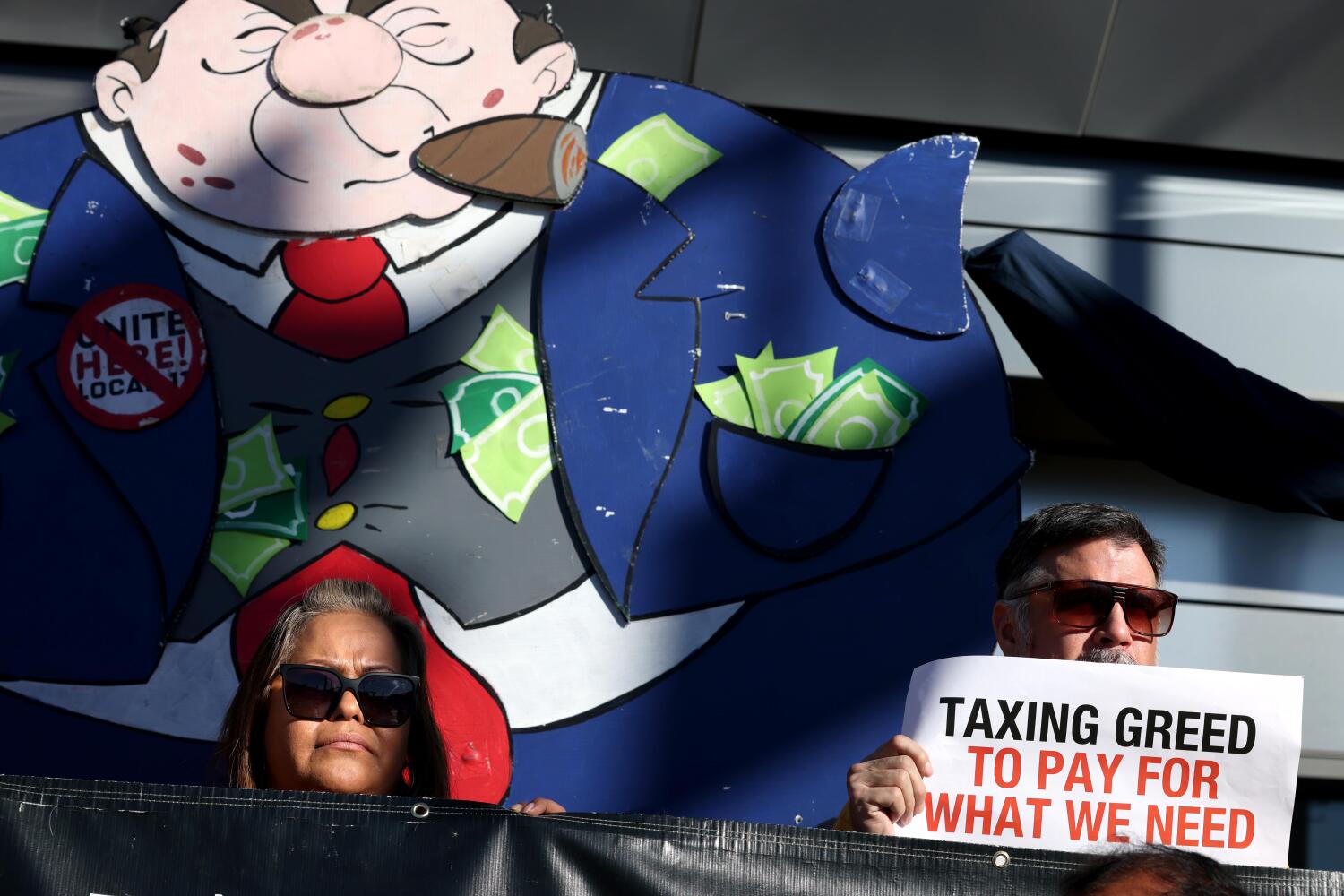
The battle over a new tax on California’s billionaires is set to heat up in the coming months as citizens spar over whether the state should squeeze its ultra-rich to better serve its ordinary residents.
The proposed billionaire tax that triggered the tempest is still far from being approved by voters or even making the ballot, but the idea has already sparked backlash from vocal tech moguls — some of whom have already shifted their bases outside the state.
Under the Billionaire Tax Act, Californians worth more than $1 billion would pay a one-time 5% tax on their total wealth. The Service Employees International Union-United Healthcare Workers West, the union behind the act, said the measure would raise much-needed money for healthcare, education and food assistance programs.
Other unions have piled on billionaires, targeting the rich in Los Angeles.
A group of Los Angeles labor unions said Wednesday that it is proposing a ballot measure to raise taxes on companies whose chief executive officers earn 50 times more than their median-paid employees.
Here is how this fight could continue to play out in the Golden State:
Who would be affected?
The California billionaire tax would apply to about 200 California billionaires who reside in the state as of Jan. 1. Roughly 90% of funds would go to healthcare and the rest to public K-14 education and state food assistance.
The tax, due in 2027, would exclude real estate, pensions and retirement accounts, according to an analysis from the Legislative Analyst’s Office, a nonpartisan government agency. Billionaires could spread out the tax payment over five years, but would have to pay more.
Which billionaires are already distancing themselves from California?
Google co-founders Larry Page and Sergey Brin
Google is still headquartered in California, but December filings to the California Secretary of State show other companies tied to Page and Brin recently converted out of the state.
One filing, for example, shows that one of the companies they managed, now named T-Rex Holdings, moved from Palo Alto to Reno last month.
Business Insider and the New York Times earlier reported on these filings. Google didn’t respond to a request for comment.
Palantir co-founder Peter Thiel
Thiel Capital, based in Los Angeles, announced in December it opened an office in Miami. The firm didn’t respond to a request for comment. Thiel recently contributed $3 million to the political action committee of the California Business Roundtable, which is opposing the ballot measure, records provided to the Secretary of State’s Office show.
Oracle co-founder and Chief Technology Officer Larry Ellison
Years before the wealth tax proposal, Ellison began pulling back from California, but he’s continued to distance himself farther from the state since the proposal emerged.
Last year, Ellison sold his San Francisco mansion for $45 million. The home on 2850 Broadway was sold off-market in mid-December, according to Redfin.
Oracle declined to comment.
DoorDash co-founder and Chief Technology Officer Andy Fang
Fang, who was born and raised in California, said on X that he loves the state but is thinking about moving.
“Stupid wealth tax proposals like this make it irresponsible for me not to plan leaving the state,” he said.
DoorDash didn’t respond to a request for comment.
What would it still take to become law?
To qualify for the ballot, proponents of the proposal, led by the healthcare union, must gather nearly 875,000 registered voter signatures and submit them to county elections officials by June 24.
If it makes it on the November ballot, the proposal would be the focus of intense scrutiny and debate as both sides have already lined up big war chests to bombard voters with their positions. A majority of voters would need to approve the ballot measure.
Lawyers for billionaires have also signaled the battle won’t be over even if the ballot measure passes.
“Our clients are prepared to mount a vigorous constitutional challenge if this measure advances,” wrote Alex Spiro, an attorney who has represented billionaires such as Elon Musk in a December letter to California Gov. Gavin Newsom.
What are the initiative’s chances?
It’s unclear if the ballot measure has a good chance of passing in November. Newsom opposes the tax, and his support has proved important for ballot measures.
In 2022, he opposed a ballot measure that would have subsidized the electric vehicle market by raising taxes on Californians who earn more than $2 million annually. The measure failed. The following year, he opposed legislation to tax assets exceeding $50 million. The bill was shelved before the Legislature could vote on it. A bill that would impose an annual tax on California residents whose net worth surpassed $30 million also failed in 2020.
However, Sen. Bernie Sanders (I-Vt.) and Rep. Ro Khanna (D-Fremont) have backed the wealth tax proposal, and Californians have passed temporary tax measures before. In 2012, they approved Proposition 30 to increase sales tax and personal income tax for residents with an annual income of more than $250,000.
Could it solve California’s problems?
The Legislative Analyst’s Office said in a December letter that the state would probably collect tens of billions of dollars from the wealth tax, but it could also lose other tax revenue.
“The exact amount the state would collect is very hard to predict for many reasons. For example, it is hard to know what actions billionaires would take to reduce the amount of tax they pay. Also, much of the wealth is based on stock prices, which are always changing,” the letter said.
California economist Kevin Klowden said the tax could create future budget problems for the state. “The catch is that this is a one-off fix for what is a systemic problem,” he said.
Supporters of the proposal said the measure would raise about $100 billion and pushed back against the idea that billionaires would flee.
“We see a lot of cheap talk from billionaires,” said UC Berkeley law professor Brian Galle, who helped write the proposal. “Some people do actually leave and change their behavior, but the vast bulk of wealthy people don’t, because it doesn’t make sense.”
Still, the pushback has been escalating.
Palo Alto-based venture capitalist Chamath Palihapitiya estimates that the lost revenues from the billionaires who have already left the state would lead to more losses in tax revenues than gained by the new tax.
“By starting this ill-conceived attempt at an asset tax, the California budget deficit will explode,” he posted on X. “And we still don’t know if the tax will even make the ballot.”
The union backing the initiative says “the billionaire exodus narrative” is “wildly overstated.”
“Right now, it appears the overwhelming majority of billionaires have chosen to stay in California past the Jan. 1 deadline,” said Suzanne Jimenez, chief of staff at SEIU-United Healthcare Workers West. “Only a very small percentage left before the deadline, despite weeks of Chicken Little talking points claiming a modest tax would trigger a mass departure.”
Times staff writer Seema Mehta contributed to this report.