The fatal shooting of Renee Nicole Good by a federal immigration agent in Minnesota has sparked outrage over the conduct of Immigration and Customs Enforcement (ICE) agents.
Good, 37, was shot and killed by a federal immigration agent in Minneapolis on January 7, in an incident that has raised renewed debate over federal immigration enforcement tactics in residential neighborhoods.
The ICE agent allegedly involved in the fatal shooting has been identified as Jonathan E. Ross, according to court records. Ross, a Minnesota resident, is a 10-year veteran of ICE’s Enforcement and Removal Operations division and served on the agency’s Special Response Team, according to several reports.
As details surrounding the incident in Minneapolis continue to emerge, former ICE officials are offering different assessments of the incident which has rocked the nation.
Falling Standards
John Sandweg, who served as acting director of ICE during the Obama administration, raised concerns about the agency’s internal practices. Speaking on CNN, Sandweg questioned whether recent hiring practices may have compromised the preparedness of agents.
The administration has launched an aggressive nationwide push to recruit thousands of new ICE agents. Critics have raised concerns that the speed and scale of the hiring drive could strain training, oversight, and accountability.
“My immediate concern is this: to what extent has this rushing of hiring of people–this shortcutting on our training–to what extent might that have informed what happened here,” Sandweg told CNN.
Justified Use Of Force
One former ICE official defended the agents’ actions, claiming that the shooting of Good in Minnesota was justified.
“She takes the vehicle, lunges the vehicle, drives through after they stopped her. And she dies because they defend themselves, and people want to know whether or not it’s justified. Yes, it’s justified, it is absolutely justified,” the former ICE official, who requested anonymity to speak freely about a sensitive case, told Newsweek.
However, some law enforcement experts and independent analysts have questioned whether the SUV was actually advancing toward agents, noting that the Department of Homeland Security’s (DHS) policy requires deadly force to be a last resort.
“The officer’s actions do not comport with DHS guidance on use of force, and the administration’s narrative doesn’t align with witness statements and concurrent video of the tragedy,” Harun Ahmed, a former DHS official, told Newsweek.
Assessing The Incident
According to video analysis and reporting, the incident unfolded when ICE agents conducting an enforcement operation encountered Good’s SUV stopped in a residential Minneapolis street.
Footage shows multiple agents approaching the vehicle on foot and issuing commands for Good to exit. Moments later, the SUV begins to move, first slightly backward, then forward at an angle, while agents are positioned close to the vehicle.
As the vehicle advances, one agent fires multiple shots. Good’s SUV then continues forward briefly before crashing into parked cars. After the shooting, agents secure the scene while bystanders attempt to provide aid, with at least one medically trained individual reportedly told to step back.
Federal officials later characterized the shooting as self-defense, saying the agent perceived the moving vehicle as an imminent threat, while independent video analysis and critics have questioned whether the vehicle was moving directly toward agents or away from them, making the justification for deadly force a central point of dispute.
“Tactically, you usually never approach a vehicle from the front, but that doesn’t mean that you can’t,” the former official said.
“By the looks of it all, from a lot of other law enforcement professionals, it’s definitely going to be deemed a justified shooting. There’s no doubt about that. She used her vehicle as a weapon,” the former official added.
Comply With Commands
The incident highlights the complexities of enforcing immigration laws in residential areas, where bystanders may be nearby.
“When law enforcement approaches your vehicle, tells you to stop (or) get out of the vehicle, that is the point where you follow the lawful commands of law enforcement, whether that’s federal agents or local police department,” use-of-force expert Peter Johnson told CBS News.
“The danger is when we as a society craft a narrative around, ‘It’s up to me to decide when I comply with law enforcement.’ We have a judicial system specifically in place if the agent or officer was wrong for the traffic stop, any traffic stop. That is where the fight takes place, not on the road.”
Too Early To Judge
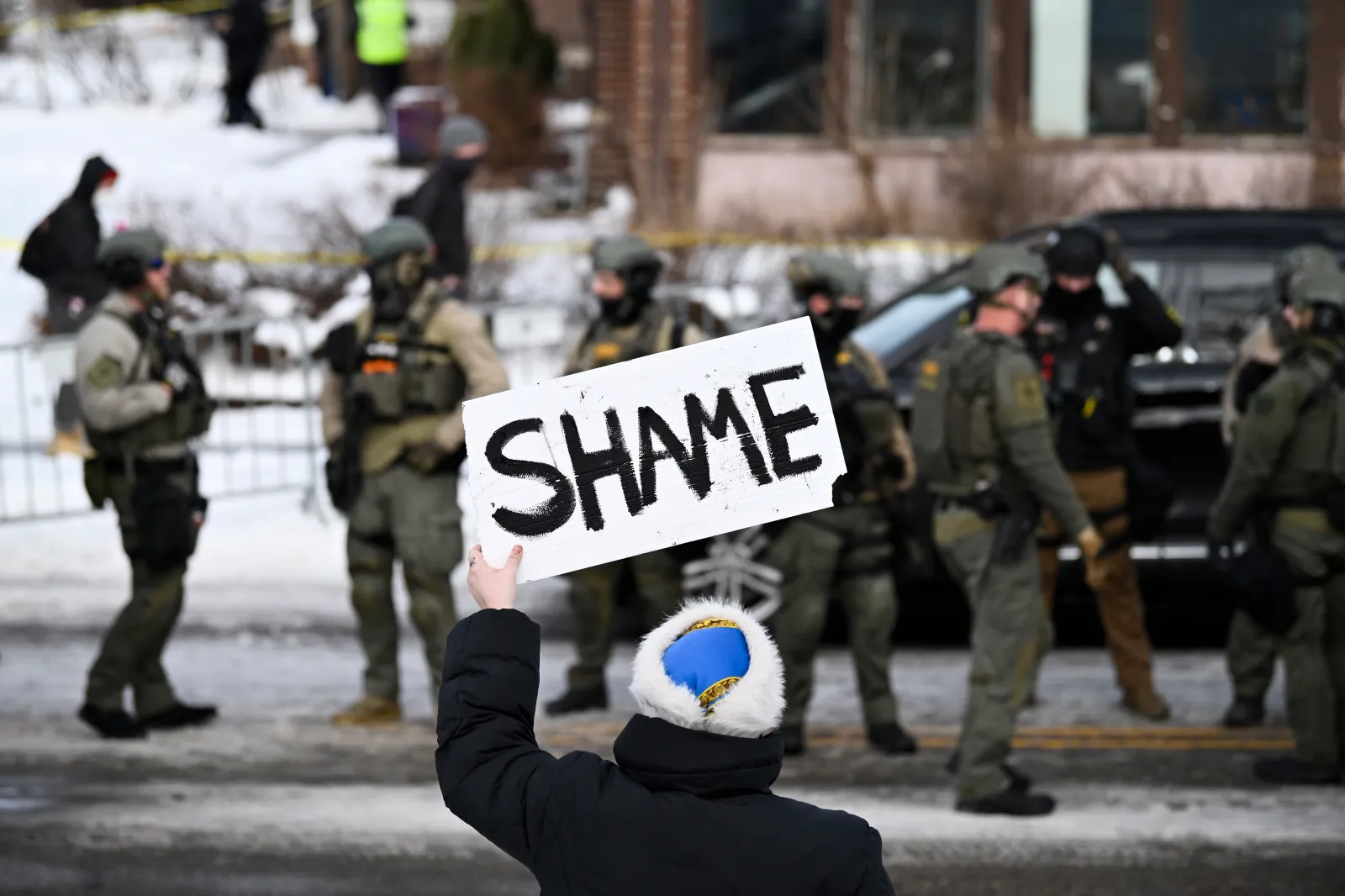
The shooting has sparked protests across the nation, with activists calling for ICE to leave Minnesota following the incident.
“First and foremost, this is a tragic event, and I want to extend my sincere condolences to the family and loved ones of Renee Nicole Good,” Kyle Milowski, a former ICE agent, told Newsweek. “It is inappropriate to judge an officer’s actions during a dynamic and rapidly changing situation in hindsight through the lens of social media videos.”
“Officers are trained to position themselves in front of a vehicle to create a ‘contact and cover’ environment, referred to as a tactical ‘L-shape,’ used to maintain control of a scene,” he said.
“I have full confidence in the ICE Director, who is very competent and will ensure the agency conducts a thorough, transparent investigation into how these actions align with DHS guidelines,” he added.
Prioritize de-escalation and non-force
Department of Homeland Security (DHS) policy requires that law enforcement officers, including ICE agents, may use force only when it is “reasonable in light of the totality of the circumstances” and necessary. Officers are instructed to prioritize de-escalation and non-force alternatives whenever feasible.
Officers are expected to prioritize de-escalation, using verbal warnings and non-force tactics whenever possible. The guidance stresses minimizing risks to both officers and the public and avoiding situations where deadly force becomes the only option.
“Law enforcement Officers (LEOs) may use force only when no reasonably effective, safe, and feasible alternative appears to exist and may use only the level of force that is objectively reasonable in light of the facts and circumstances confronting the LEO at the time force is applied,” the policy reads.
The policy further states that firearms may not be discharged at the operator of a moving vehicle unless deadly force is justified under the circumstances.
“DHS LEOs are prohibited from discharging firearms at the operator of a moving vehicle, vessel, aircraft, or other conveyance unless the use of deadly force against the operator is justified under the standards articulated elsewhere in this policy,” the policy reads.
Increasing Scrutiny
The conduct of ICE agents has come under increased scrutiny in recent months, with multiple shootings and use-of-force incidents raising questions about the agency’s protocols. Critics have called for greater oversight, particularly in residential neighborhoods where federal enforcement actions can put civilians at risk.
Multiple use-of-force incidents nationwide have prompted renewed calls from civil rights groups, immigration advocates, and some lawmakers for greater transparency and oversight of federal immigration enforcement.
Supporters of ICE argue that agents frequently operate in unpredictable and dangerous conditions and must make split-second decisions to protect themselves and others. Critics counter that aggressive enforcement tactics heighten the risk of deadly encounters and disproportionately affect immigrant communities.