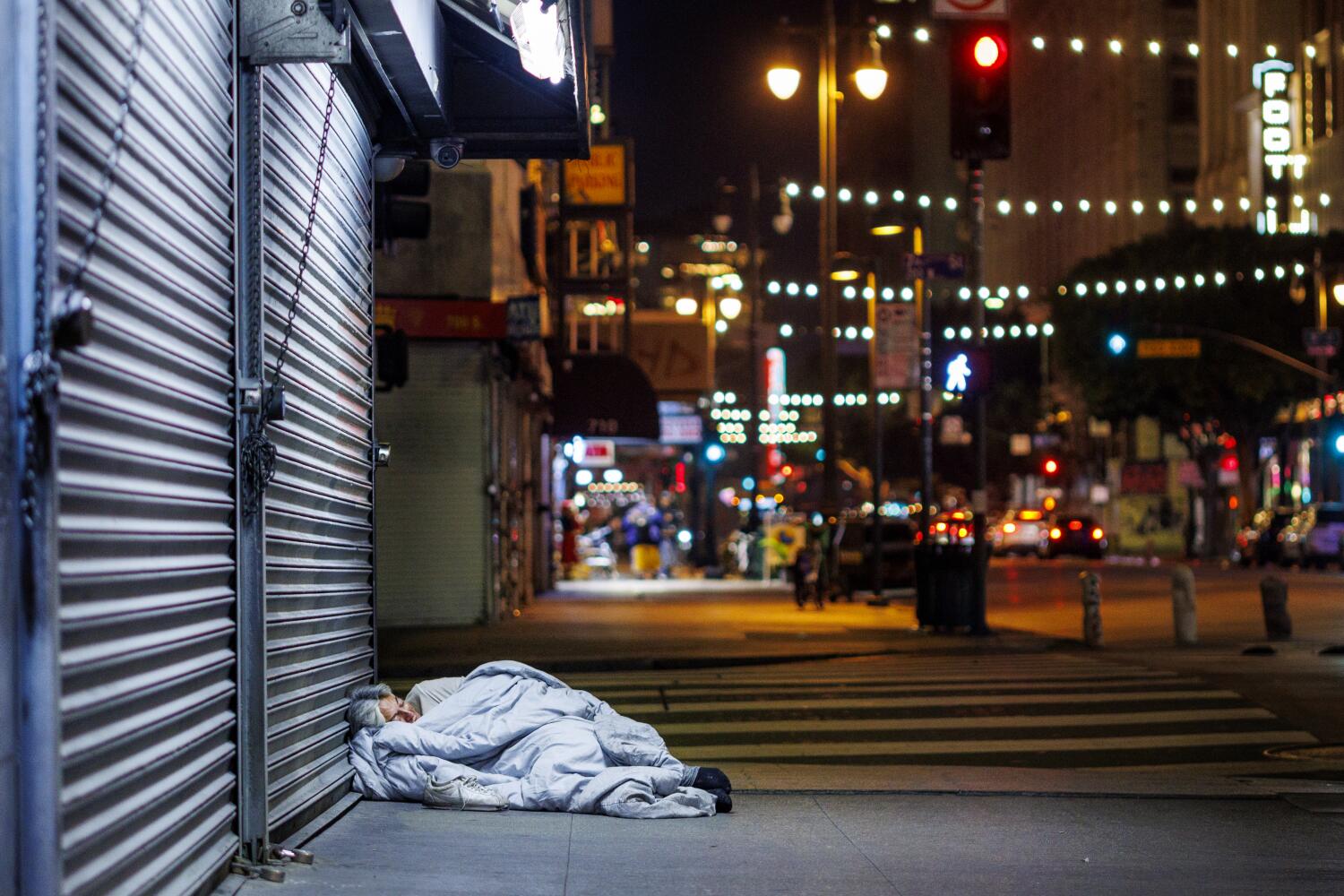
For the first time in the decade that homeless mortality has been tracked in Los Angeles County, fewer people have died on the streets and in shelters, the Department of Public Health reported Tuesday.
A sharp decrease in overdose deaths drove a decline of 10% in the rate of homeless deaths from all causes in 2024, the most recent year of data analyzed by the county.
But drug overdose remained the leading cause of death, followed by heart disease and vehicle accidents.
The annual analysis found 2,208 deaths in 2024. That was 300 fewer than in the previous year but still more than six deaths a day and more than four times the mortality rate for the county as a whole.
The decrease solidified an improving trend over the prior two years, which saw only slight increases.
Before that, the rate had increased 56% over two years.
Health officials attributed the improvement to overdose prevention and mental health and substance use treatment, but warned that the trend could be disrupted by expected cuts to those services.
“At a time of major reductions in federal and state funding for homeless services and supports, we are at risk of losing precious ground and seeing an increase in the number of vulnerable people losing their lives,” public health director Barbara Ferrer said in a statement released with the report.
Overdoses accounted for 40% of all homeless deaths, down from 45% the prior year. It was followed by heart disease, 14%; traffic accidents 11%; homicide, 5%; and suicide, 4%. The remaining 27% was a combination of other natural causes, accidents and unknown causes, said Will Nicholas, director of the health department’s Center for Health Impact Evaluation.
Though a small percentage of all homeless deaths, suicide was 13 times more prevalent than among the general population.
A 21% decline in the rate of death attributed to drugs and alcohol reflected a similar, albeit steeper, plunge throughout the total county populace. Consequently, while overdose declined slightly as the leading cause of death among homeless people, the dramatic gap with the general population only widened. Overdose death was 46 times more prevalent among homeless people, up from 40 the year before.
Gary Tsai, director of the county’s Substance Abuse Prevention and Control Bureau, said most of the reduction was from fewer fentanyl-related deaths.
He credited county investments in risk reduction services, street outreach and recovery-oriented housing.
“I think our efforts at ensuring widespread access to Naloxone is also helpful and one of the main reasons for that reduction,” Tsai said, referring to the overdose reversal drug.
Getting people off the street into temporary or permanent housing was a factor in the 12% decrease in the mortality rate for heart disease, Tsai said.
“Housing is the biggest determinant of health outcomes including heart disease,” he said. “If someone is housed, one of their needs is already addressed. They can spend their time on other things. Ideally it would be on their health. If they are unhoused, there is a whole cascade of things they have to address.”
“We have medically oriented outreach workers trying to reach people in all settings, whether temporary, permanent housing or street settings,” Nicholas said. “Street is harder. You’re more likely to get attention if you’re in a permanent or semipermanent setting.”
Homeless people are also disproportionately vulnerable to traffic accidents. Nicholas said his team learned in working with the county transportation department that about 30% of all traffic deaths were of unhoused people.
The 315 traffic deaths recorded in 2024 were 25% more than the prior year and accounted for about 30% of all traffic deaths across the county, Nicholas said. The challenge in finding solutions is that the locations are so spread out. Rather than trying to address specific locations, “we’re going to look at similarities in the context of those disparate locations that might amenable to some more global strategies,” Nicholas said.
The health department compiles the annual report from records provided by the Los Angeles County medical examiner augmented by state death certificates. Following guidelines of the U.S. Department of Housing and Urban Development, it includes people living in shelters and unsheltered settings but not formerly homeless people living in supportive housing.
In addition to the raw numbers, the county calculated deaths per 100,000 using an average of the 2024 and 2025 estimates from the annual point-in-time count conducted by the Los Angeles Homeless Services Authority.
The report outlined recommendations for maintaining the momentum. They ranged from the broad — ensuring access to affordable housing and medical insurance — to the focused — providing suicide prevention training to shelter staff.
But the sustainability of those efforts is in jeopardy.
After a decade of dramatic growth, homelessness programs now face a period of diminishing resources. Last month, the Los Angeles County Board of Supervisors responded to the rising costs by cutting $200 million from homelessness programs largely funded by the Measure A half-cent sales tax.
Hoping to lessen the impact on interim and permanent housing as much as possible, the supervisors slashed $27 million from outreach and navigation programs and cut by two-thirds the county program that moves people out of street encampments into shelters.
Those local cuts are compounded by a 50% cut in Gov. Gavin Newsom’s proposed budget for the coming fiscal year’s Homeless Housing and Assistance Program, much of which funds operational costs for homeless shelter and housing providers and short-term rental subsidies.
The Trump administration wants to end funding for homeless-specific programs that seek to house people before addressing issues such as drug addiction or mental health, a policy the county considers a cornerstone of its approach.