A dog owner was left stunned after sharing their husky mix’s DNA results on social media, revealing an unusually high “wolfiness” score that quickly caught other users’ attention.
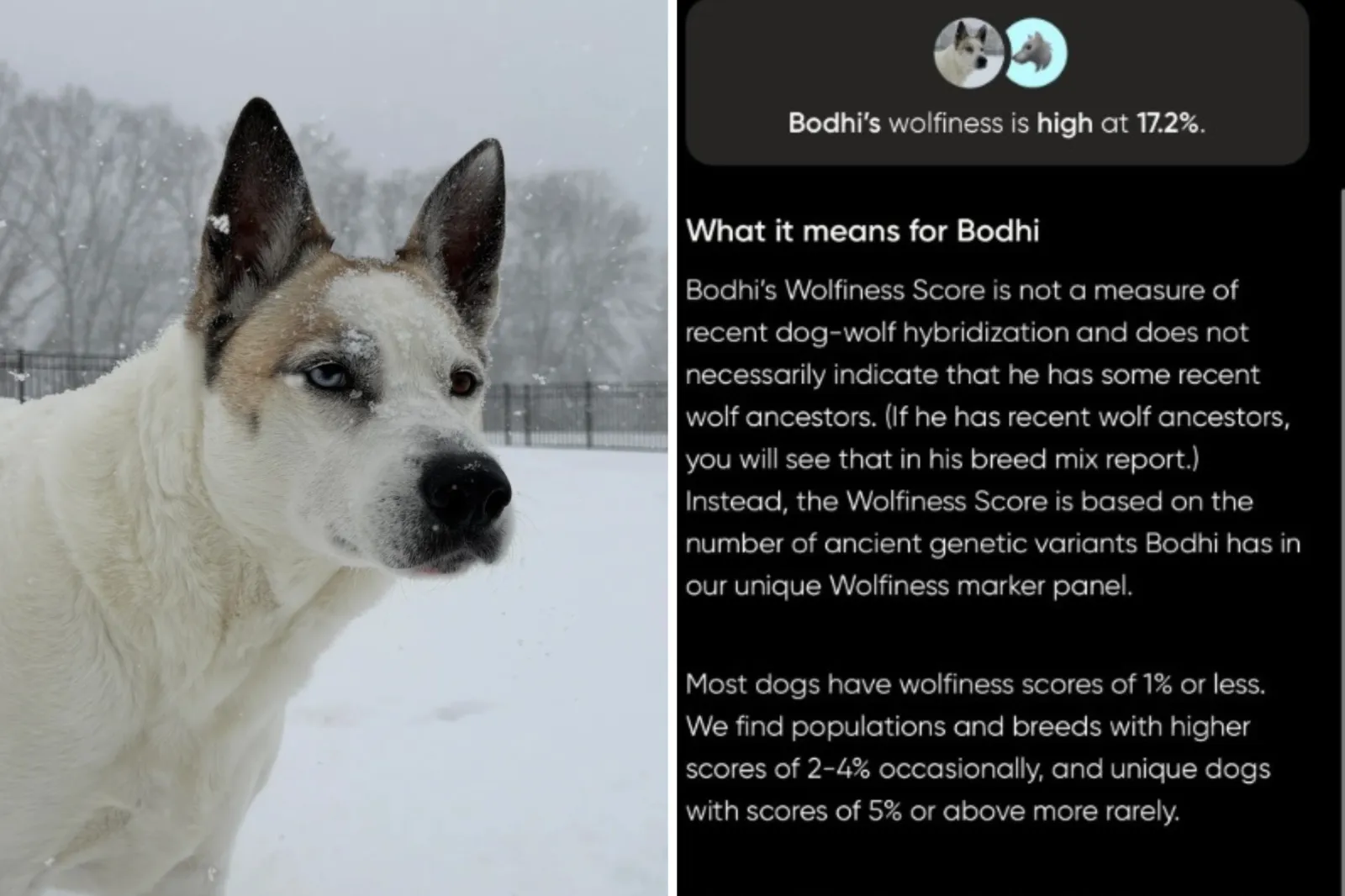
The March 7 Reddit post shared by user West-Map9298 includes a photo of the white canine, who has a partly gray head, alongside screenshots from the DNA test results titled: “Embark wolfiness [percentage] of 17 [percent]?????”
The owner explained that, while their dog’s husky relatives showed relatively low scores, Bodhi’s results stood out.
“His husky relatives only had 1 to 2 percent wolfiness,” the owner wrote. Bodhi, who is 50 percent Siberian husky, supermutt (13.5 percent), American pit bull terrier (13 percent), and the rest, chow chow, boxer and German shepherd, has more than 17 percent wolfiness.
What a ‘Wolfiness’ Score Actually Means
The featured screenshot from the dog’s DNA results states, “Bodhi’s Wolfiness score is not a measure of recent dog-wolf hybridization.” Embark DNA explains that a wolfiness score does not measure recent wolf ancestry. Instead, it reflects ancient genetic traits linked to early dog domestication.
According to the company, these traits are found in specific regions of the genome that differ sharply between dogs and wolves. Scientists calculate the score using markers in those regions. Some breeds, particularly northern canines such as Siberian huskies and ancient breeds such as Shiba Inus, tend to score higher than average.
A screenshot from Bodhi’s results notes that “most dogs have wolfiness scores of 1 percent or less, and unique dogs with scores of 5 percent or above more rarely.”
Reddit Reacts
So far, the post has received just under 400 upvotes and more than 80 comments, with many users sharing their own dogs’ DNA results in response.
“I’ve never seen that, how interesting! Sounds like it’s a lot like humans having a bit of Neanderthal DNA,” one user wrote, referring to genetic material inherited from Neanderthals, an extinct group of early humans who interbred with modern humans tens of thousands of years ago.
According to MedlinePlus, the percentage of Neanderthal DNA in modern humans is zero or close to zero in people from African populations and about 1 to 2 percent in people of European or Asian background.
The percentage of Denisovan DNA is highest in the Melanesian population, at 4 to 6 percent, lower in other Southeast Asian and Pacific Islander populations, and very low or undetectable elsewhere in the world.
Another Reddit user commented: “My husky mix is around 13 [percent] wolfiness. It was surprising at first, but then she does murder a lot of pigeons.”
What Research Says About Wolf Ancestry in Dogs
Research suggests that most modern canines, from large Shiloh shepherds to tiny Chihuahuas, carry small but measurable traces of wolf ancestry that entered their genomes long after dogs were first domesticated.
A study published in Proceedings of the National Academy of Sciences by researchers from the Museum and the Smithsonian’s National Museum of Natural History analyzed more than 2,700 genomes from wolves, breed dogs and village canines.
The researchers found that nearly two-thirds of breed dogs have some level of wolf ancestry from crossbreeding that occurred roughly 1,000 generations ago.
Higher levels of wolf ancestry were found in larger canines and in those bred for work such as sledding and hunting, while terriers and gundogs had the least. Even small breeds such as Chihuahuas showed detectable wolf DNA.
The findings suggest that modern dog genomes can retain limited wolf ancestry while remaining fully domesticated and that these lingering genes may have helped shape traits such as size, sensory abilities and behavior.
Newsweek reached out to u/West-Map9298 for comment. We could not verify the details of the case.