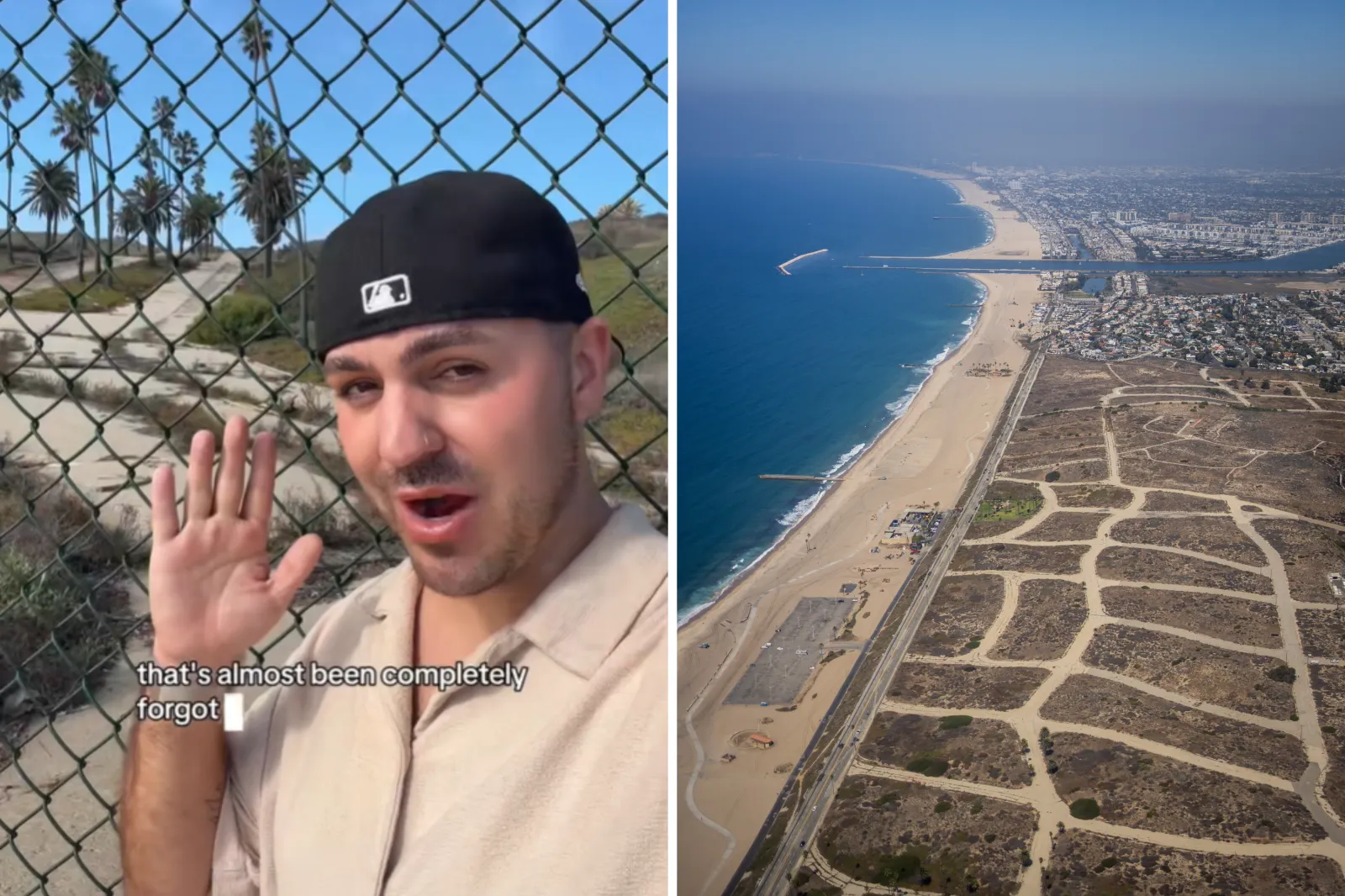
A storyteller has gone viral for showcasing a forgotten piece of modern American history: the ghost town of Surfridge, Los Angeles.
Tyler Wells, 29, is a content creator living in Los Angeles, with his videos focusing on everything from lifestyle and pop culture to true crime and “lost history.”
One video with the on-screen caption “LAX’s hidden ghost town” was recently shared to his TikTok account @ttylerwells, and explored the lost history of Los Angeles—to be specific, a former beachside community, home to dozens of people, which has ceased to exist.
“If I pass something or notice something that looks like it used to be something else, I have a natural curiosity that I have to act on,” Wells told Newsweek. “I just moved to Playa del Rey which is down the street, and one day, I passed the gated off, empty streets that planes take off over and had a feeling it used to be more than just airport grounds.
“On maps, I noticed there are still street names assigned. So all it took was a Google search of the area for me to discover there once was an entire neighborhood there.”
In the video, posted on November 19, he introduced viewers to what used to be “an entire luxury beachside neighborhood right next to LAX, that’s almost been completely forgotten about.”
Known as Surfridge and Palisades Del Rey, the neighborhood was built on sand dunes overlooking the ocean, giving families a relaxed, quiet life by the sea.
But there was a problem that quickly became apparent: what we now know as the enormous LAX airport began in the 1920s as a barley field rented by aviation pioneers, who used a dirt runway to fly small propeller planes, according to the Flight Path Museum LA.
By 1928, an official small airport known as Mines Field was in operation and in 1946, for major airlines were operating from it. The first commercial jet flew from LAX in 1959, but by the 1960s, enormous, loud commercial jets were regularly taking off directly over the neighborhood.
The noise became intolerable for families, with the sounds of the jets taking over completely.
Eventually, LA officials were forced to accept Surfridge had become “uninhabitable”: they bought people out of their homes as the airport expanded, with other homes being demolished or moved to a different part of town.
Fifty years ago, in 1975, every home in Surfridge was gone—however, there are some clues to show the proof of the ghost town. The old street layouts are still visible from above, driveways, the remains of walls, and steps to the complexes are still visible from the road, and the Vista Del Mar Park, if you know what you’re looking for.
And, for a look at what the neighborhood used to look like, Wells revealed it shows up in 1967 Elvis Presley movie Clambake, as he drives by the ocean with Surfridge homes visible on the side.
The entirety of the old neighborhood is fenced off, and is now preserved land for an endangered butterfly species, the El Segundo blue butterfly, which were near extinction when the last of Surfridge’s homes were removed.
More than 1.5 million people have seen Wells’ video on the history of Surfridge, which Wells believes is because “it is not as widely talked about, even if you’re an LA local…I think people do have a curiosity when it comes to entire ecosystems that once existed, and you would never guess today that such a place existed.”
Wells told Newsweek that while he is “not the first person to unearth the once thriving community of Surfridge,” he wanted to use his storytelling skills, “not only tell the story of Surfridge, but invite other people to share their stories of Surfridge in the comments.”
And it had the desired effect—TikTok users were hugely interested, many learning about it for the first time, as one commenter wrote: “I’ve always wodered about those nice street lamps.”
“Always wondered what the purpose of that land was! How interesting,” another said, as another shared: “Wow I grew up in El Segundo and this is my first time learning bout this! I always wondered why that land was just empty.”
And one shared a photo they had taken from a flight, showcasing the old street layouts, and said: “Wow I saw this on a flight I took a few months ago and was wondering what it was!”
Others wondered why the area would have been left vacant, or why LAX was built on “prime beachfront area”—but as one person explained: “When [LAX] was built this was not prime real estate but rather farm land far outside of city limits.”
Some shared their own stories from the former neighborhood, one revealing: “My aunt bought two homes from that area and had them towed to her empty lot in Los Angeles,” and another recalled: “I grew up in El Segundo that’s literally adjacent to this! My dad had friends that lived here, and he remembers when they demolished all the houses.”
“There were so many people who felt comfortable enough sharing their connections in the comments of my video—which is exactly what I encourage with these stories,” Wells said. “Seeing all those perspectives come together really brought the history to life.”
But Surfridge’s history isn’t unique, Wells said, even just in Los Angeles. “There are several places that were once full communities and now exist in some altered, erased, or hidden form,” he said.
“A couple that are on my personal list to explore are Sunken City in San Pedro and the history of what happened with Chavez Ravine and the construction of Dodger Stadium, which many people in my comments compared Surfridge to.
“I have a whole bucket list of sites like this that I’m planning to dive into, and I’m continuing to explore and tell these stories on my platforms as I go.”