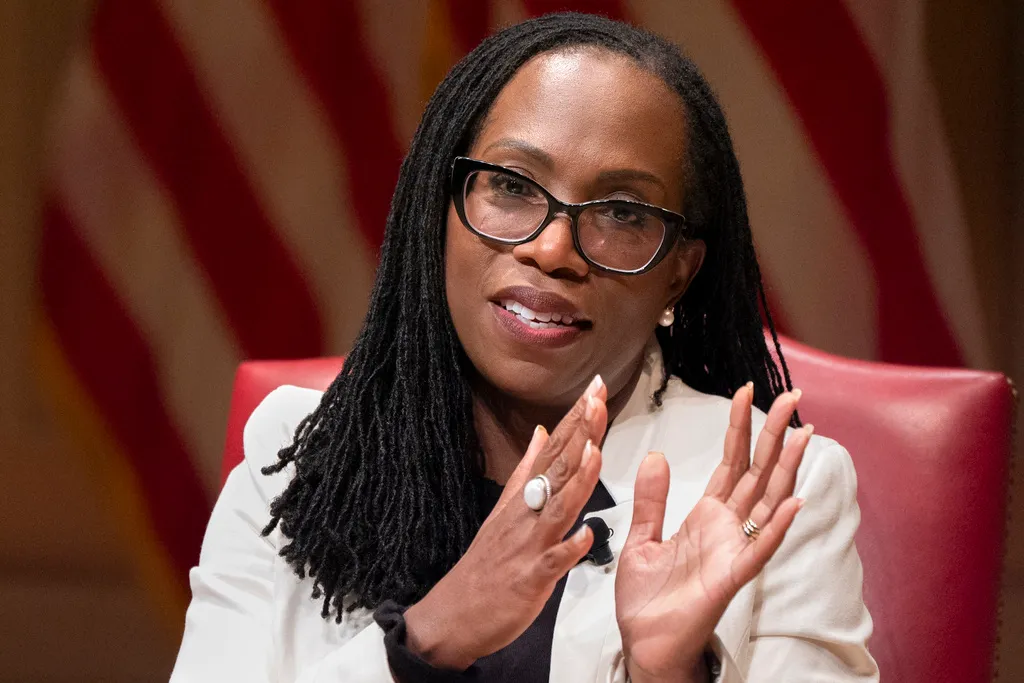
Supreme Court Justice Ketanji Brown Jackson said that a legal theory supported by the Republican National Committee in a case related to mail-in ballots “imperils a lot of different things.”
Jackson noted during oral arguments in the case on Monday that election practices have changed over time, which she said undermines the idea that there was ever a consistent practice across all states.
“It’s been changing throughout the course in a way that undermines the notion that there was one consistent practice first of all, or that Congress’s law, the meaning of Election Day in the federal statutes, somehow was tied to what the state’s practices were about that,” Jackson said. “I mean, I think this is your original point that there were lots of different practices and so to the extent we’re saying, ‘oh, you could only look at Election Day in the federal statute to mean exactly what the states were doing back at that time.’ This imperils a lot of different things, not just post-Election Day ballot deadlines.”
Why It Matters
The Supreme Court’s conservative justices largely seemed skeptical about a Mississippi law allowing late-arriving mail-in ballots to be counted in federal elections. Liberal justices indicated they would uphold state laws with post-Election Day deadlines.
The court currently has a 6-3 conservative majority.
If the court strikes down the Mississippi law, the decision could affect voters in 13 other states and the District of Columbia, all of which have grace periods for mail-in ballots. States that have later deadlines for ballots from military and overseas voters also could be impacted.
What To Know
The court heard arguments in Watson v. Republican National Committee on Monday. The case centers on whether federal law sets a single Election Day that requires ballots to be both cast by voters and received by state officials.
Justice Samuel Alito asked about the appearance of fraud in situations where “a big stash of ballots” that arrive late “radically flipped” an election.
States with post-Election Day deadlines for mail-in ballots include Alaska, California, Texas, New York and Illinois.
Lawyers for the Republican and Libertarian parties, as well as President Donald Trump’s administration, are asking the justices to affirm an appeals court ruling striking down Mississippi’s law. The state law allows ballots to be counted if they arrive within five business days of the election and are postmarked by Election Day.
Both conservative and liberal justices expressed concerns about other legal issues that could arise from the ruling.
Justice Neil Gorsuch said that if the court upholds post-Election Day deadlines, ballots could be received two months after the election.
Justice Elena Kagan said the argument used to challenge post-Election Day deadlines could also be used to strike down early voting and absentee ballots. Conservative Justices John Roberts and Amy Coney Barrett also expressed concerns about the limits of early voting.
What People Are Saying
Justice Sonia Sotomayor, during oral arguments on Monday: “The people who should decide this issue are not the courts, but Congress, the states and Congress.”
Justice Samuel Alito, during oral arguments on Monday: “Confidence in election outcomes can be seriously undermined if the apparent outcome of the election … on the day after the polls close is radically flipped by the acceptance later of a big stash of ballots that flip the election.”
What Happens Next
The court is expected to issue a ruling by late June.
Do you have a story that Newsweek should be covering? Do you have any questions about this story? Contact LiveNews@newsweek.com.
In a polarized era, the center is dismissed as bland. At Newsweek, ours is different: The Courageous Center—it’s not “both sides,” it’s sharp, challenging and alive with ideas. We follow facts, not factions. If that sounds like the kind of journalism you want to see thrive, we need you.
When you become a Newsweek Member, you support a mission to keep the center strong and vibrant. Members enjoy: Ad-free browsing, exclusive content and editor conversations. Help keep the center courageous. Join today.