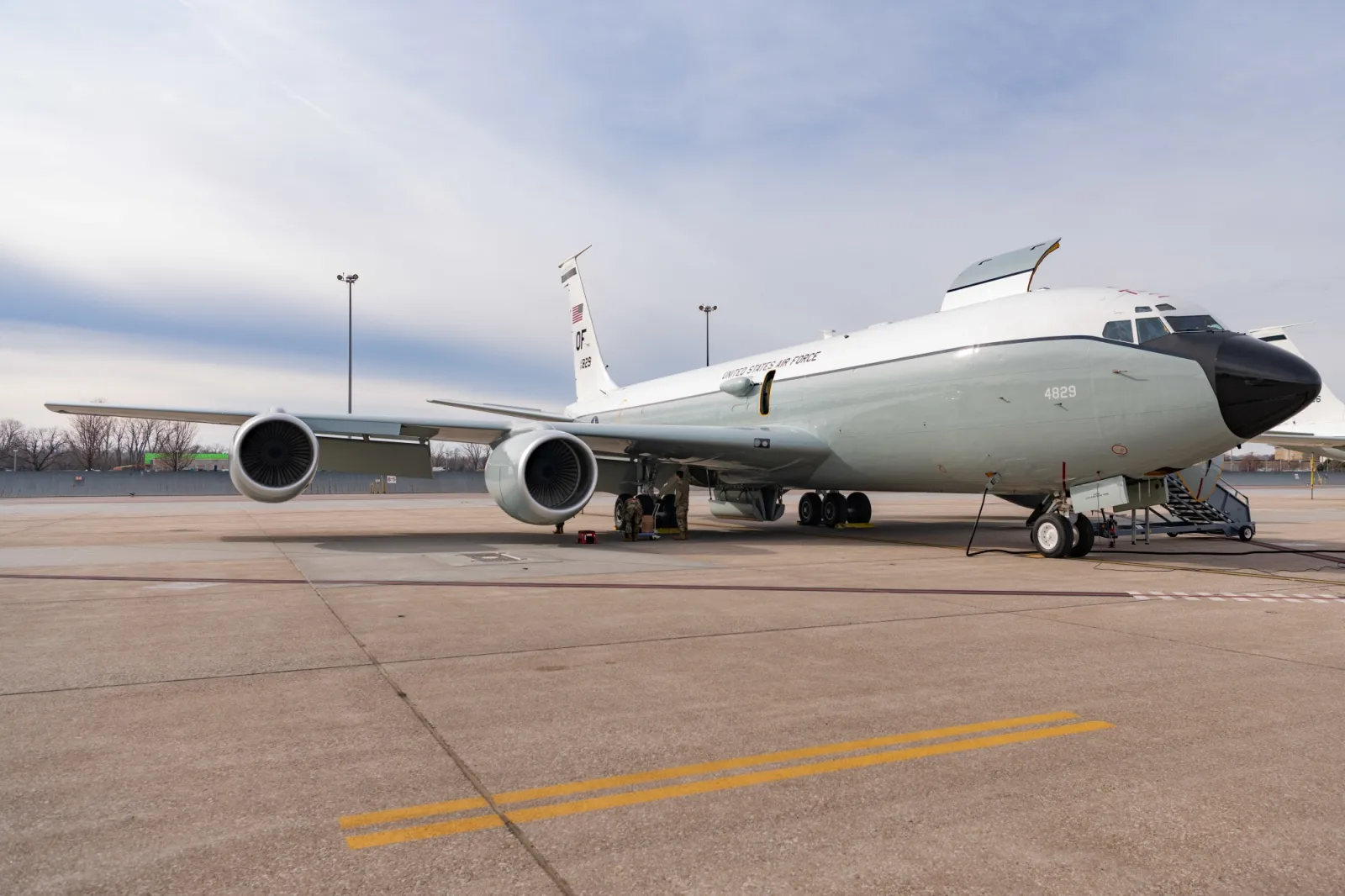
A United States specialized military aircraft designed to detect nuclear activities was tracked flying near Russia’s Pacific coast on Thursday during its deployment in Japan.
The WC-135R Constant Phoenix atmospheric collection aircraft, commonly known as the “Nuke Sniffer,” is capable of collecting particulate and gaseous effluents and debris in support of the 1963 Limited Nuclear Test Ban Treaty, the U.S. Air Force said.
Newsweek has contacted the U.S. Pacific Air Forces for comment by email. Russia’s defense and foreign ministries did not immediately respond to a request for comment.
Why It Matters
The deployment of the “Nuke Sniffer” from its home base in Nebraska follows Russian President Vladimir Putin’s order last month to assess preparations for full-scale nuclear tests, in response to U.S. President Donald Trump’s directive to restart nuclear testing.
Both the U.S. and Russia are signatories of the Limited Test Ban Treaty, which bans nuclear testing in the atmosphere, in space, or underwater. They later signed the 1996 Comprehensive Test Ban Treaty, which prohibits all types of nuclear explosions.
What To Know
Flight tracking data from online service Flightradar24 shows that a WC-135R aircraft with registration 64-14829 departed Kadena Air Base on Japan’s Okinawa Island on Thursday local time, flying northeast toward Japan’s four main islands near Russia.
The U.S. aircraft was untrackable after flying over Hokkaido, the northernmost Japan’s main island, until it “reappeared” on tracking about eight hours later, flying from the northeast over the Sea of Okhotsk toward Hokkaido, according to a Flightradar24 map.
@MeNMyRC1, an open-source intelligence analyst on the social media platform X who tracks American spy planes, said this was the WC-135R aircraft’s second flight since its deployment to Japan in late November, with the first occurring on Monday.
“These [Constant Phoenix] aircraft gather samples periodically to compare past results with current conditions. I expect that this flight is for that purpose,” the analyst noted, adding that the Thursday flight was supported by an aerial tanker to extend its duration.
A total of three WC-135R aircraft are in service, with 64-14829 the last to join the fleet in December 2023, replacing the legacy WC-135W fleet of two aircraft. The fleet is tasked with what the U.S. Air Force calls “mobile nuclear airborne sampling” missions.
Such missions are routinely conducted over the Far East, the Indian Ocean, the Bay of Bengal, the Mediterranean Sea, polar regions and off the coasts of South America and Africa to support the Limited Test Ban Treaty, according to a U.S. Air Force fact sheet.
In August, a WC-135R aircraft, deployed in the United Kingdom, was tracked flying over the Barents Sea, west of Russia’s archipelago of Novaya Zemlya, where Russia operates a launch site for testing the Burevestnik nuclear-powered cruise missile.
The test was not conducted until October 21, when the Burevestnik missile flew about 8,700 miles in a 15-hour flight, according to the Russian military. Putin hailed the nuclear-armed missile as a “unique product, unlike anything else in the world.”
What People Are Saying
@MeNMyRC1, an open-source intelligence analyst on the social media platform X, said: “The Constant Phoenix is designed to gather airborne samples from nuclear tests and/or airborne particles from accidents involving nuclear material, think Fukushima and Chernobyl.”
The U.S. Air Force said in its fact sheet: “The Constant Phoenix’s modifications are primarily related to its on-board atmospheric collection suite, which allows the mission crew to detect radioactive ‘clouds’ in real time. The aircraft is equipped with external flow-through devices to collect particulates on filter paper and a compressor system for whole air samples collected in holding spheres.”
What Happens Next
It remains to be seen whether the Japan-based WC-135R aircraft will conduct further flight missions near Russia’s Far East or near nuclear-armed North Korea and China.