The stairs of my Edwardian home are steep and the tiles at the bottom, hard and unforgiving. My 10-month-old squirms in my arms as I stand at the top of them and I see myself drop him, his tender head smashing as he strikes the ground.
Sleep-deprived and in chronic pain, I am riveted to that top step, but my 3-year-old’s downstairs, calling. With one hand on the banister and the second clutching my baby, I sit and twist so that he’s safe against the stairwell before slowly inching down.
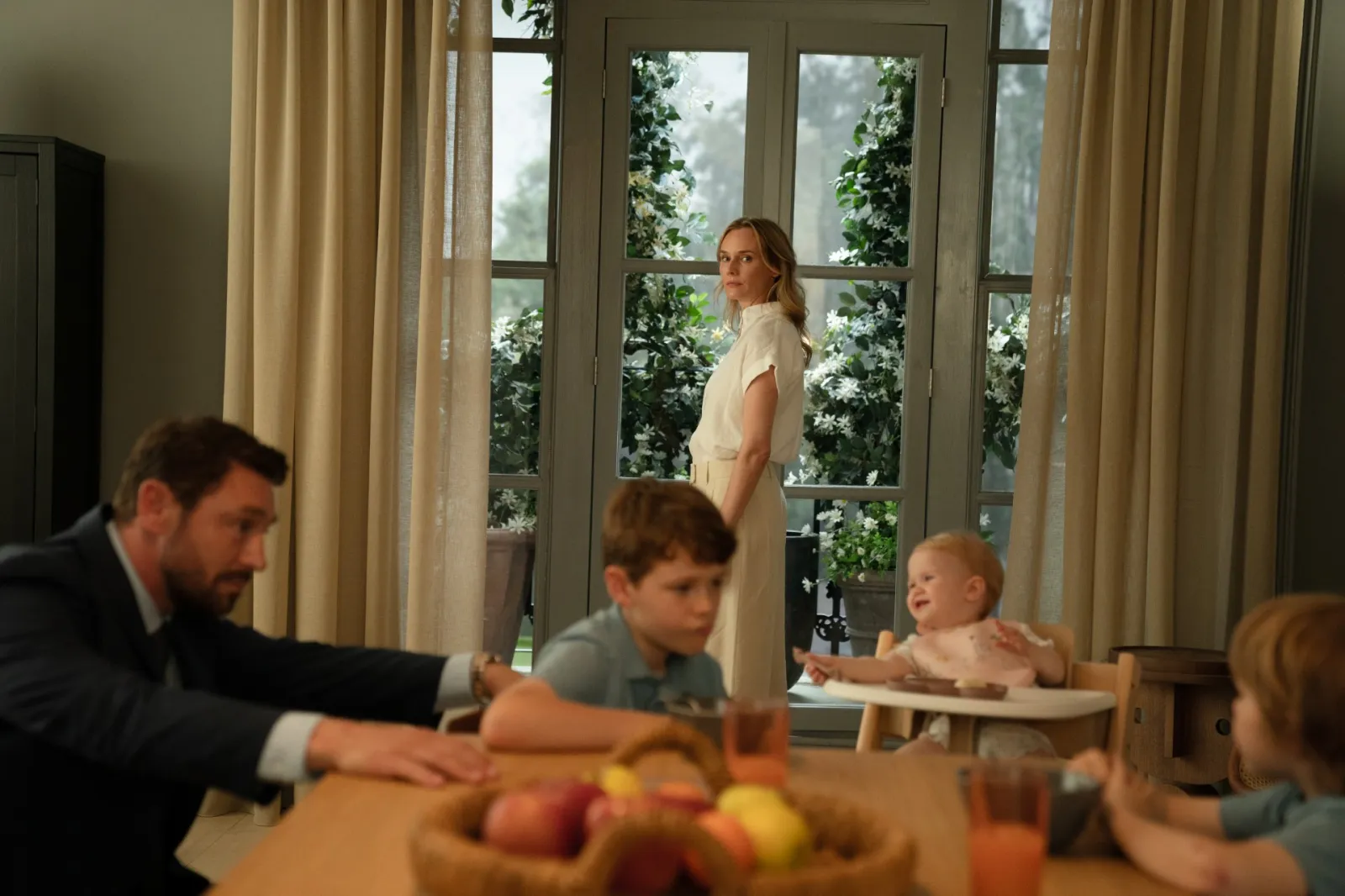
Fast forward 16 years and Diane Kruger stands at the top of a flight of stairs she sees tipping and swaying. She grips a newborn, sits on her bottom and shuffles down. The scene opens episode five of Little Disasters, in which Kruger plays Jess, an affluent mother-of-three plagued by intrusive thoughts and a dark secret. When I watch the edits later in my study, I start to cry.
Little Disasters, which drops on Paramount+ this week, was inspired by my experience after having my second baby. A perfect storm of circumstances—being unable to walk during a difficult pregnancy, quitting the job that validated me, moving house at 30 weeks pregnant which left me socially isolated—triggered my rapid unravelling and a form of obsessive-compulsive disorder called perinatal OCD.
My postnatal experience, during which I effectively gaslit myself, was extreme and so ripe for dramatization. But motherhood in general is a fertile area for psychological drama, and in particular, suspense as “mom-noir” crime writers and now TV execs are realizing. After all, which other common experience begins with blood, pain and terror and is so freighted with intense emotions? And which other relationship can ricochet violently between panic and joy in its first moments and hold the potential for elation and fear?
While Liane Moriarty’s Big Little Lies, with its depiction of uber-competitive parenting, led the way and Celeste Ng’s Little Fires Everywhere followed, I’d argue that recent TV adaptations—from Taffy Brodesser-Akner’s Fleishman is in Trouble to Andrea Mara’s All Her Fault to my own Little Disasters—are increasingly unflinching in their portrayal of motherhood.
In part, that’s through a willingness to depict the extremes of emotion it provokes. The opening of All Her Fault thrusts us straight into this when a tremulous, tear-welling Marissa discovers 5-year-old Milo isn’t at a supposed playdate and tears through her home searching for him. Little Disasters’ Jess’ terror peaks when 8-year-old Frankie goes missing at night, at a vast holiday house with a pool, and she notes that he can’t swim. She’s so fraught, her running becomes uncoordinated, limbs flailing, voice escalating, face contorted. Any parent who’s lost a child will recognize that visceral panic and heart-stopping moment: They’re lost and you should have been vigilant. It’s all your fault, so to speak.
And then there’s the recognition of the maternal load, not just of the relentless, bone-wearying practicalities but the emotional heft of motherhood.
When we pitched Little Disasters at the start of 2023, the talk was all of Fleishman, in which Claire Danes’ Rachel roars in distress at her birth trauma, societal pressures and sense being unseen by her ex-husband. No surprise it went viral. In Little Disasters, a traumatic birth is also crucial: It’s the trigger for Jess’ perinatal OCD. But it’s the maternal load that weighs more heavily. It’s there for stay-at-home-mother Jess in the painstaking preparations she makes for Frankie’s party and the fact her husband, Ed, is clueless about this. And it’s made explicit by Liz, the pediatric registrar whose decision to contact social services about a safeguarding concern, drives the show and splits the friendship group.
“I do 60-hour weeks. I am constantly tired. I’ve never had enough sleep or spent enough time with my kids or done something for myself like go to the gym and my house is always a mess but there’s nothing I can do about that,” she rails at Jess. “Nothing. Because my family are relying on my money to pay the mortgage.”
This moment, which doesn’t exist in my book, feels like a battle cry of a generation told they could have it all before realizing they’ve been sold a lie. That they’ll never be enough, and each little disaster is on them. It’s a speech that could’ve been made by Jenny (All Her Fault), or Rachel (Fleishman). Because mothers nowadays experience a double whammy. Economic pressures push moms to work harder and longer (74 percent of U.S. mothers work, according to the latest Department of Labor statistics, with most—79 percent—doing so full-time ), yet even perfectionist SAHMs like Jess buy into the same lie that we must provide a perfect childhood. Social media, endless school WhatsApp groups and dwindling grandparental support intensify this pressure, yet as Liz says at the start of Little Disasters, “Perfection is an illusion—something curated, filtered and tweaked.”
It seems we’ve reached a tipping point. If #MeToo exposed the extent of sexual violence against women, perhaps the pandemic, demanding that we focus even more on our children, has forced us to address the true burden on mothers?
In a world where Insta mommy influencers hold up an unattainable version of motherhood, shows like Little Disasters, with their honest, unfiltered depiction, might offer a timely corrective.
Sarah Vaughan is an international bestselling author who studied English at Oxford and spent 15 years as a journalist before turning to fiction. Anatomy of a Scandal, her first psychological thriller, was a global No. 1 on Netflix, seen for 200 million hours in the first month alone. Little Disasters was a No. 1 Paramount+ show in the U.K. and is now streaming worldwide.
The views expressed in this article are the writer’s own.