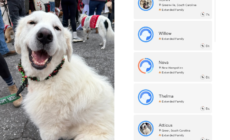
When a South Carolina dog rescue began DNA testing its foster dogs, the goal was simple: learn more about their backgrounds and health, but what the results revealed was a troubling pattern that they said made their “stomach drop.”
Dog Squad, a small nonprofit rescue based in the Upstate of South Carolina, says multiple Great Pyrenees that have passed through its care—rescued at different times and from different places—are genetically related.
“That was the moment we realized this was bigger than coincidence,” Jenna Sahli, executive director of Dog Squad, who runs the rescue alongside CEO Randy Owens, told Newsweek.
Great Pyrenees dogs are becoming increasingly common in shelters across parts of South Carolina, according to Dog Squad, which says it has taken in 15 of the breed in the past year alone.
Dog Squad routinely DNA tests its foster dogs using Wisdom Panel, both to understand breed makeup and to screen for hereditary diseases. The test also identifies dogs that share genetic relatives, similar to how human ancestry tests work.
It was that feature that first raised alarms earlier this year. On January 1, Dog Squad received DNA results for Atticus, a Great Pyrenees rescued from a cruelty situation. His injuries were so severe that a veterinarian ultimately amputated his front leg.
The results revealed that Atticus was the half‑brother of Bernie, a Great Pyrenees owned by Sahli and Owens. Bernie had also lost the same leg roughly a year and a half earlier after being found caught in what animal control described as a bear trap, with multiple gunshot wounds.
“Two dogs, two completely different years, two different parts of town—and somehow they ended up in the same rescue with the same amputation,” Sahli said. “At the time, it honestly felt like fate.”
That feeling changed when DNA results came back for Cracker, another foster dog.
“When Cracker’s DNA results came back this week, we learned he is genetically related to Atticus as well,” Sahli said. “That was the moment we realized this was bigger than coincidence.”
The rescue also discovered genetic connections between other former fosters, including dogs named Andi, Yeti and Ronin.
“These dogs did not come from the same homes. They were not surrendered by the same people. They did not land in rescue at the same time,” Sahli said. “And yet—here we are again.”
An Unusual Pattern
Dog Squad says it now plans to DNA test two additional Great Pyrenees currently in foster care and would not be surprised if they are genetically connected as well.
“We are watching the same gene pool cycle through our rescue over and over again,” Sahli said.
In a series of social media posts, the rescue described what it says is the “back end” of irresponsible placement, including dogs abandoned, injured, mislabeled as aggressive or surrendered once their natural instincts emerge.
“Great Pyrenees are not accessories,” Sahli said. “They are not oversized golden retrievers.”
The Great Pyrenees was recognized as a breed by the American Kennel Club in 1933. With males weighing up to 100 pounds and more, they were bred centuries ago to work with shepherds and herding dogs in the Pyrenees Mountains and are known for their intelligence.
According to Dog Squad, the breed is often misrepresented to families as easygoing companion dogs, rather than independent livestock guardians bred to think and act without constant human direction.
“They were not bred for obedience,” Sahli said. “They were bred to guard and make decisions on their own.”
A Call for Education and Responsibility
Dog Squad believes part of the increase in Great Pyrenees entering shelters can be traced back to the rise in homesteading around 2020, when more people began purchasing livestock guardian dogs without fully understanding their needs.
“Many people assume you can place a Pyrenees on a farm and instinct will automatically take over,” Sahli said. “Unfortunately, it doesn’t work that way.”
Without training, supervision and boundaries, the rescue says these dogs may harm livestock, wander away or end up surrendered—often at a young age.
Cracker’s case, Sahli said, illustrates the consequences. He and his brother Doug were surrendered to a shelter at 12 weeks old with a request for euthanasia after their owner shot and killed their parents following an incident involving ducks.
“It’s heartbreaking,” Sahli said. “But it’s also predictable when livestock guardian dogs are placed in environments without the training or management they require.”
For the Dog Squad, their mission continues, and they hope to continue to support dogs in need and spread awareness.
“We need to have a hard conversation about what’s happening with Great Pyrenees in the Upstate of South Carolina,” Sahli said. “When you breed carelessly, you are not just creating cute puppies. You are creating future heartbreak.”