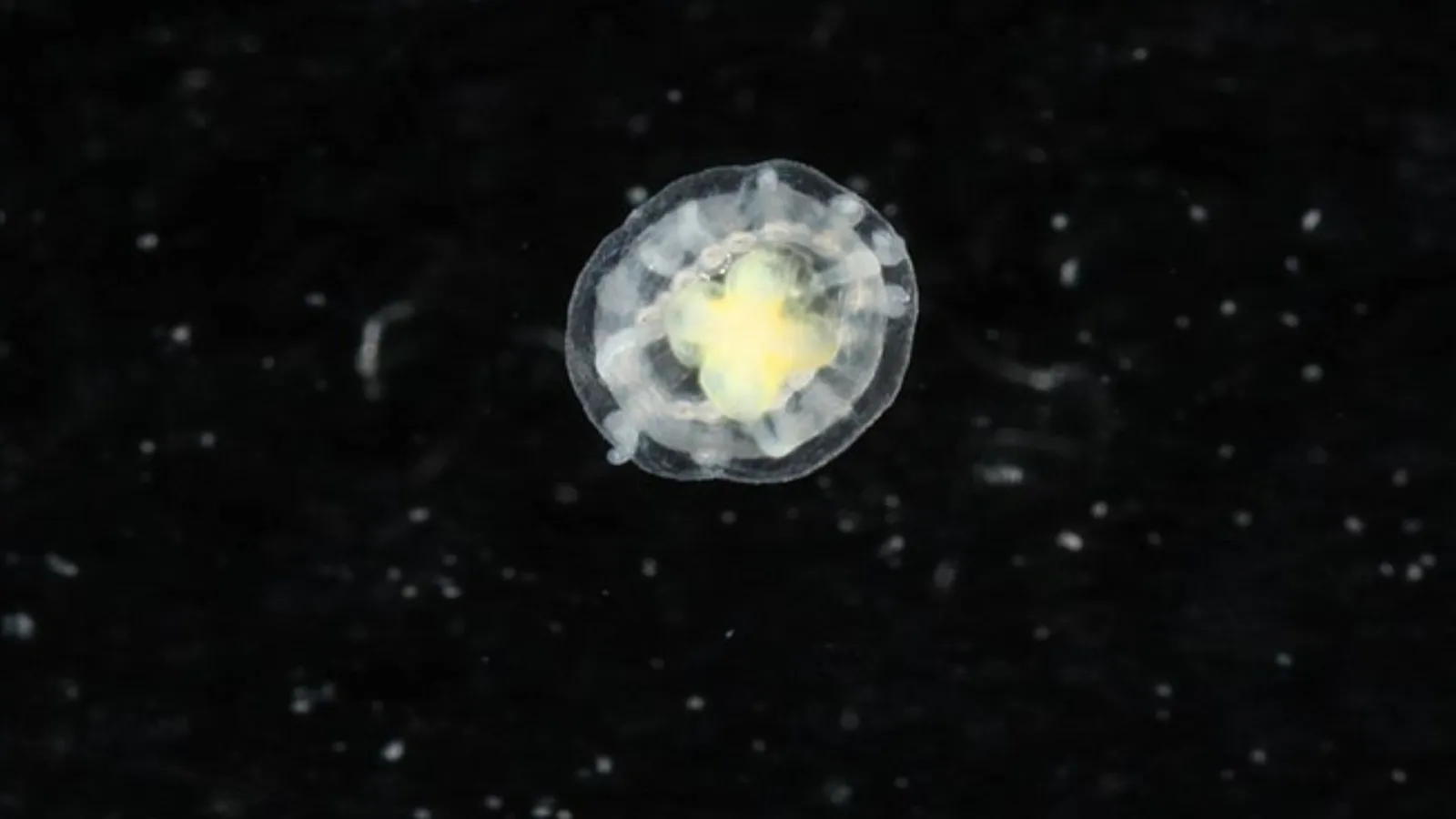
One ocean-dwelling creature found in tropical waters is known to be able to reverse its own life cycle, cheating death.
The jellyfish, Turritopsis dohrnii, was first discovered in 1883, but it was around 100 years later that scientists uncovered the creature’s ability to rejuvenate its own life cycle and combat environmental and physical stresses.
Why It Matters
The Turritopsis dohrnii‘s ability to rejuvenate could “hold important clues to maintaining a long life and lengthening the healthspan of humankind,” Michael Layden, a professor of biological sciences at Lehigh University, told Newsweek.
He added that the jellyfish were also “very inexpensive to work with in a lab, and thus have the potential to be a huge return on investment for biomedical research.”
“The distinct rejuvenation mechanism of Turritopsis provides an excellent real life example of an animal self healing,” he added. “Understanding how that happens won’t allow us to make ourselves immortal, but it likely opens up novel strategies to develop therapies to treat damaged tissues and organs.”
What To Know
The Turritopsis dohrnii, or T. dohrnii, is a type of hydrozoan, a subgroup of a diverse group of aquatic invertebrates called cnidarians, and hydrozoans are closely related to what are known as “true jellyfish.”
Hydrozoans are similar to jellyfish in terms of their appearance, although they are structurally different, and the well-known Portuguese Man O’War jellyfish belongs to the hydrozoan family.
T. dohrnii is around 4.5 millimeters wide and tall, making it smaller than the nail of your little finger, and when it experiences environmental or physical stresses, which could include starvation, instead of dying, it rejuvenates itself.
Essentially, its cells can “transform into new cell types turning the unhealthy or stressed adult medusa into a ball of tissue from which a polyp can grow,” Christine Schnitzler, a professor of biology in the Whitney Laboratory for Marine Bioscience at the University of Florida, told Newsweek.
A medusa is the term used to describe an adult jellyfish and a polyp is the name for the organism at its early stage of life. This process—the medusa turning into a new polyp, which is referred to as transdifferentiation—also reportedly takes only 24 to 36 hours.
Research also found that over a two-year period, colonies of the jellyfish were able to naturally rejuvenate themselves up to 10 times, sometimes with intervals of only one month.
In order to carry out this process, when T. dohrnii is “physically damaged, starving, or stressed by temperature changes,” it sinks to the ocean floor to begin the transformation, “effectively bypassing death,” Maria Pia Miglietta, a professor of marine biology at Texas A&M University, told Newsweek.
Schnitzler said the basis of this process is “the activation of many genes involved in things like stem cell pluripotency, DNA replication, DNA repair, telomere maintenance, stem cell maintenance, and intercellular communication”—ultimately, it is an “extreme example of cellular plasticity.”
This ability has likely evolved in creatures like cnidarians “as way to respond to and adapt to changing environmental conditions,” she added.
There are also other types of hydrozoans that are able to carry out this kind of cellular plasticity, Schnitzler said.
Other cnidarians can also “rejuvenate themselves either through regeneration after injury and/or amputation or through asexual reproduction where they produce clones of themselves,” Layden said.
Layden added that many cnidarian species are “theoretically immortal.” For example, certain types—i.e. corals, Hydra and Nematostella—are able to “reproduce asexually to clone themselves making them theoretically immortal.”
Of course, while these jellyfish are described as “immortal” because they can cheat death, that’s not to say they can’t be killed, as some are prey to a number of sea animals.
What People Are Saying
Christine Schnitzler, a professor of biology in the Whitney Laboratory for Marine Bioscience at the University of Florida, told Newsweek: “Scientists used to think that most terminally differentiated cell types could never become anything other than what they are. For example, it was thought that a muscle cell could not change and become any other type of cell. The idea that the differentiated state of a cell may not be a terminal end point but, rather, could just be a stable state that is open to change based on environmental factors, is becoming more accepted as more examples are found in nature. The implications of this are many. The most relevant to human health is this—these natural examples might offer novel solutions for producing fully functional mature cell types from human pluripotent stem cells in the field of stem cell therapeutics. One day, we might have a better understanding of how to control these complex molecular and cellular processes and harness them for biomedical use.”
Maria Pia Miglietta, a professor of marine biology at Texas A&M University, told Newsweek: “Turritopsis dohrnii is scientifically notable because it offers a rare window into the genetic mechanisms of regeneration and aging. In humans, cells with the ability to become any other cell type are largely restricted to early embryonic development. In contrast, this jellyfish can reprogram its own fully differentiated adult cells and return them to a more flexible state. Studying T. dohrnii allows researchers to investigate the genetic and epigenetic networks that enable this kind of cellular reprogramming. Its biological “immortality” also implies efficient systems for DNA repair and cellular protection. Understanding how these processes work in the jellyfish can shed light on fundamental mechanisms that are also crucial in humans, including genome maintenance, aging, and tissue regeneration.”