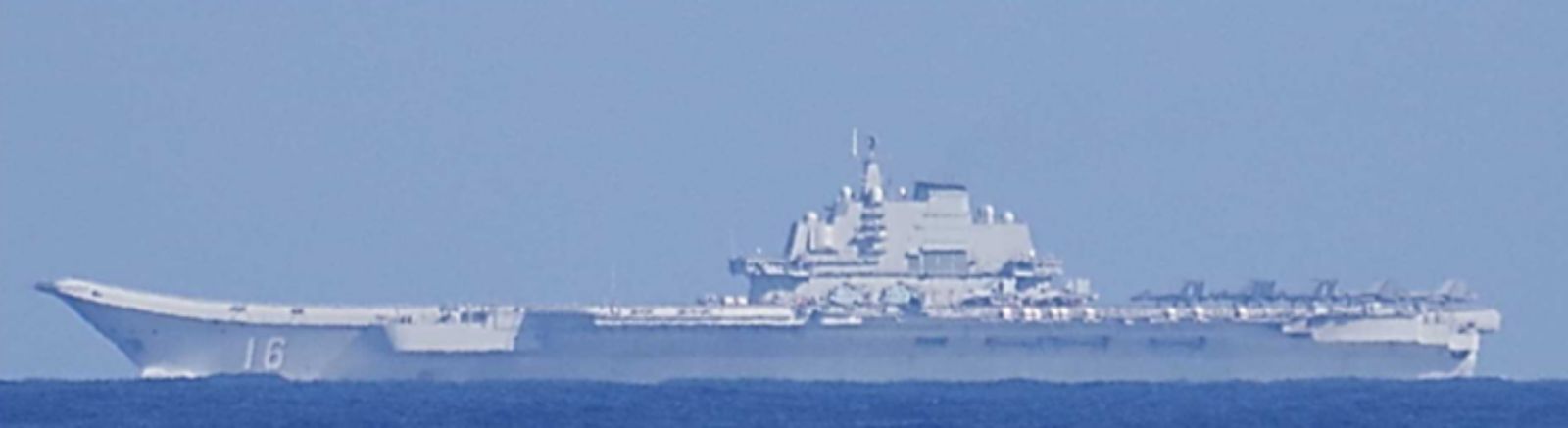
Japan’s Defense Ministry said a Chinese aircraft carrier has concluded a weeklong deployment near the country’s southwestern outlying islands in the Pacific Ocean.
Tokyo said in a Friday press release that Japan Self-Defense Forces’ naval and air units were deployed to monitor CNS Liaoning—China’s first of three aircraft carriers—along with its escorting ships and fighter jets in waters south of Japan’s main islands.
The Chinese navy previously said the Liaoning was dispatched to the Philippine Sea for what it called a normal ocean-going training exercise for its fighter aircraft and accused the Japanese military of “approaching” China’s training zones that had been announced in advance.
The Chinese Foreign Ministry did not immediately respond to a request for comment.
Why It Matters
China’s deployment of an aircraft carrier near Japan—a key United States treaty ally in countering Beijing’s military maneuvers in the western Pacific—came amid ongoing tensions between the two nations over remarks Tokyo made about military intervention in the event of a Chinese military blockade of Taiwan, a self-ruled island near Japan.
As part of efforts to build a “world-class” military, China operates the largest navy in the world by hull count, with over 370 ships and submarines. The fast-growing fleet enables Beijing to expand and maintain its military presence and reach beyond East Asian waters, with notable examples including a dual aircraft carrier mission in June.
What To Know
According to the Japanese Defense Ministry, five Chinese vessels, led by the Liaoning, were spotted passing through the Miyako Strait in Japan’s southwestern island chain to the northwest as they returned to the East China Sea from the Philippine Sea on Friday.
The remaining vessels of the Liaoning‘s naval task group were identified by their hull numbers as the Type 055 destroyer CNS Nanchang, the Type 052D destroyers CNS Xining and CNS Kaifeng, and the Type 901 fast combat support ship CNS Hulunhu.
The Chinese naval formation was tracked south of Okinawa Island after transiting the Miyako Strait on December 6. It then sailed northeast toward waters north of the remote island of Kitadaitojima and south of Japan’s southernmost main island, Kyushu.
The Liaoning and its escorting ships reappeared in the waterway after circumnavigating Kitadaitojima and two small islands, Minamidaitojima and Okidaitojima, clockwise.
The map provided by the Japanese Defense Ministry shows the Chinese ships operated well beyond Japan’s territorial waters, extending up to 13.8 miles from the coastline, but mostly within its 230-mile-wide Exclusive Economic Zone during the voyage.
Data from the same Tokyo report also shows that fighter jets and helicopters deployed aboard the Liaoning conducted a total of 260 takeoffs and landings while the aircraft carrier was operating in the Philippine Sea east of Japan’s southwestern island chain.
While the Liaoning returned home, CNS Fujian—China’s latest and most advanced aircraft carrier—was spotted leaving its South China Sea home port at Yulin Naval Base on Sunday. The warship was officially commissioned at the base in November.
Meanwhile, satellite imagery of Yulin Naval Base taken on Friday—two days before the departure of the Fujian, captured in a video—shows China’s second aircraft carrier, CNS Shandong, returning to port following a brief mission in the South China Sea.
What People Are Saying
Senior Captain Wang Xuemeng, a spokesperson for the Chinese navy, said: “The Chinese Liaoning Task Group recently conducted routine flight training for carrier-based fighters in waters east of the Miyako Strait, with previous notice of the training waters and airspace. The Japanese Self-Defense Forces (JSDF) aircraft, however, repeatedly approached the Chinese PLA [People’s Liberation Army] Navy’s training area, causing disturbances that severely disrupted normal training of the Chinese side and posed significant risks to flight safety.”
A Japanese Defense Ministry’s statement read: “It is natural and imperative for the ministry of defense and JSDF, which are responsible for safeguarding Japan’s territorial airspace and protecting the lives and property of the Japanese people, to appropriately conduct airspace intrusion countermeasures against carrier-based aircraft launched from Liaoning, regardless of whether prior notification of the training was provided.”
What Happens Next
It remains unclear whether China will conduct another aircraft carrier deployment in the Philippine Sea before the end of the year. The U.S. currently stations two aircraft carriers in the region, but one of them has completed its missions and returned to base.