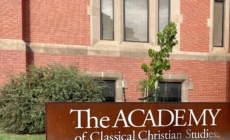
The story broke months ago. It was one of those heartwarming stories Steve Hartman delivers for CBS Evening News in his On the Road series. Last October, he told a high school sports story from Oklahoma City that became a local legend—and was soon to become a national one. A story about integrity. About winning and losing. And about sportsmanship. But after watching the story, it was apparent to anyone watching Hartman’s story that something important—something deeper—was missing.
The story began with The Academy of Classical Christian Studies Lady Griffins basketball team, a program a mere 4 years old, clinching its very first district championship with a 44-43 victory over Apache High School in 2024. But it’s what happened after the game that made this story so remarkable.
It turns out the Lady Griffins’ head coach, Brendan King, had his doubts about the win. Enough so that he went home after the victory and reviewed the full video footage of the game, adding up the score not once but twice.
“As soon as I walked out of the locker room, my stomach was turning in knots,” King told Hartman. “And I said, ‘I need to know if we won the game or not.’”
It turns out there had been some kind of scoreboard error during the game and after adding every score on video, King discovered his team hadn’t won by 1 point—but had instead lost.
King had another job to do: He had to tell his players the bad news. Soon, the team was meeting—on a Sunday evening, no less. The girls knew something was up—that there was some kind of bad news coach was about to deliver.
“I thought somebody died,” senior Ellie Cheng said, her comment prompting laughter from her teammates.
Their coach then explained the situation—that in fact they’d lost the game. The players did not hesitate to do the right thing: They unanimously agreed to challenge the official results of the game and return the trophy to the rightful winners.
“There was never like, Oh, but we can still keep the trophy,” then-senior Maya Beasley explained. “Because why would we do that?”
That was not an ordinary response from an American teenager. And as Hartman’s report ended, the question lingered. Why would Beasley and her teammates do such a thing? What motivated them? What was the source of their youthful integrity?
It didn’t take long to find out the deeper truth left untold in Hartman’s CBS piece. A quick google search led to a Christian Broadcast Network (CBN) report on the same story. We quickly learned this was more than a good sportsmanship story: It was an integrity story inspired by a higher calling. And a story about a classical Christian school in the middle of the Bible Belt producing young people willing to do the right thing because their God demanded it. A school designed to make not just better students, but better people.
“It didn’t benefit us in the way that we would have been able to continue,” senior Bindi Paradee told CBN. “But it did benefit us in showing the world that this was really the good thing to do—the thing that glorifies God the most.”
The story only got more interesting. It turns out that the Academy—and the players—could have legally retained their championship trophy. Oklahoma Secondary School Activities Association rules dictate that once a game is finished, the score becomes permanent, and there is no way to change the outcome of a completed score.
But that didn’t stop the team from appealing, anyway. They won the appeal—and lost the game. And by doing so, they not only set a precedent, but made history. And made the world a better place.
None of what happened surprised Casey Shutt, an Academy parent.
“It gives them a higher target in life,” he explained about the educational objectives at the school. “Virtue is something the school speaks of quite a bit.”
CBN’s report included an interview with the Academy’s headmaster, Nathan Carr.
“Parents know what they’re calling is, and their duty to their children,” Carr said. “And they see classical Christian education as one of the most effective partnerships, giving their children memory, helping them be practiced in virtue, and baptizing their imagination into something good, true, beautiful and eternal.”
One of the many students interviewed by CBN had this to say about what she’s learned at her school: “Growing up in the Academy has given me almost a gold standard of community I want to live up to.”
After the appeal, Coach King hand-delivered the championship plaque to his competitors at Apache High School.
“It showed us, you know, there are still good people in this world,” Apache coach Amy Merriweather told reporters. “It’s something we’ll always remember.”
Coach King was asked about the national and worldwide attention the Academy has received.
“I’m thankful the story’s out there, and hopeful it is encouraging to other coaches and other teams out there that there are so many bigger life lessons than just wins and losses,” he said.
How CBS managed to miss the heart and soul of the story—and the power source behind it, God—is anyone’s guess. But there are no good reasons, for sure. That CBS never mentioned the fact that the Academy is a classical Christian school was also hard to miss—given the sign at the front of the school says just that. But CBS left that out, too.
Perhaps it’s because Hartman and his people don’t quite know what’s happening in the world of Christian education—and the explosive rise of classical Christian academies all over the nation thanks to a burgeoning school-choice movement.
“The $10 Billion Rise of Classical Christian education,” read the headline from a Forbes.com story last April. “Classical Christian Education (CCE) has expanded from a niche movement to a significant market force, with over 677,500 students enrolled across 1,551 institutions for the 2023-2024 school year,” Forbes reported. “Projections indicate this figure could reach 1.4 million by 2035.”
Forbes extolled CCE’s 2,500-year-old approach to teaching that includes integrated curriculum rather than specialized subject, aesthetic education that prioritize beauty and order, the use of Socratic teaching methods that develop critical thinking—and a school culture built around biblical principles.
We’ll never know why Hartman—a good and sincere reporter—and his CBS crew missed the Christian dimension of the story. But one thing is certain: When CBN came calling, the coach and players didn’t hesitate to give credit to the real source of their character and integrity—and why they did the right thing without hesitation.