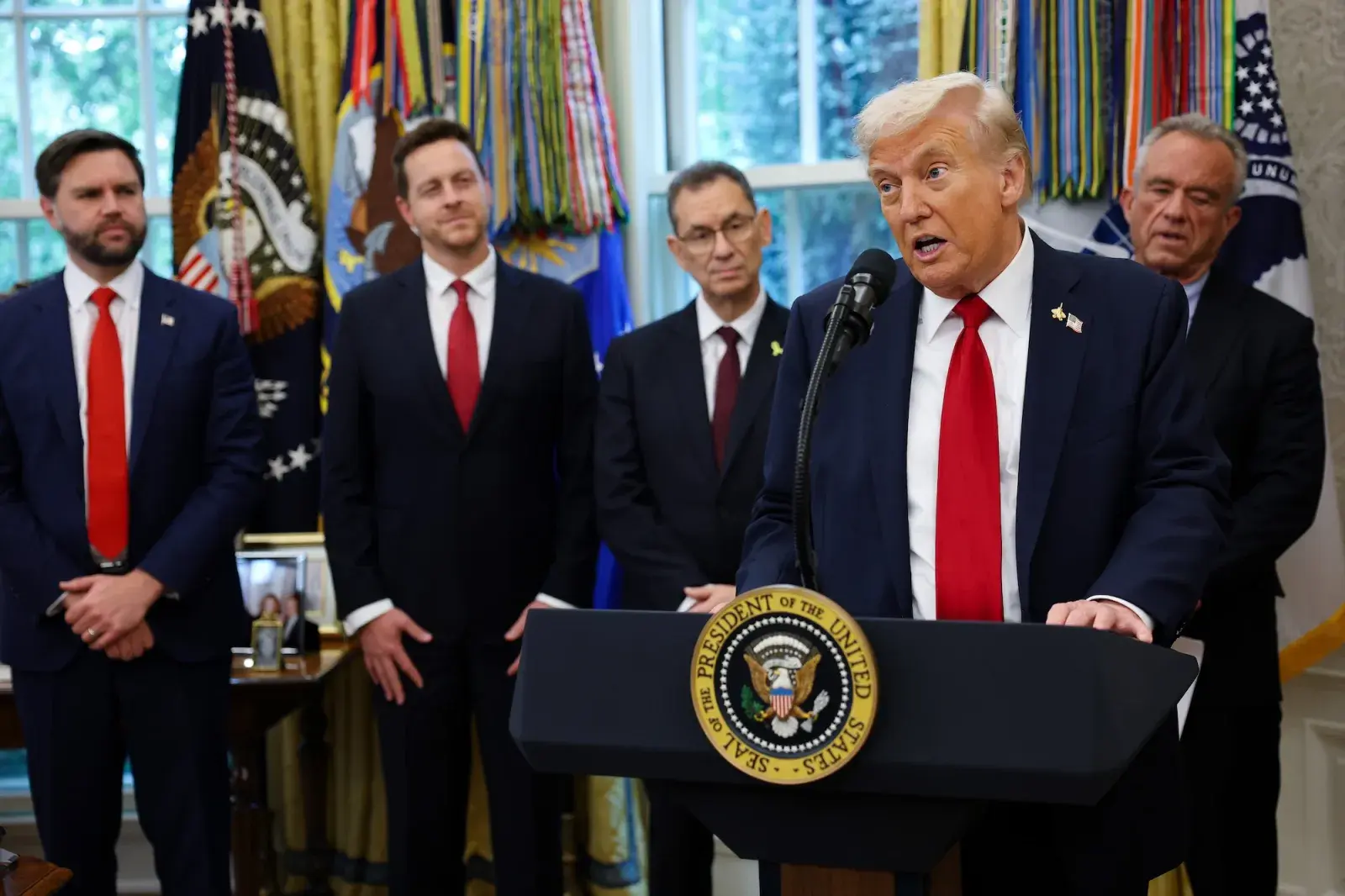
President Donald Trump’s negotiations with pharmaceutical companies demonstrate how his Art of the Deal approach to governance produces results for working-class Americans. President Trump is the first national leader willing to drain the swamp, taking on powerful lobbyists and special interests to deliver lower prices for patients. Democrats have simply shifted costs from patients to taxpayers, while Republicans have too often been reluctant to take on generous corporate donors. The result has been that Americans spend more on health care than other developed countries, but have shorter average life expectancies.
President Trump, on September 30, made news by announcing a deal with Pfizer—the first of many—to secure most favored nation pricing for Medicaid patients on the company’s existing drugs and for all Americans on its new drugs. This means American patients will no longer pay three to four times more than patients in other developed countries for the same drugs.
The creation of TrumpRx, a website where American patients with a prescription can go to purchase drugs directly from drug manufacturers, received far less attention Yet, direct-to-consumer (DTC) pricing models like TrumpRx could have a huge impact. For instance, Eucrisa, a drug prescribed to approximately a million American patients with eczema at almost $1,000 a tube, will be offered to Americans at an 80 percent discount—bringing the price under $200.
Many pundits mistakenly proclaimed the direct-to-consumer option would only benefit the uninsured and not help the majority of Americans who have private insurance coverage with prescription drug coverage. However, the following hypothetical examples show the power of this model, if patients pay cash:
- A recent college graduate in Chicago earns $45,000 a year, and takes home $3,600 a month, working at a firm that offers full insurance coverage. He’s been diagnosed with eczema but the treatment his doctor recommends is on a nonpreferred tier and he either has to use step therapy to get coverage for the treatment or pay 30 percent of the list price in cost sharing. DTC could save him about $100 a month in bills in Chicago, where he might be spending 65 percent of his monthly income on rent.
- A working mom of four, earning $96,000 in Houston has a Patient Protection and Affordable Care Act exchange plan. She chose a bronze plan to reduce her monthly premium, but has a deductible of $7,500, and has to meet her deductible before her drug coverage kicks in. Instead of paying full price, she uses DTC to lower her cost to $200—saving her hundreds per month to provide for her kids instead.
- A married man, earning $55,000 in rural Missouri, has a blue-collar job at a small business that can only offer a high-deductible health plan. He previously used his health savings account to cover the $1,000 monthly cost but can now instead save $800 a month towards future health bills.
The Trump administration should make the DTC model even more powerful by expanding it to include “DTP,” or direct-to-health plans pricing. The administration could facilitate direct contracting on some high-volume, highly rebated drugs, such as GLP-1s, between self-insured employers and pharmaceutical manufacturers. This would eliminate the perverse incentive of the rebate, driving employers and patients to higher-cost care, and could cut the cost of the drug, on average, by 40 percent. In fact, Trump’s Office of Personnel Management could create TrumpRx as a clearinghouse where the top 50 high-volume, highly rebated drugs could sell at discounted prices to the 8.3 million covered individuals in federal employee health plans—and other employers could use the model to set up their own “no-middleman” drug contracts when the no-middleman model is cheaper than the middleman model.
This type of direct contracting could generate substantial savings in cases when the middlemen model is set up at the expense of patients. For example, employees at Johnson and Johnson had a drug benefit designed to charge them more than $10,000 for a drug that, if using direct contacting, would have been only $40.55. There is nothing holding back companies from being able to do so under the authorities of the Employee Retirement Income Security Act. Yet, companies are often stymied from using this flexibility because of anticompetitive behavior from Pharmacy Benefit Managers—blocking access to data, resisting requests for customized design, and charging higher prices for companies to get an itemized receipt for the care they’re purchasing. Congress has heard these complaints and introduced reforms to correct for this anticompetitive behavior, but employers can seize this authority now and set no middleman contracts between company and drug manufacturer.
The president’s breakthrough announcement is a strong step forward for patients, and a welcome contrast to the Biden administration’s heavy-handed approach that threatened the innovation that generates new cures. President Trump has chosen to empower patients—not bureaucrats, middlemen, or pharmaceutical companies—by letting them make health care decisions for themselves. Politicians too often design health care policies around programs, not patients. President Trump cut through the red tape to deliver real health care savings for patients. He is making Americans healthy again, by trusting and empowering patients.
Bobby Jindal (@BobbyJindal) was the governor of Louisiana from 2008-2016 and a candidate for the 2016 Republican presidential nomination.
Hannah Anderson is Director of Healthy America Policy and Senior Director of Policy at America First Policy Institute.
The views expressed in this article are the writer’s own.