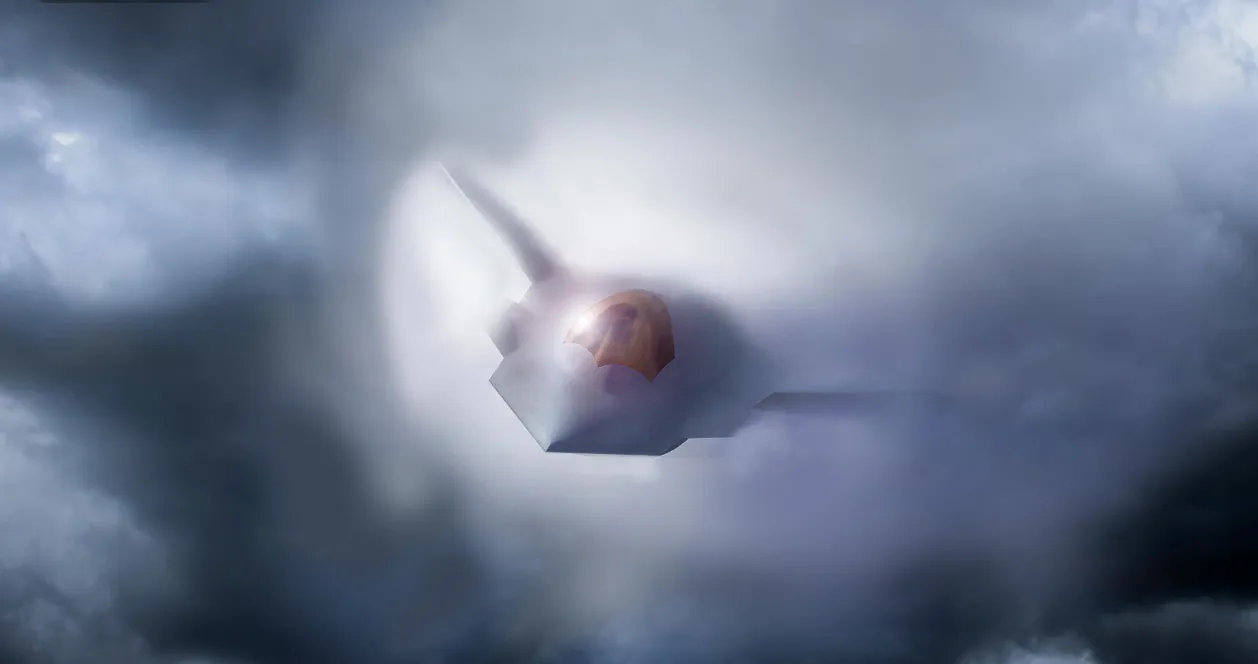
Washington will speed up development of the U.S. Navy’s new advanced fighter jet, according to a new report, after previously delaying the program.
The White House has approved a Pentagon plan to move ahead with a second “sixth-generation” jet project, dubbed the F/A-XX, Bloomberg reported on Monday, citing a document sent to Congress by the Department of Defense. The U.S. Air Force (USAF) already has a parallel program.
Newsweek has reached out to the Pentagon for comment.
The sixth-generation jets now being designed will be very hard to detect, boast the most cutting-edge avionics and weapons, and closely integrate with new drone designs.
No sixth-generation jets are currently in use. The most sophisticated fighter jets available for militaries at the moment are fifth-generation aircraft, like the U.S.’ F-35 and F-22. The new wave of aircraft will be the next major leap forward for fighter jets, and help determine which militaries have the most formidable air forces.
U.S. officials had prioritized the USAF’s quest for sixth-generation capabilities over the Navy’s F/A-XX carrier-based program, arguing defense companies would only be able to produce one design at a time on a tight deadline.
It will likely be the most expensive raft of aircraft ever built and the U.S. programs are seen as key in deterring China. Budget estimates indicated a sixth-generation jet could cost up to three times the price tag attached to an F-35, contrasting with USAF insistence its future fighter will cost less than an F-22.
The Pentagon had previously said it would keep the F/A-XX on “minimal development funding” while forging ahead with the USAF’s F-47, the fighter jet component of its Next Generation Air Dominance (NGAD) project.
President Donald Trump said the F-47 would be the “most lethal aircraft ever built” in March 2025.
“America’s enemies will never see it coming,” Trump told reporters at the time. “Nothing in the world comes even close to it.”
A senior U.S. defense official said last year the Pentagon had made the “strategic decision to go all-in on F-47.”
The F-47 is expected to make its first flight by the end of the Trump administration. The timeline for the F/A-XX is not clear.
U.S. defense giants Boeing and Northrop Grumman are vying to build the Navy aircraft after Lockheed Martin dropped out of the race to be the main contractor for the F/A-XX. Boeing was picked to develop the F-47.
The F/A-XX will eventually replace the Navy’s F/A-18 Super Hornet jets.
There are two separate, largely European initiatives to develop and build sixth-generation jets. The joint British, Italian and Japanese project—commonly referred to as the Global Combat Air Programme, or GCAP—is years ahead of France, Germany and Spain’s beleaguered Future Combat Air System (FCAS).
The GCAP fighter jet is scheduled to go into service around 2035.
China has teased its own sixth-generation prototypes.