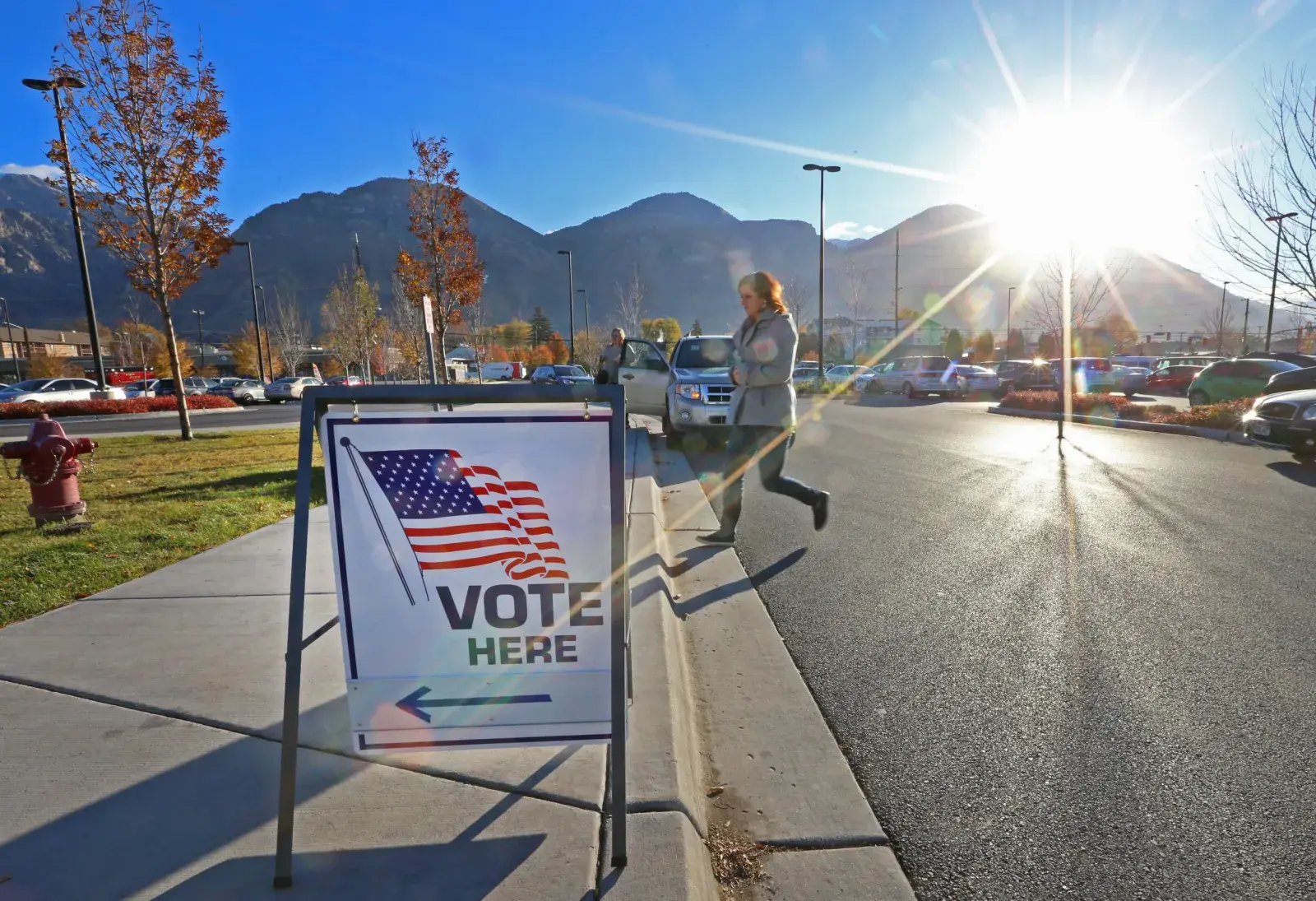
Utah legislators voted to advance a congressional map that could reshape its boundaries ahead of the 2026 midterms—potentially giving Democrats a chance at flipping a few districts.
Why It Matters
Democrats are hopeful about their chances of flipping control of the House of Representatives in November 2026. Historically, the party in the White House loses seats in the midterms, and President Donald Trump’s approval rating remains low. But several states like Texas and Missouri have engaged in mid-decade redistricting to eliminate several Democratic-leaning quadrants in an attempt to thwart losses.
Utah is one state where Democrats could gain seats in redistricting, as a court previously struck down its current map, viewed as a partisan gerrymander. Although former Vice President Kamala Harris received 38 percent of the vote in the state, none of its four congressional districts are Democratic-leaning or even competitive. The new map advanced on Monday would change that.
What To Know
Both the Utah House of Representatives and Senate voted to advance a new map to comply with court orders Monday afternoon, bringing it one step closer to becoming law ahead of the midterms. The map did not receive support from Democratic legislators but passed with Republican support.
Republicans would have an advantage in each of the four districts, but two would be viewed as more competitive than on the current map.
Under the new map, Trump would have received just under 50 percent of the vote in UT-03, defeating Harris by about 2 percentage points. This district would contain all of Salt Lake City, a Democratic stronghold split up in the current map, other parts of Salt Lake County and more rural, conservative areas.
In UT-02, he would have beaten Harris by about 7 points. This map contains the rest of Salt Lake County and rural areas to the west.
An analysis conducted by The Salt Lake Tribune that accounted for other races found the districts to be slightly more conservative—UT-02 at R+10.7 and UT-03 at R+6.
The map only splits Salt Lake County into two districts. Under the current map, it is split between each of the four districts—which critics said diluted the power of Democratic voters. Although all districts backed Trump, the two single-digit districts would likely be contested by Democrats, particularly if 2026 shapes up to be a blue wave.
What People Are Saying
Better Boundaries, an anti-gerrymandering group, wrote in a statement: “When politicians control redistricting, there is always an incentive to protect power. That is why Utah voters passed Proposition 4 to create fair standards and measures that could evolve as data and technology changed. Map C demonstrates how the core principles of Proposition 4 are being sidestepped. Proposition 4 called for fairness measured by the best available tools and data, transparency in how maps are drawn, and accountability to voters rather than political interests.”
GOP State Senator Scott Sandall said in a statement reported by KSL-TV: “Despite a condensed timeline, our committee remained committed to transparency and public engagement. The approved map adheres to Proposition 4 requirements and reflects the diversity of Utah by ensuring every district includes both rural and urban communities. Redistricting is the Legislature’s constitutional responsibility, and we continue to prioritize fair maps that give every Utahn a strong, equal voice in Congress.”
What Happens Next
The map will be submitted to the court later Monday, KSL reported.
Other states are also considering redistricting. Most notably, California voters will head to the polls next month to decide on a ballot measure that would temporarily replace its commission-drawn map with one more favorable to Democrats. The ballot measure was introduced in response to efforts in Texas. Polls suggest a majority of voters support the California move.